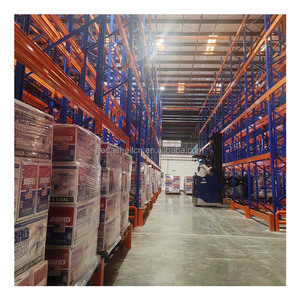
Selective Load
Q235B Cold Rolled
Custom structural engineering, high-tonnage cold-formed profiles, and anti-corrosive powder coatings configured to maximize cubic utilization for high-turnover logistics hubs.
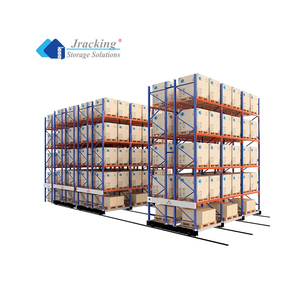
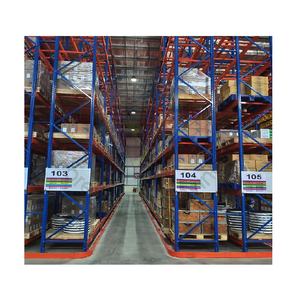
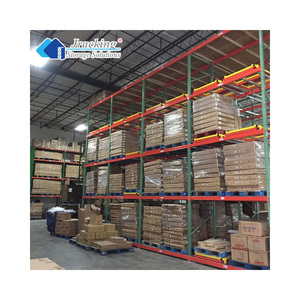
A rigorous architectural breakdown of continuous aisle optimization, structural kinematics, and load-path distribution for international logistics operators.
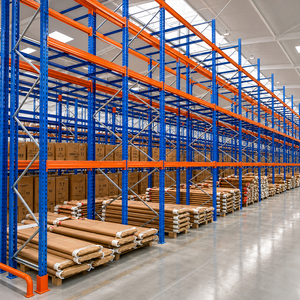
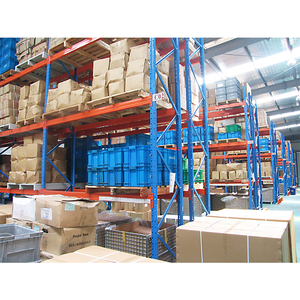
In modern supply chain architecture, floor space represents an ongoing operational liability. Conventional selective pallet racking systems dedicate up to 60% of floor area exclusively to operating forklift aisles. While this guarantees 100% immediate selectivity, it severely limits volumetric efficiency in facilities handling low-SKU count, high-volume inventory. Drive-Through (and Drive-In) Pallet Racking Systems resolve this cubic shortfall by condensing storage into multi-deep continuous lanes, eliminating transverse picking aisles and escalating spatial density by up to 80% compared to standard configurations.
Unlike a standard Drive-In rack—which relies on a single access aisle enforcing a Last-In, First-Out (LIFO) inventory sequence—a genuine Drive-Through Pallet Racking structure provides discrete ingress and egress portals located at opposite ends of the storage block. Forklift operators deposit pallet loads from the entry aisle and retrieve them sequentially from the discharge face. This geometric configuration enables true First-In, First-Out (FIFO) batch turnover, rendering it an indispensable structural choice for ambient food processors, cold-storage cold chain networks, pharmaceutical central depots, and raw material buffer hubs.
Continuous support rails formed from cold-rolled structural steel carry pallet bottom boards along deep cantilevers. Single-piece stamped support brackets guarantee continuous dynamic load dissipation across heavy upright frames without structural deflection.
Because Drive-Through bays permit industrial lift trucks to drive through the structure, traditional cross-aisle horizontal beams are eliminated within storage lanes. Overhead top-ties and portal trusses restore torsional rigidity against cyclic impact.
Integrated floor guide rails (angle iron or heavy tube profiles) center the forklift during deep penetration, shielding columns from mast collision, while reinforced baseplates and ductile chemical wedge anchors safeguard anchor integrity under seismic shear forces.
Key macro-economic shifts, raw material standards, and technical compliance vectors dictating enterprise procurement decisions for 2026–2030.
Procurement leaders are navigating structural material cost volatility, tighter cold-chain energy regulations, and rapid robotic integration. Selecting an international steel fabrication and export partner requires looking beyond unit price to evaluate long-term asset life cycles, carbon metrics, and structural extensibility:
Global operators are standardizing on lane widths and rail geometries compatible with semi-automated radio shuttles. Converting conventional drive-through channels into shuttle bays later cuts forklift transit cycle times by 65% and preserves structural steel investment.
With sub-zero cubic refrigeration costs rising sharply, drive-through racks are prioritized to eradicate thermal voids. Procurement standards require certified low-temperature steel toughness (preventing brittle transition down to -30°C) and hot-dip galvanized finishes.
Tier-1 multinational engineering EPCs mandate rigorous EN 15512, RMI, and ISO 9001 compliance. Mill test certificates (MTC) proving Q235B/Q355B chemical and tensile consistency, coupled with finite element analysis (FEA) reports, are now baseline prerequisites for customs clearance.
Combining 25+ years of dedicated structural storage fabrication with verified European and international credentials.
Prime Baosteel and Shougang cold-rolled structural steel coils inspected for uniform thickness, chemical ductility, and mechanical yield strength.
Computer-controlled roll-forming mills shape up to 12-meter continuous upright posts without splicing, integrating high-precision diamond hole punching.
Full chemical pickling, degreasing, and phosphating bath sequence eliminates surface mill scale, ensuring exceptional mechanical bonding for coatings.
Automated powder coating cured at 200°C creates an anti-impact, scratch-resistant barrier formulated to withstand tropical ASEAN humidity and chemical vapors.
Operating out of our advanced Guangzhou production complex, Guangzhou Heda Shelves Co., Ltd. serves as a reliable direct manufacturing partner to warehouse operators, system integrators, and government contractors across Europe, the Middle East, the Americas, and Southeast Asia (including regular shipments to Malaysia, Thailand, Vietnam, Indonesia, the Philippines, and Singapore). Our manufacturing operation holds CE Certificate No. 2435-CPR-8605159, ISO 9001:2015 Certification No. 18624Q00169R0M, and comprehensive RoHS environmental clearance.
From rapid 2–10 day sea container transit to major regional ports, to full seismic calculations and custom CAD layout engineering delivered before contract sign-off, HEDA Shelves minimizes supply chain friction. We deliver high-integrity storage assets engineered precisely to local site specifications.
Engineering parameters, site clearance requirements, and export logistics answered by our technical department.
A Drive-In system utilizes a single entrance/exit aisle where the forklift enters and departs from the same portal, enforcing a strict Last-In, First-Out (LIFO) inventory sequence. A Drive-Through system provides separate access portals at opposite ends of the storage lane, enabling true First-In, First-Out (FIFO) stock rotation by loading from one side and picking from the other.
Because lift trucks enter directly into the storage bays, the clearance between pallet support arms must equal the overall forklift width plus a minimum margin of 75mm to 100mm per side. Standard counterbalanced forklifts or reach trucks can be accommodated, provided the overhead guard is contoured to clear the cantilever brackets. Guide rails along the floor are strongly recommended to prevent upright collisions.
Yes. For seismic environments such as the Philippines, Indonesia, or Japan, our engineering team executes customized structural calculations factoring local spectral acceleration (Ss, S1 values). We adjust upright steel gauges, increase footplate thickness, specify chemical anchor embedment depths, and add heavy portal bracing trusses to withstand severe horizontal ground motion.
Every steel bundle is banded with edge protectors, separated by non-chafing dunnage, and sealed in waterproof plastic wrapping to prevent saltwater corrosion during ocean transport. Uprights and horizontal beams are systematically bundled by tier numbers for rapid offloading and site staging, maximizing container volume and reducing shipping cost per pallet position.
Send our senior engineering team your warehouse layout drawings, pallet specifications, and forklift model details. We deliver complete 2D CAD layouts, structural load calculations, and competitive FOB/CIF export quotations within 24 hours.
Send an Inquiry