Featured Industrial & Narrow Aisle Pallet Storage Systems
Engineered to strict FEM 10.2.02, EN 15512, and RMI standards. Every system is custom roll-formed to optimize clear bay heights, aisle clearances, and dynamic beam loading capacities.
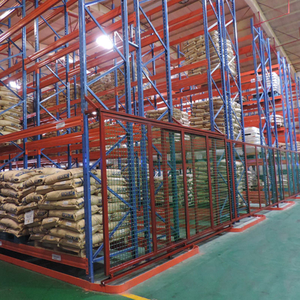
Raw Material Storage VNA Very Narrow Aisle Racking Anti Corrosion Steel Narrow Lane Warehouse Pallet Rack OUGLON OGL-VNA-027
Precision-engineered for raw material logistics hubs. Features guide rail anchoring, anti-corrosion pre-treatment, and high vertical reach to maximize vertical cubic volume without sacrificing selectivity.
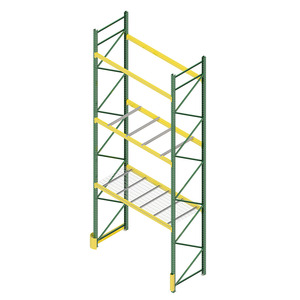
WAREHOUSE RACKING Warehouse Heavy Duty Cold Storage Rack Selective Narrow Aisle Metal Industrial Pallet Racking System
Formulated with low-temperature impact resistant steel. Delivers dense floor configuration for refrigerated warehouses, reducing HVAC thermal loss per stored pallet position.
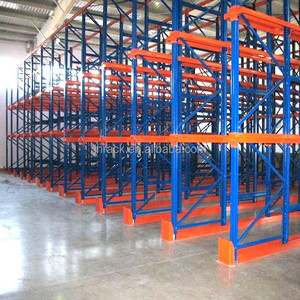
Drive in Rack Metal Sheet Shelf Warehouse Heavy Duty Racking System Industrial Rack Storage Shelves Drive Through Pallet Racking
Eliminates operating aisles by allowing forklifts to enter storage lanes directly. Optimal for homogenous goods with seasonal shipping cycles and high-volume raw materials.
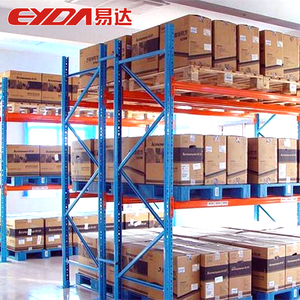
Eyda Factory Directly Steel 5-Layer Narrow Aisle Heavy-Duty VNA Pallet Rack Corrosion Protection Warehousing Storage VAN
Designed for high-bay commercial distribution complexes requiring fast SKU picking via man-up turret trucks. Surface treated with phosphating wash and thermal electro-coating.
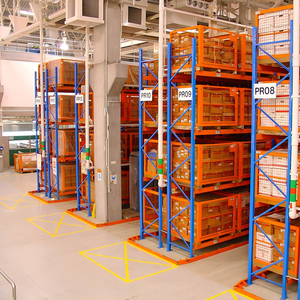
Factory Direct Very Narrow Aisle VNA Pallet Racking Heavy Duty Steel Warehouse Storage Selective Rack System 500-4000kg/Level
Ultra-narrow profile configurations engineered to contract warehouse footprints by up to 45%. Accommodates standard Euro, ISO, or perimeter base custom pallet footprints.
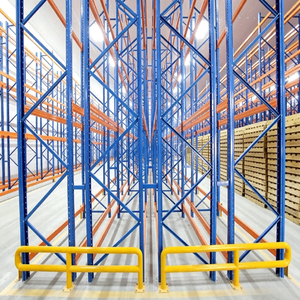
Factory OEM ODM Q235B Steel High Density Adjustable Warehouse Double Deep Pallet Racking System
Stores pallets two deep on back-to-back bays. Balances selectivity with exceptional space optimization, decreasing aisle ratios without the complexity of deep automated systems.
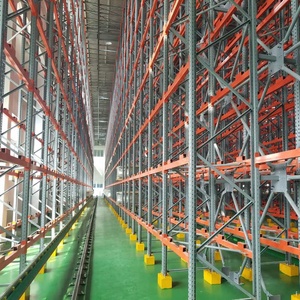
High Density Vertical Carousel Automatic Shelving Designing Rack AS/RS System
Integrates automated retrieval mechanisms and computerized inventory synchronization. Ideal for high-throughput fulfillment centers that demand pinpoint SKU accuracy.
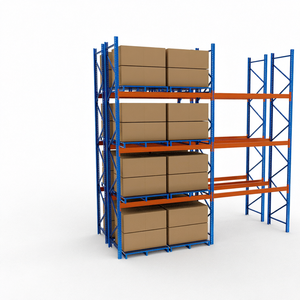
Metal Rack Storage Shelf Heavy Duty Selective Pallet Beam Racking for Industrial Warehouse Pallet Cargo
The benchmark storage architecture across industrial warehousing globally. Ensures 100% immediate accessibility to all pallets with zero specialized lift equipment constraints.
Physics & Architecture of Narrow Aisle (VNA) Systems
An exhaustive engineering breakdown of kinematic tolerances, floor flatness specifications, and structural dynamics required for high-bay narrow aisle operations.
Aisle Dimensional Mechanics
In conventional wide-aisle configurations, counterbalance lift trucks demand clearance envelopes between 3.2 to 3.8 meters to complete 90-degree pallet insertions. This wastes over 55% of floor area exclusively on vehicle navigation.
Very Narrow Aisle (VNA) systems compress working aisles to 1,500 mm – 1,800 mm. Forklifts do not turn within the aisle; rather, specialized turret trucks or articulated forklifts rotate their mast or fork attachments 180 degrees while the chassis stays strictly linear.
Floor Flatness: DIN 15185 & TR34
Because VNA upright structures frequently exceed heights of 12 to 18 meters, minute floor imperfections at ground level amplify exponentially at the top beam level. A 2mm slab deviation causes a dangerous 40mm mast sway at elevation.
Operational compliance mandates Superflat Flooring standards conforming to DIN 15185 or Concrete Society TR34 (DM1 / DM2) classifications. Failing to survey slab tolerances before VNA installation introduces severe collision risks.
Guidance Dynamics: Mechanical vs. Wire
Turret trucks travelling down narrow corridors require tracking guidance. Buyers evaluate two primary methodologies:
1. Mechanical Guide Rails: Structural steel low-profile angle profiles (e.g., L100x75x8 or L120x80x10) anchored directly into the slab with heavy expansion or epoxy bolts. Offers physical crash protection but complicates cleaning.
2. Inductive Wire Guidance: An embedded frequency wire slotted 15mm into the slab floor that connects to steering sensors on the truck. Provides clean floor visuals, zero wheel wear, and rapid end-aisle transitions.
| Storage System Type | Aisle Width (Clear) | Max Height (Practical) | Floor Area Utilization | Direct SKU Access | Handling Unit Capital |
|---|---|---|---|---|---|
| Standard Wide Aisle (Selective) | 3,200 – 3,800 mm | Up to 10.5 m | 35% – 42% | 100% Direct | Low (Standard Counterbalance) |
| Double Deep Pallet Racking | 3,000 – 3,400 mm | Up to 11.0 m | 50% – 58% | 50% (Requires Shifting) | Moderate (Pantograph Forklift) |
| Drive-In / Drive-Through | N/A (Inside Lanes) | Up to 10.0 m | 65% – 75% | Very Low (Batch LIFO/FIFO) | Low - Moderate |
| Very Narrow Aisle (VNA) Pallet Racking | 1,500 – 1,850 mm | Up to 18.0 m | 75% – 85% | 100% Direct | High (Specialized Turret/Swing-Mast) |
| Automated AS/RS Crane Aisle | 1,400 – 1,650 mm | Up to 35.0 m+ | 85% – 95% | 100% Direct | Very High (Stacker Crane & PLC) |
Future Procurement Trends in High-Bay Racking Architecture
Global supply chain shocks, land acquisition cost escalations, and labor deficits are reshaping how logistics executives specify narrow aisle storage infrastructure.
Convergence with Autonomous VNA (A-VNA)
Procurement officers are transitioning from manually operated turret trucks to driverless Automated Very Narrow Aisle (A-VNA) guided vehicles and autonomous mobile robots (AMRs). Racking structures must now be engineered with tighter deflection thresholds (1/500 rather than standard 1/200).
China manufacturers are integrating laser target reflectors, barcode positioning plates, and QR datum marks along beam spans directly during factory roll-forming to facilitate robotic computer vision alignment.
Seismic Multi-Hazard Ductility Calculations
With massive distribution hubs expanding in seismic activity belts across Southeast Asia (Indonesia, the Philippines), South America (Chile, Peru), and Australasia (New Zealand), structural specifications now reject generic loading charts.
Purchasing contracts demand dynamic modal response spectrum analysis (per AS 4084, IBC 2024, or Eurocode 8). Uprights require heavy-gauge baseplate assemblies, high-tensile anchor embedments, and top-tie structural cross-ties.
Decarbonized Metallurgy & Life-Cycle TCO
International tender packages increasingly require Environmental Product Declarations (EPDs). Leading Chinese mills are responding by switching to electric arc furnace (EAF) low-carbon steel coils.
Additionally, powder coating methodologies have eliminated volatile organic compounds (VOCs) and heavy metals, adopting triglycidyl isocyanurate (TGIC)-free formulations capable of passing 1,000-hour continuous salt spray tests for coastal logistics yards.
Technological Breakthroughs in Modern Racking Production
How China's premier racking fabricators utilize cold roll-forming lines, automated laser cell punchers, and multi-stage chemical passivation to outperform legacy suppliers.
Omega (Ω) Continuous Profile Roll-Forming
Structural stability in uprights depends upon sectional cold-work stiffening. Standard fabricators utilize simple C-profile shapes prone to torsional buckling under heavy eccentric loads. Modern top-tier Chinese facilities utilize 24 to 28-station sequential cold roll-forming machines to yield advanced Omega (Ω) upright geometries with multiple return bends.
These multi-faceted return flanges deliver drastically higher radii of gyration ($r_x, r_y$) and superior torsional rigidity ($J$), ensuring that upright frames remain plumb under extreme dynamic loadings when turret trucks extract cantilevered heavy pallets at 15 meters.
Automated Laser Punching & Submerged Arc Robot Welding
Beam connectors (claws) carry immense shear and bending moment stresses. Traditional manual manual metal arc welding (MMAW) produces weld spatter, porosity, and heat-affected zone (HAZ) embrittlement. Certified export manufacturers utilize 6-axis robotic welding cells running argon-rich shield gases.
This guarantees continuous, penetration-verified full-throat fillet welds joining box beams or interlocking step beams to heavy 4-claw or 5-claw connectors. CNC automated laser lines simultaneously punch teardrop or diamond slot patterns with tolerances within ±0.1 mm over a 12-meter single upright run.
The 10-Step Quality Assurance Cycle: From Mill Steel to Sea Freight










Guangzhou Heda Shelves: China's Benchmark Storage Fabricator
Founded in 2001, Guangzhou Heda Shelves Co., Ltd. has grown from a specialized rolling shop into a premier high-bay racking and mezzanine production powerhouse serving global intralogistics contractors.
Factory Scale & Capacity
Operating a dedicated 30,000 m² production complex in Guangzhou with over 300 highly trained technical specialists. Our automated rolling and finishing lines consistently achieve an industrial throughput of up to 30,000 tons per month, ensuring tight schedule containment on fast-track mega DC projects.
Verified Compliance Credentials
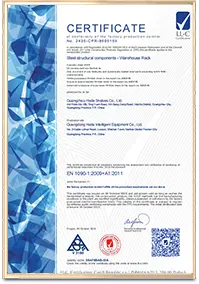
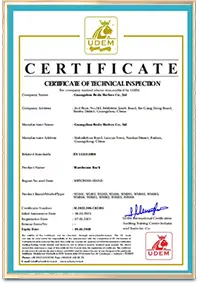
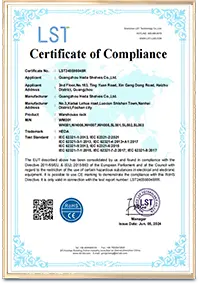
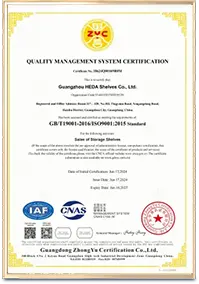
Every structural calculation is backed by third-party verified certifications: CE Certificate No. 2435-CPR-8605159, ISO 9001:2015 Quality Management System (No. 18624Q00169R0M), and environmental RoHS compliance. We design in full alignment with European FEM, British SEMA, and American ANSI/RMI MH16.1 specifications.
Full ASEAN & Global Shipping Corridor
Strategically situated minutes from Nansha and Guangzhou international deep-water terminals. Fast transit cycles: 2–5 days to Vietnam, 3–5 days to Manila, 5–7 days to Singapore / Laem Chabang, and 6–8 days to Port Klang. Components are numbered and containerized to compress freight costs per pallet position.
Frequently Asked Technical & Sourcing Questions (FAQ)
Clear, definitive engineering answers addressing the core challenges overseas contractors face when importing narrow aisle racking from China.
VNA racking installations strictly demand compliance with international defined-movement floor specifications, typically conforming to DIN 15185 or TR34 (Table 3.1 DM1 for lift heights > 13m, or DM2 for lift heights up to 13m). Standard free-movement floors (such as FM2 or FM3) are unacceptable for turret trucks because minor transverse inclinations ($\text{d}Z$) and longitudinal inclinations ($\text{d}X$) lead to excessive mast sway, creating dangerous impact hazards against beam faces. Prior to racking layout finalization, an optical or laser floor survey must be performed to identify high and low points; out-of-spec corridors require precision robotic grinding or self-leveling polymer remediation.
We deploy a rigorous 8-stage automated pre-treatment surface preparation line that includes continuous immersion chemical degreasing, acid pickling to eliminate mill scale, cold-water rinsing, and zinc-manganese phosphating. This forms an insoluble microcrystalline conversion layer on the steel surface that drastically elevates mechanical paint adhesion. Components then pass through an automated electrostatic powder coating booth receiving 60–90 μm of high-grade thermosetting polyester or epoxy-polyester powder, followed by a 200°C curing tunnel. For extreme environments—such as marine ports, sub-zero cold stores with condensing humidity, or chemical warehouses—we offer full Hot-Dip Galvanizing (HDG) to ISO 1461 standards delivering C4/C5 atmospheric corrosion ratings.
Yes. Our in-house structural engineering department utilizes specialized finite element analysis (FEA) software (including ANSYS and SAP2000) to execute static and dynamic modal response spectrum calculations tailored to your facility's exact geographic coordinates. We factor in local ground acceleration coefficients ($S_s, S_1$), site soil classification, importance factors ($I_p$), and ductilities prescribed under Eurocode 8, AS 4084, or US IBC/RMI MH16.1. Modifications include heavier-gauge cold-formed column steels (upgrading from Q235B to high-yield Q355B), enlarged ductile baseplates with dual embedment chemical anchors, strengthened diagonal frame bracings, and overhead top-tie portal frames spanning adjacent rows.
To engineer an optimized, compliant warehouse layout proposal within 24 to 48 hours, our technical team requires:
- Building Architectural Drawings: DWG/PDF floor plans indicating clear internal eaves height, building column grid spans, overhead crane clearances, roll-up door positions, and fire sprinkler/HVAC drops.
- Pallet & Unit Load Profile: Overall pallet footprint (Width × Depth × Height inclusive of cargo overhang) and maximum gross weight per pallet.
- Material Handling Equipment (MHE): Specific turret truck or forklift brand/model, collapsed mast height, maximum reach elevation, chassis turning radius, and guide rail/wire specifications.
- Inventory Dynamics: Total SKU count, targeted pallet storage capacity, and whether inventory follows FIFO or LIFO rotation.
Standard fabrication lead time is 15 to 25 calendar days depending on total container volume. All beams, uprights, and accessories are categorized with steel straps, heavy corrugated interleaves, protective bubble plastic wraps, and solid timber cradles designed to withstand ocean container transport without friction scratching. Every shipment includes step-by-step 3D exploded assembly diagrams, labeled part lists, and high-definition installation video tutorials. For large-scale multi-tier or complex VNA operations, we dispatch bilingual commissioning site supervisors or connect you directly with our accredited local installation contractor networks across Southeast Asia, the Middle East, and the Americas.
Request a Certified High-Bay Storage Proposal & Engineering CAD Layout
Consult directly with Guangzhou Heda Shelves Co., Ltd.'s senior intralogistics engineers. We analyze your building slab geometry, unit loads, and material handling workflows to deliver a fully optimized, code-compliant narrow aisle pallet racking layout free of charge.
- Free 2D CAD & 3D BIM Layout Design
- Finite Element FEA Stress Calculations
- Direct Ex-Factory Tier-1 Sourcing Rates
- Full CE & ISO 9001:2015 Verified Quality