Featured Industrial Warehouse Racking & High-Density Systems
Explore our precision-manufactured structural racking systems, custom engineered for cold chains, high-throughput logistics terminals, FMCG mega-distribution hubs, and automated manufacturing facilities worldwide.
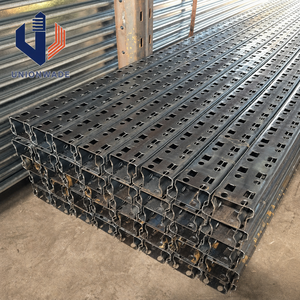
Industrial Medium Duty Steel Storage Rack Boltless Shelving System with Adjustable Shelves for Warehouse Organization
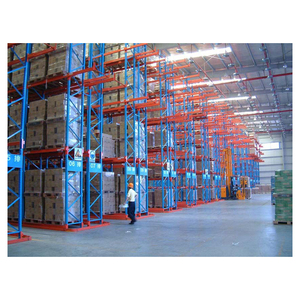
Narrow Aisle Racks Factory Price Heavy Duty VNA Rack Very Narrow Aisle Racking High Density Warehouse Storage Rack
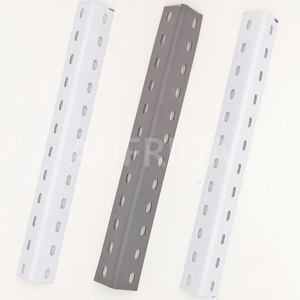
Steel Angle Bar Shelves Storage Racks Slotted Angle Light Duty Rack Uprights Adjustable Height Stable Racks
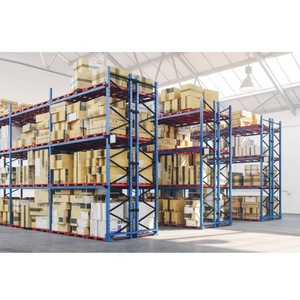
HEDA Storage Heavy Duty Rack and Warehouse Movable Pallet Rack Tile Display Rack System Warehouse Shelving Storage Equipment
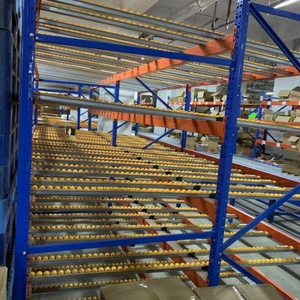
Industrial 5 Layer Heavy Duty Flow Rack Gravity-Fed Storage Solution for Warehouses Picking Efficiency for Boxes and Cartons
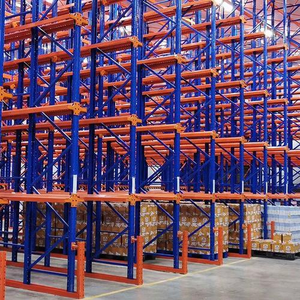
EBILMETAL 5 Steel Very Narrow Aisle Pallet Racking | OEM/ODM Adjustable Heavy Duty VNA Warehouse Racking Factory Direct Price
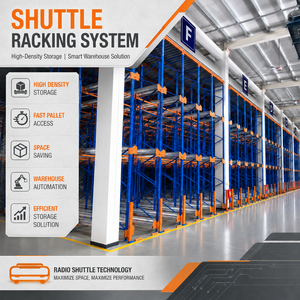
Factory Supply Radio Shuttle Rack Heavy Duty Pallet Shuttle Racking System High Density Warehouse Storage Custom OEM Supplier
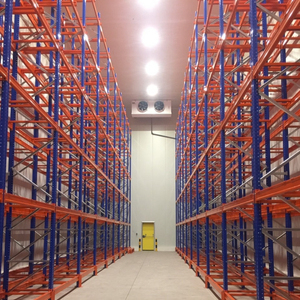
OEM Heavy Duty Steel Teardrop Selective Pallet Racking System Directly from Vietnam Factory for Warehouses
Drive-In Pallet Racking: Kinematic Mechanics & Volumetric Optimization
Drive-in and drive-through racking configurations represent the pinnacle of static spatial yield in structural intralogistics. By eliminating conventional forklift operating aisles, these systems consolidate storage floor area utilization up to 80% compared to standard selective racking.
Aisle-Free High Density Storage
Conventional selective racks reserve up to 65% of warehouse floor footprint exclusively for forklift maneuvering corridors. Drive-In racking condenses storage lanes into unified monolithic blocks, where counterbalanced or reach trucks enter structural bays directly along continuous cantilevered pallet support rails.
LIFO vs. FIFO Flow Physics
Configured primarily as Last-In, First-Out (LIFO) with a single entry/exit face, Drive-In is ideally engineered for homogeneous SKUs with prolonged product lifecycle turnover. When deployed as Drive-Through (dual access entries), the system achieves First-In, First-Out (FIFO) stock circulation, supporting high-velocity batch processing.
Thermal Energy Conservation
In refrigerated and sub-zero blast freezer warehouses (-25°C to -35°C), cooling every cubic meter represents a perpetual operational expenditure. By increasing cubic density by up to 2.5x, Drive-In configurations exponentially lower energy expenditure per stored metric ton of perishable inventory.
Multi-Axis Dynamic Load Bracing
Because Drive-In structures lack traditional cross-beam ties across forklift travel bays, spatial stability relies heavily on overhead top-tie portal beams, rear diagonal anchor trusses, and high-tensile column base floor anchoring. Our structural design satisfies FEM 10.2.02, EN 15512, and ANSI/RMI MH16.1 codes, ensuring exceptional rigidity under repeated mast-impact dynamics.
| Racking Topology | Floor Area Utilization | Volumetric Efficiency | Inventory Flow Logic | SKU Variety Suitability | Capital Expenditure (Per Pallet) |
|---|---|---|---|---|---|
| Drive-In Racking (HEDA Standard) | 75% - 85% | Very High (Up to 80%) | LIFO (Last-In First-Out) | Low - Moderate (Bulk Homogeneous) | Economical / Low-Medium |
| Selective Pallet Racking | 35% - 45% | Moderate (40%) | 100% Direct Access (FIFO/LIFO) | Maximum (High SKU Complexity) | Baseline Economical |
| Very Narrow Aisle (VNA) | 55% - 65% | High Vertical (>15m) | 100% Selectivity | High SKU Diversity | Medium - High (Truck Cost) |
| Radio Shuttle Automation | 80% - 90% | Maximum Ultra-Dense | Programmable FIFO & LIFO | Moderate - High Throughput | Higher Automation Initial CAPEX |
Future Procurement Dynamics for Heavy-Duty Warehouse Storage
Global supply chain shocks, shifting manufacturing footprints across ASEAN, and escalating industrial real estate lease prices are transforming industrial racking procurement criteria through 2026 and beyond.
Site-Specific Dynamic Seismic Calculations
Procurement officers can no longer rely on generic load tables. With massive logistics expansions in seismically active corridors across Indonesia, the Philippines, New Zealand, and the Pacific Rim, racking tenders mandate finite element analysis (FEA) accommodating dynamic ground acceleration spectra.
High-Yield Micro-Alloyed Steels
Transitioning from standard Q235B carbon steel to high-yield Q355B (equivalent to S355JR and ASTM A572 Grade 50) allows cold-roll forming of slimmer upright wall profiles with enhanced modulus of section, reducing dead weight while elevating buckling resistance.
Drive-In to Autonomous Shuttle Conversion
Forward-thinking warehouse operators specify Drive-In upright profiles pre-punched for dual compatibility. This allows seamless upgrading to automated Radio Shuttle carriers or AGV interface rails down the line without replacing the fundamental upright frames.
Digital Twin & Impact Sensor Analytics
Modern rack procurement increasingly incorporates real-time health monitoring. IoT-enabled impact sensor beacons fitted on Drive-In guide rails log forklift collisions, generating instant structural fatigue alerts in compliance with mandatory EN 15635 annual inspection standards.
Guangzhou Heda Shelves: 10-Step Controlled Fabrication Process
Quality control is engineered directly into our 30,000 m² Guangzhou manufacturing hub. Every upright frame, support arm, and pallet rail passes through 10 strictly monitored production stages to guarantee dimensional accuracy and structural resilience.
Certified Prime Steel
Mill-certified high tensile Q235B & Q355B coils verified for tensile and chemical purity.
Precision CNC Slitting
High-speed longitudinal slitting ensuring laser-straight edges within ±0.1mm tolerances.
Automated Pitch Punching
Continuous CNC multi-head punching for standard 50mm, 75mm, or 76.2mm teardrop pitch holes.
Multi-Stage Cold Bending
18-to-24 station roll forming lines ensuring work-hardening strength without residual stress.
Continuous Profile Sizing
Specialized omega profile forming for uprights and inverted-L profiles for drive-in pallet rails.
Robotic Laser Deburring
Automated weld prep and mechanical edge smoothing eliminating micro-fissure stress raisers.
Robotic Gas Shield Welding
CO₂/Argon mixed shield automated robotic welding ensuring deep-penetration weld seams.
Pickling & Phosphating
Multi-tank chemical degreasing, acid descaling, and zinc-phosphate adhesion pre-treatment.
Electrostatic Coating
Swiss Gema automated powder guns applying 60-80μm thermosetting epoxy-polyester cured at 200°C.
Full Load Testing & QC
Pre-shipment batch destructive stress testing, container staging, and custom seaworthy bundling.
Engineering Credentials, Mill Direct Pricing & Rapid ASEAN Delivery
Since 2001, Guangzhou Heda Shelves Co., Ltd. has stood as a world-leading manufacturer of industrial pallet racking and structural mezzanine platforms. Partnering directly with HEDA unlocks undeniable commercial and structural benefits.
Rigorous International Certifications
Our engineering workflows and manufacturing systems are independently audited and certified: CE Certificate No. 2435-CPR-8605159, ISO 9001:2015 Quality Management Certificate No. 18624Q00169R0M, alongside comprehensive RoHS compliance for cleanroom operations.
Fast Sea Transit to ASEAN & Global Hubs
Operating from our Guangzhou production base minutes from Nansha and Huangpu ports, we provide unparalleled sea shipping speeds across Southeast Asia: 2-5 days to Vietnam, 3-5 days to Manila, 5-7 days to Singapore & Laem Chabang, 6-8 days to Port Klang, and 7-10 days to Jakarta, backed by container-maximized packing.
Complimentary CAD Layouts & FEA Calculations
Every facility floor plan is analyzed by our senior structural engineering team. We deliver custom 2D AutoCAD equipment layouts, immersive 3D BIM models, and comprehensive static and dynamic load calculation packages at zero upfront cost before production commitments.
High-Humidity Anti-Corrosion Finishing
To conquer aggressive tropical humidity, coastal salt fog, and cold room condensation, our products undergo chemical phosphate pre-treatment and specialized architectural-grade thermosetting powder coatings. Hot-dip galvanization is available for outdoor yards and harsh chemical environments.
Frequently Asked Technical & Procurement Inquiries
Direct, authoritative answers from our senior project engineering desk to resolve critical questions regarding specifications, clearances, building codes, and international delivery.
What minimum dimensional clearances are mandatory between pallets and upright frames in Drive-In lanes?
According to international EN 15512 and FEM 10.2.02 codes, the standard horizontal clearance between the widest point of the loaded pallet (including cargo overhang) and the upright frames must be a minimum of 75mm on each side (150mm total lane clearance). Pallet entry guides at floor level and guide rails along bay floors are strongly recommended to prevent mast collision.
How does HEDA guarantee structural stability without standard beam shelf ties?
Drive-In systems lack standard horizontal shelf beams across vehicle travel paths. HEDA engineers structural rigidity via heavy-duty top-tie portal beams that link upright rows across the roof of the rack, robust rear diagonal bracing towers, reinforced spine bracing panels, and widened, dual-anchored floor baseplates that securely anchor into the concrete slab.
Can HEDA custom-engineer racking for seismic zones such as the Philippines and Indonesia?
Yes. We regularly supply major logistics developments throughout seismic zones. Our structural engineers incorporate local geological parameters (such as PGA, spectral acceleration factors, and soil classification) into finite element software, providing reinforced column cross-sections, heavy-duty floor base shoes, and high-shear mechanical chemical wedge anchors.
What concrete slab floor specifications are needed to support heavy-duty Drive-In installations?
Warehouses typically require a reinforced concrete floor slab with a minimum compressive strength of C25/30 or C30/37 (minimum 3,500 to 4,000 PSI) with a minimum slab thickness of 180mm to 220mm, depending on concentrated point loads under upright baseplates. Slab flatness should conform to DIN 18202 Table 3 Line 4 or ASTM E1155 FF/FL standards to prevent forklift mast oscillation.
What is the standard production lead time and ocean shipping transit from Guangzhou?
Standard production cycles for a multi-container Drive-In system are typically 15 to 22 working days. Direct port-to-port ocean transit from Guangzhou (Nansha/Huangpu) to Southeast Asian main ports ranges from 2 to 10 days. Shipments to European main ports take approximately 22-28 days, and to US West Coast ports approximately 14-18 days.
How does HEDA assist with overseas site installation and safety compliance?
Every export container is packed with numbered components corresponding exactly to detailed 3D exploded assembly drawings, CAD installation schemes, and comprehensive video installation documentation. For major warehouse installations, HEDA dispatches senior structural site supervisors to direct local installation teams and certify compliance before system commissioning.
Request Your Custom Warehouse Layout & Direct Factory Quotation
Share your architectural floor plans, ceiling clearance under hook, pallet footprints, and forklift specifications. Our senior structural intralogistics engineers will return a complete 2D CAD layout, 3D visual rendering, and accurate static load calculation pack within 24 hours.