Direct Factory High-Density Racking & Warehouse Infrastructure
Select from certified high-capacity drive-in racking bays, customizable steel structures, and integrated logistic components designed to eliminate unusable operating aisles and elevate cubic space utilization up to 85%.
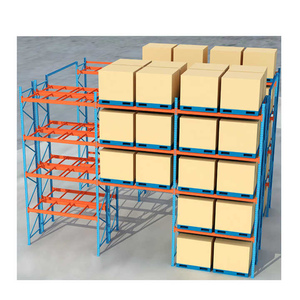
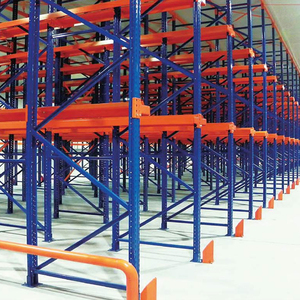
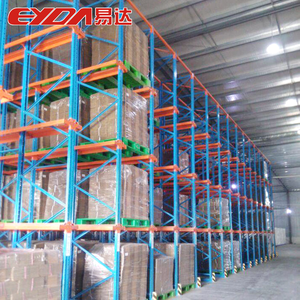
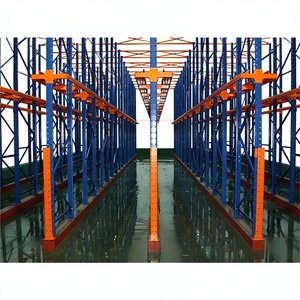
Engineering Fundamentals of High-Density Drive-In & Drive-Through Racking
Modern industrial supply chains demand extreme volumetric efficiency. In standard selective pallet racking systems, operating aisles consume between 55% and 65% of the total warehouse floor footprint. For capital-intensive environments such as cold-storage freezers, pharmaceutical temperature-controlled facilities, and raw-material bulk buffer staging, dedicated forklift access aisles represent unsustainable overhead.
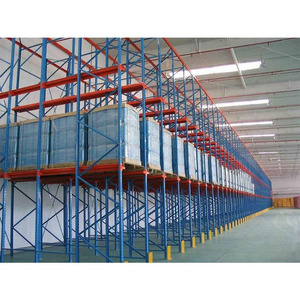
Drive-in and drive-through pallet racking represents an engineered structural solution that converts dead aisle space into active, contiguous pallet positions. By cantilevering continuous pallet support rails directly from heavy-duty vertical upright frames, forklifts enter the structural lanes themselves to deposit or retrieve unit loads. This eliminates intermediate cross beams and enables continuous lanes up to 10 to 12 pallets deep and 4 to 6 levels high.
First-In, Last-Out (FILO) Mechanics
Standard drive-in systems operate with a single entry and exit corridor. Pallets are deposited against the back wall or cross bracing, making the last pallet stored the first one retrieved. This provides optimum density for seasonal inventory, uniform fast-moving consumer goods (FMCG), and high-volume batch runs with identical SKUs.
First-In, First-Out (FIFO) Drive-Through
By engineering access from both opposing sides (Drive-Through), pallets are loaded at one portal and retrieved from the opposite end. This layout establishes strict FIFO inventory discipline, critical for perishable agricultural exports, dairy storage, and expiry-monitored pharmaceutical items, requiring balanced top horizontal tie-bracing.
Structural Integrity & Deflection
Because cross-aisle load beams are absent, drive-in systems rely on top portal ties, rear structural X-bracing, and heavy-gauge base anchoring. Columns must be calculated to resist dynamic sidesway forces and forklift contact stress in compliance with FEM 10.2.02, RMI (MH16.1), and AS4084 standards.
Key Structural Anatomy & Load Transfer Mechanics
The structural stability of a drive-in system relies on precision engineering. Unlike selective racks where transverse beams stabilize columns in both axes, drive-in systems have uninterrupted bays. The engineering team must balance three critical structural assemblies:
1. Cantilever Rail Arms & Pallet Support Runners: Pallets sit on cold-rolled or heavy-gauge formed structural angle rails (typically 2.5mm to 3.5mm thick). These support rails are bolted to cantilever brackets welded or interlocked to upright columns. Tapered rail entry guides (flared front horns) are mandatory to center forklift entry and avoid pallet snagging.
2. Top Spine & Portal Bracing: Overhead top beams and diagonal cross-bracing connect adjacent blocks into a rigid, monolithic steel matrix. This overhead frame resists lateral shear displacement when lift trucks negotiate inner bays with multi-ton elevated payloads.
3. Heavy-Duty Floor Guide Rails & Upright Armor: Because forklift clearances within the lanes are tight (often within 75mm to 100mm tolerance), floor-anchored steel angle or channel guide rails protect upright posts against truck chassis impact. Post protectors and wrap-around column guards with shock-dampening poly inserts absorb inevitable impact energy.
Top 10 Drive In Warehouse Racking Manufacturers & Suppliers
An independent technical comparison of the world's premier racking fabricators, evaluating steel raw material quality, engineering customization, cold-chain surface resilience, and global turnkey delivery.
Guangzhou Heda Shelves Co., Ltd.
Established in 2001, HEDA Shelves operates a state-of-the-art 30,000 m² factory equipped with precision automated roll-forming lines, automated column punching, and an integrated pickling-phosphating electrostatic coating line. Producing over 30,000 metric tons per month, HEDA specializes in heavy-duty drive-in and drive-through racking tailored for tropical, seismic, and sub-zero cold chain deployments. Certified under ISO 9001:2015 and CE standards, HEDA delivers factory-direct engineering, complete CAD layout design, and full CIF/FOB logistics across Southeast Asia, North America, Europe, and the Middle East.
SSI SCHAEFER Group
A world-renowned conglomerate specializing in intralogistics and automated pallet racking. SSI Schaefer's drive-in racking components feature high-tolerance structural profiles, modular upright assemblies, and automated shuttle-ready conversion options. Known for unmatched durability and adherence to rigorous European EN/FEM engineering codes, ideal for massive enterprise cold storage facilities.
Mecalux, S.A.
Mecalux holds extensive global manufacturing capacity across Europe and the Americas. Their drive-in racking portfolios are engineered with tapered pallet rail arms, heavy structural channel columns, and seamless integration with their proprietary Easy WMS software. Mecalux systems excel in chemical, beverage bottling, and consumer packaged goods distribution centers.
Nedcon B.V. (A Koch Company)
Nedcon is acclaimed for complex structural engineering and heavy industrial rack-supported buildings. Their drive-in steel systems offer bespoke upright punching configurations, ductile high-tensile steel alloys, and extreme deflection resistance, making them a preferred choice for complex industrial automation and deep-freeze logistics across Western Europe.
Frazier Industrial Company
Frazier is North America's leading manufacturer of 100% structural steel racking. While roll-formed racks dominate standard applications, Frazier's structural drive-in racks use hot-rolled ASTM A36 channels. These systems withstand heavy forklift abuse in aggressive, high-throughput food distribution hubs where impact resistance is crucial.
Stow Group (stow Racking)
Stow is one of Europe's largest manufacturers of standard industrial racking, operating automated production facilities across Belgium, France, and Germany. Their drive-in racking line utilizes optimized upright geometries that reduce steel tonnage while maintaining compliance with Eurocode and FEM standards, providing competitive cost-per-pallet economics.
Daifuku Co., Ltd.
As a global titan in automated material handling, Daifuku provides drive-in and radio shuttle drive-in racking systems built to rigorous Japanese Industrial Standards (JIS). Their structural systems excel in seismic performance, featuring tuned sway bracing and specialized base dampening systems developed for earthquake-prone Pacific Rim installations.
Ridg-U-Rak, Inc.
With over 75 years of manufacturing history, Ridg-U-Rak provides heavy-duty drive-in racking systems featuring their patented cylindrical column designs with heavy internal ribbed reinforcement. Their systems resist torsional buckling and side-impact shear from reach trucks in distribution and retail buffer operations.
Jungheinrich AG
Jungheinrich combines industrial truck manufacturing with racking engineering. Their drive-in racking solutions are matched with specialized narrow-chassis reach trucks, featuring integrated electronic end-of-aisle braking sensors, mechanical floor guide tracking, and laser positioning systems to minimize rack strikes during high-elevation pallet picks.
Dexion (Gonvarri Material Handling)
A cornerstone of industrial storage engineering, Dexion provides versatile drive-in racking across Europe, Australia, and the Middle East. Featuring galvanized upright options, heavy-duty rail connectors, and comprehensive third-party load certification, Dexion remains a premier engineering choice for industrial bulk storage.
Future Procurement Trends in Drive-In & High-Density Pallet Racking
The global warehousing market is shifting toward automated, resilient, and energy-conserving storage architectures. Facilities facing rising real estate costs and soaring industrial electricity tariffs are rethinking their procurement criteria for high-density storage systems.
Hybrid Shuttle-Ready Conversions
Traditional drive-in systems are evolving into "Radio Shuttle Ready" structures. Buyers specify cantilever profiles that accommodate both standard pallet guide rails and automated four-wheel radio shuttle tracks. This allows facilities to start with manual forklift drive-in operation and later upgrade to automated shuttle carriers without replacing the upright framework.
Cold-Chain Cubic Compression
Cold rooms are the most expensive cubic footage in modern logistics, with energy costs consuming up to 65% of warehouse OPEX. Modern buyers in dairy, frozen seafood, and vaccine logistics rely on deep drive-in racks (up to 10 pallets deep) to minimize refrigerated volume per stored pallet position, reducing cooling requirements by up to 35%.
High-Performance Surface Coatings
Condensation in temperature-variable loading docks accelerates steel corrosion. The industry is moving from standard single-pass spray finishes to automated 10-step surface preparation systems: chemical degreasing, ultrasonic pickling, zinc phosphating, and thermo-cured electrostatic powder coats. Marine environments increasingly specify hot-dip galvanizing per ISO 1461.
Total Cost of Ownership (TCO): Selective Racking vs. Drive-In System
While the initial capital expenditure of drive-in racking is approximately 20% to 30% higher per pallet position than standard selective racking (due to specialized continuous rails, cantilever support brackets, and overhead tie framing), the long-term TCO is significantly lower:
• Real Estate Reduction: A drive-in layout storing 5,000 pallets requires roughly 35% less building footprint than a selective rack configuration holding identical inventory. In prime industrial zones, this translates to tens of thousands of dollars saved annually in facility lease or construction costs.
• HVAC & Lighting Efficiencies: Fewer operating aisles reduce building volume and allow lighting fixtures to be concentrated at entry portals, cutting lighting and refrigeration energy consumption.
• Forklift Travel Optimization: Lift trucks operate within dedicated lanes rather than traversing extensive aisle networks, lowering equipment engine hours, tire wear, and fuel consumption.
Why Engineering Teams Choose HEDA Shelves
Guangzhou Heda Shelves Co., Ltd. combines comprehensive manufacturing capacity with tailored engineering design, verified compliance, and direct factory pricing for projects worldwide.
30,000 m² Manufacturing Hub
In-house precision cold-bending roll lines, robotic welding stations, and fully automated column punching ensure tight tolerances on cantilever arms, rails, and uprights with zero third-party markups.
Certified Quality (CE & ISO)
Certified under CE No. 2435-CPR-8605159 and ISO 9001:2015 No. 18624Q00169R0M, backed by rigorous static and dynamic load testing to verify deflection limits and payload safety factors.
Tropical & Cold Room Protection
Every component undergoes multi-stage chemical pickling and phosphating before thermoset powder coating, providing long-term resistance in 80%+ humidity and -30°C cold chain environments.
Free 3D & CAD Layouts
Experienced racking engineers return detailed CAD warehouse layouts, 3D spatial renders, and structural load calculations within 24 to 48 hours, tailored to your specific pallet, truck, and floor specs.
Frequently Asked Questions: Drive-In Racking Sourcing
Straightforward engineering answers covering seismic design, forklift clearance, floor slab loading, and international shipping.
How much clearance is required between the forklift and upright columns?
Standard engineering calls for 75mm to 100mm (3 to 4 inches) of clearance on each side between the forklift chassis/load and the cantilever upright frames. To minimize impact risk during transit, floor-mounted heavy steel guide angles or recessed guide channels are anchored into the concrete floor.
Can drive-in racking accommodate bottom-level floor storage without support rails?
Yes. In many designs, the first level of pallets can be placed directly on the concrete warehouse floor slab between the guide rails. This eliminates one tier of cantilever support arms, reducing capital cost and making bottom-level retrieval straightforward for standard counterbalanced trucks.
How are drive-in racking systems engineered for high seismic activity zones?
In earthquake-prone regions such as the Philippines, Indonesia, Japan, or the American West Coast, seismic load criteria are factored into structural calculations. HEDA engineers incorporate oversized baseplates with dual concrete expansion anchors, heavy-gauge steel uprights, and longitudinal portal roof bracing to withstand horizontal ground acceleration.
What parameters are required to calculate warehouse floor slab bearing capacity?
Drive-in racking exerts concentrated point loads on concrete floor slabs via upright baseplates. You should provide slab concrete thickness (typically 150mm to 250mm), steel rebar reinforcement mesh specifications, sub-base soil compaction rating (k-value), and compressive strength (e.g., C25/30 or 3000-4000 PSI) to verify point load capacity.
What is the typical shipping lead time from Guangzhou port to ASEAN destinations?
HEDA Shelves ships factory-direct from Guangzhou/Nansha Port. Sea transit averages 2-5 days to Haiphong/Cat Lai (Vietnam), 3-5 days to Manila (Philippines), 5-7 days to Bangkok/Laem Chabang (Thailand) and Singapore, 6-8 days to Port Klang (Malaysia), and 7-10 days to Jakarta (Indonesia), offering substantial supply chain lead-time advantages.
What pallet quality is necessary for reliable drive-in storage?
Because pallets are supported solely by their outer 50mm to 75mm edges on cantilever rails, high-quality, non-defective wooden pallets (such as grade-A Euro pallets, GMA pallets, or heavy-duty plastic runners) are required. Damaged bottom boards, cracked stringers, or sagging deckboards must be rejected, as lack of center support can lead to rail drop-through accidents.