High-Density & High-Bay Industrial Storage Systems
Explore our heavy-duty cold-rolled steel storage systems engineered for maximum cubic efficiency, heavy unit loads, and seamless material handling integration.
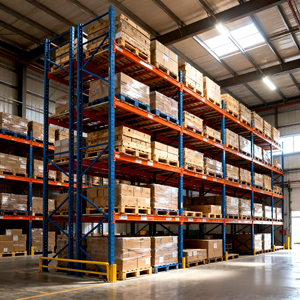
High-Rise Heavy Duty Beam Racking
10–15m tall structural steel shelving tailored for large logistics distribution centers with automated high-bay stacking capabilities.
View Product Specs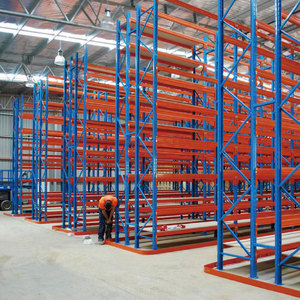
Adjustable Narrow Aisle (VNA) Racks
Cold-rolled Q235B steel narrow-aisle racking engineered with precision bottom guide rails for tight-passage warehouse operations.
View Product Specs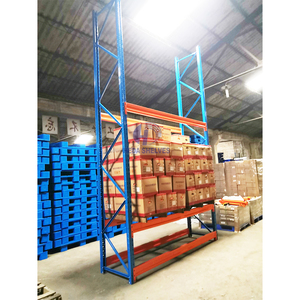
Pallet Flow & Push Back System
Gravity-feed dynamic rolling beds and nested push-back carts designed for 2–5 pallet depths in cold storage and high-throughput lanes.
View Product Specs
Live Pallet Gravity Flow Racking
FIFO gravity skate-wheel assemblies with integrated centrifugal speed controller brakes for date-sensitive perishable storage.
View Product Specs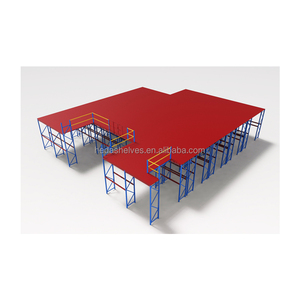
Industrial Platform Mezzanine
Heavy-duty structural mezzanine systems providing 300–1,000 kg/m² overhead platform capacity without requiring secondary foundation work.
View Product Specs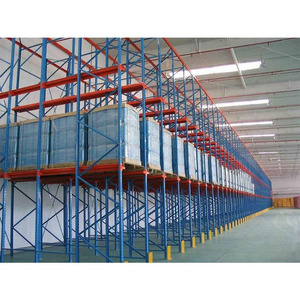
Drive-In FILO Racking System
Continuous drive-in lane configuration eliminating operating aisles for homogenous pallet batches, cold rooms, and bulk staging.
View Product Specs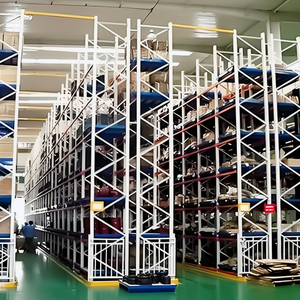
VNA E-Commerce Racking System
High-density narrow-aisle pallet matrices configured for ultra-fast individual case picking and omnichannel logistics fulfillment.
View Product Specs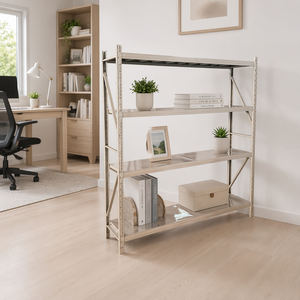
Modular Retail & Store Shelving
Precision cold-formed modular shelving systems for forward-facing retail stockrooms, micro-fulfillment centers, and hardware depots.
View Product SpecsStructural Mechanics and Volumetric Optimization of Double Deep Racking
A rigorous examination of kinematic reach mechanics, structural beam deflection tolerances, and the economic inflection point of double-deep warehousing configurations.
1. The Kinematics and Geometry of Two-Deep Storage Architecture
Double deep racking represents an engineered compromise between pure selective racking (100% immediate pallet selectivity) and ultra-high-density systems (such as Drive-In or Pallet Flow). By storing palletized unit loads two positions deep along a single operating aisle, warehouse operators eliminate up to 50% of the interior access corridors required by standard single-selective layouts. In physical terms, a typical single-selective bay layout utilizes approximately 35% to 40% of floor space for actual pallet footprints, with the remaining 60% dedicated to forklift maneuvering aisles.
Double deep systems dramatically shift this volumetric ratio: by pairing two rows of back-to-back selective racks together (four rows per aisle module), floor footprint utilization increases to 55%–65%. Access to the rear pallet position is facilitated via specialized material handling equipment—principally a double-reach pantograph reach truck or a forklift equipped with telescopic extending forks. This structural configuration creates an operational paradigm of Last-In, First-Out (LIFO) within individual storage slots, making it particularly optimal for stock profiles containing 2 to 4 pallets per distinct Stock Keeping Unit (SKU).
2. Material Metallurgy and Structural Load Calculations Under EN 15512 & RMI
Engineered storage racks must resist dead loads, unit product loads, dynamic seismic excitations, and operational impact forces. HEDA Shelves utilizes cold-rolled structural steel conforming strictly to SS400, Q235B, and Q355B high-tensile metallurgical grades. Under EN 15512 (European Standard for Steel Static Storage Systems) and ANSI/RMI MH16.1 specifications, beam design requires a maximum permissible vertical deflection limit of L/200 (where L equals the clear span between upright column faces). For a standard 2700mm beam carrying two 1,200 kg pallets (2,400 kg total bay level), maximum elastic deflection must never exceed 13.5mm under fully stabilized working load conditions.
Furthermore, in a double deep framework, upright frame columns absorb asymmetrical moments during loading cycles. As a pantograph reaches into the rear slot, the gravitational center of mass shifts dramatically forward, exerting transient torsional and eccentric axial loads onto front upright posts. Our structural engineers deploy reinforced 90mm–120mm omega-profile columns with continuous variable cold-rolled return flanges, bolted cross-bracing diagonals, and oversized 10mm anchor baseplates to ensure zero structural distortion under continuous dynamic duty cycles.
| Storage System Type | Floor Space Efficiency | Selectivity Index | Material Handling Equipment | LIFO / FIFO | Relative Cost / Pallet |
|---|---|---|---|---|---|
| Double Deep Racking (HEDA) | 55% – 65% | 50% (Immediate) | Pantograph Reach Truck / Telescopic | LIFO (Per Slot) | Moderate ($$) |
| Standard Selective Racking | 35% – 42% | 100% (Immediate) | Standard Counterbalance / Reach | FIFO / LIFO | Lowest ($) |
| Drive-In / Drive-Through | 65% – 75% | 15% – 20% | Standard Counterbalance | Strict FILO / FIFO | Moderate-High ($$$) |
| Very Narrow Aisle (VNA) | 50% – 60% | 100% (Immediate) | Articulated / Turret VNA Truck | FIFO / LIFO | High ($$$$) |
| Radio Shuttle Racking | 70% – 85% | Automated Lane-Level | Standard Forklift + Automated Shuttle | Both FIFO & LIFO | Capital Intensive ($$$$$) |
Aisle Floor Space Consolidation
Eliminate every second forklift aisle compared to standard selective layouts, instantly releasing up to 30%–35% of overall square meters for manufacturing, sorting, or auxiliary buffer storage.
Lower CapEx Than Automated Shuttles
Gain high-density cubic storage without committing to high maintenance automation electronics, sensor battery lifecycle overheads, or complex warehouse control system (WCS) integration.
Tropical-Grade Pre-Treatment
Full 8-stage pickling and phosphating pre-treatment bath process before electrostatic powder curing guarantees coating adhesion in 85%+ relative humidity and harsh oceanic climates.
Future Procurement Trends in High-Density Warehouse Racking
Essential economic, geopolitical, and technical shifts transforming how logistics executives and procurement managers evaluate warehouse infrastructure investments through 2030.
1. Nearshoring and Regional Hub Modular Scalability
Global supply chain disruptions have precipitated a profound transition from hyper-centralized mega-warehouses to regional, distributed distribution nodes across Southeast Asia, North America, and Eastern Europe. Supply chain leaders are increasingly specifying modular double deep and VNA systems that allow rapid reconfiguration. Procurement contracts today emphasize bolted upright frame design rather than welded truss configurations, facilitating cost-effective ocean freight packing in standard 40HQ containers and providing rapid structural adjustability if pallet dimensions change from standard ISO 1200x1000mm to Euro 1200x800mm profiles.
2. Green Steel Certification and Embodied Carbon Accounting (Scope 3)
Environmental, Social, and Governance (ESG) compliance is transitioning from corporate reporting to mandatory procurement criteria. Major multinational 3PL operators and enterprise retailers now audit the embodied carbon footprint of structural steel storage systems. Guangzhou Heda Shelves Co., Ltd. continuously sources certified low-emission steel coils processed in blast furnaces utilizing scrap-blended charge ratios. Our modern electrostatic powder coating lines run solvent-free, closed-loop reclamation cycles with zero VOC discharge, ensuring full compliance with international RoHS and ISO 14001 guidelines.
3. Hybrid AGV/AMR Telematics & Camera-Assisted Double-Reach Trucks
The historical operational pain point of double deep racking—operator visibility obstruction when positioning loads into deep, upper-level tier 4 and tier 5 bays—is now comprehensively resolved by camera telematics and laser-guided mast sensors. Looking forward, procurement directors are rapidly procuring double deep racking pre-drilled and structurally adapted for automated reach Autonomous Guided Vehicles (AGVs). These laser-navigated trucks require tighter structural tolerances (permissible column out-of-plumbness tolerances under 1/1000th per FEM 10.2.03 standard), positioning HEDA's automated CNC continuous column punch tooling at the forefront of manufacturing quality.
10-Stage Precision Manufacturing Protocol
Why leading multinational distributors in Malaysia, Singapore, Thailand, Vietnam, and Indonesia trust HEDA Shelves as their primary OEM/ODM racking partner.
Verified CE & ISO Credentials
Certified under CE Factory Production Control (Certificate No. 2435-CPR-8605159) and ISO 9001:2015 Quality Management System (Certificate No. 18624Q00169R0M). Every project includes structural calculation packages and mill test certificates.
Precision Cold-Bending Lines
Equipped with computerized high-precision roll-forming machines capable of rolling continuous upright profiles up to 15 meters without splicing joints, guaranteeing absolute sectional symmetry and maximum buckling resistance.
Rapid ASEAN Shipping Network
Operating factory-direct from Guangzhou and Nansha deepwater ports. Direct sea freight delivers to Ho Chi Minh City in 2–5 days, Manila in 3–5 days, Singapore/Bangkok in 5–7 days, and Jakarta in 7–10 days.
Frequently Asked Questions by Industrial Warehouse Specifiers
Addressing the core technical, logistical, and structural questions encountered during double deep racking specification and tender evaluation.
What is the typical operating aisle width for double deep reach trucks?
Depending on reach truck chassis specifications and pallet dimensions, standard double-reach pantograph trucks typically require an operating aisle width between 2,800mm and 3,200mm. This is approximately 400mm wider than a standard pantograph reach truck operating in single selective racks, but the elimination of alternate aisles provides a massive net space gain.
How do warehouse operators mitigate the "honeycombing" effect in LIFO double deep slots?
Honeycombing (unutilized rear pallet positions) occurs when front pallets are retrieved leaving vacant rear spots that cannot be filled until the slot is emptied. Leading operators use automated Warehouse Management Systems (WMS) that mandate 2-to-4 pallet SKU batching, dynamically directing incoming pallets to open back-slots during inbound put-away cycles.
Can HEDA double deep racking be engineered for high seismic risk regions?
Yes. For seismic zones such as the Philippines, Indonesia, and New Zealand, our engineering department performs full spectral response modal analysis in accordance with local building codes. We engineer reinforced upright bracing configurations, heavy-duty floor baseplate anchors (Hilti / Fischer chemical anchoring), and ductile beam-to-column connector assemblies.
What in-rack fire sprinkler requirements apply to double deep storage under NFPA 13?
Under NFPA 13 standards, double deep racks exceeding 7.6 meters (25 feet) in building height holding Class I-IV commodities or plastic products typically mandate in-rack sprinkler barriers positioned in the longitudinal flue space between back-to-back bays. HEDA designs customized beam cross-ties and flue-space maintainers to protect sprinkler risers from forklift impact.
What information is needed to receive a free 2D CAD and 3D rendering proposal?
To produce an exact engineering layout and structural calculation sheet, our team needs: (1) Warehouse building CAD drawings showing clear height under trusses and column locations; (2) Pallet dimensions (W x D x H) including load overhang; (3) Maximum unit pallet weight; and (4) Proposed or existing forklift make and mast lift model.
Can double deep racking be modified back to single selective racking in the future?
Absolutely. Because our double deep racking utilizes modular bolted frames and adjustable 50mm/75mm beam pitch hook connectors, the rows can be repositioned and disassembled into standard single-selective aisles if your warehouse inventory dynamics transition to 100% individual SKU order picking.