Engineered Heavy-Duty Racking & Shelving Systems
Fabricated from certified high-tensile Q235B/Q355B structural steel. Each system is custom-calculated to deliver maximum volumetric load bearing, seismic compliance, and continuous operational safety.
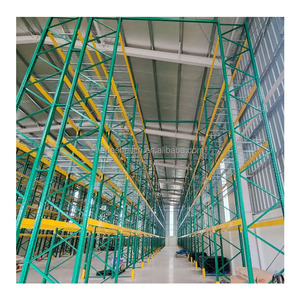
Heavy Duty Steel Racking System Industrial Warehouse Storage Shelving Unit Manufacture Factory Stacking Racks & Shelves
View Details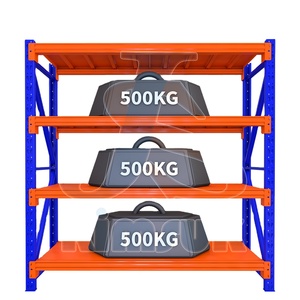
Ultra Heavy Duty Industrial Pallet Racking 2000kg Steel Shelving Rack with Dual Anti-Collision Beams 24/7 Free Technical Support
View Details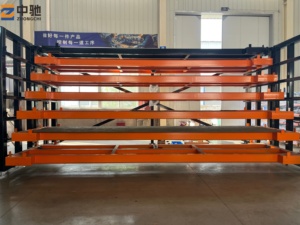
High Load Capacity 8-Layer Anti-Rust Powder Coated Steel Rack Heavy Duty Warehouse Storage System for Industrial Pallet Use
View Details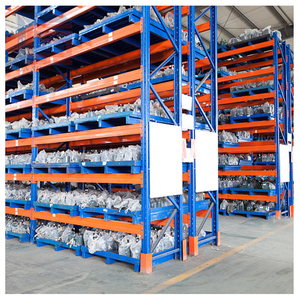
Wholesale China Industrial Pallet Storage Rack Steel Warehouse Racking Adjustable Shelving
View Details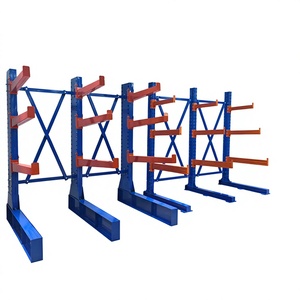
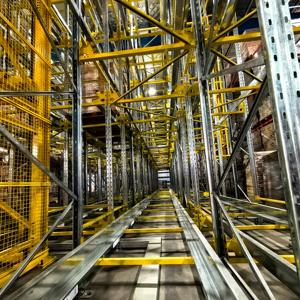
Jracking High-Load Warehouse Storage Rack CE Certified Four-Way Radio Shuttle Rack System for Cold Storage Warehouse Use
View Details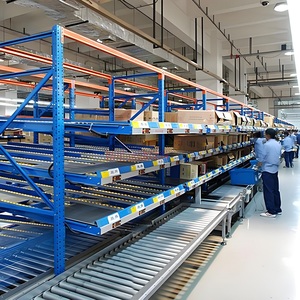
Factory Price Carton Flow Rack Adjustable Wheel Track Shelving for Warehouse Order Picking
View Details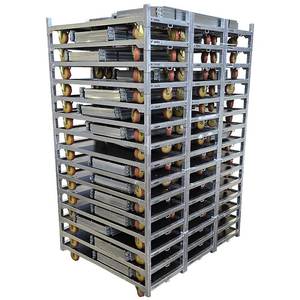
DC Trolley And Shelf Set By CUBE-Stacking Racks & Shelves
View DetailsWhy Global Supply Chains Rely on HEDA Shelves
From South China's maritime nexus directly to global logistics corridors, Guangzhou Heda Shelves Co., Ltd. delivers certified structural integrity, advanced anti-corrosive finishing, and custom FEA-validated engineering.
25+ Years Industrial Heritage
Engineered storage design backed by a seasoned team of 300+ technical production specialists, delivering zero-defect cold-rolled steel profiling since 2001.
Complimentary 3D CAD & FEA
Complete structural calculations, finite element analysis (FEA), spatial volumetric simulations, and 3D architectural CAD renderings provided prior to fabrication.
Tropical & Coastal Durability
Multi-stage chemical pre-treatment comprising acid pickling and phosphating, finished with electrostatic thermosetting powder curing that withstands extreme relative humidity.
Direct Export Route Efficiency
Port-proximity loading from Guangzhou and Nansha. Direct maritime routes ensure rapid sea transit: 2–5 days to Vietnam/Philippines, 5–8 days to Singapore/Malaysia, and expedited transpacific scheduling.
10-Stage In-House Precision Manufacturing Lifecycle
Every upright frame, load beam, and horizontal brace is manufactured within our closed-loop facility to ensure dimensional precision and raw material traceability.

Prime Steel Coils

Precision Slitting

CNC Hole Punching

Cold Forming

Continuous Rolling

Deburring & Polish

Robotic Welding

Pickling Bath

Powder Coating

FAT & Container Pack
Technological & Structural Engineering Trends in Modern Warehousing
Industrial storage is shifting rapidly from passive static iron frames to dynamic, semi-automated, data-integrated vertical storage hubs designed to optimize high-throughput fulfilment.
Automation-Ready Racking & Four-Way Shuttles
The contemporary intralogistics facility increasingly replaces conventional manual reach-truck aisles with high-density automated shuttle architectures. Racking design tolerances have tightened from ±3.0mm down to ±1.0mm to accommodate LiDAR-guided automated guided vehicles (AGVs) and four-way radio shuttles. These systems eliminate internal drive-in corridors, elevating storage density by 60% to 80% while preserving automated FIFO and LIFO retrieval sequencing under supervisory WCS/WMS warehouse orchestration.
Finite Element Structural Modeling & Seismic Codes
In accordance with global seismic design specifications (including RMI MH16.1, EN 15512, and AS 4084), structural calculations now account for dynamic ground accelerations, site soil classes, and ductility reduction factors. Advanced cold-formed profiles utilize variable steel thickness with engineered multi-flange stiffeners, yielding superior torsional resistance and post-buckling reserve strength. Heavy-duty ductile baseplates and chemical anchor arrays guarantee building structural harmony during seismic events.
Sub-Zero Cold Chain & Corrosion Kinetics
Exploding pharmaceutical distribution and frozen food export have driven profound metallurgical innovations for sub-zero (-30°C) operations. Standard structural carbon steels suffer low-temperature ductile-to-brittle transitions; modern systems implement killed fine-grain Q355ND structural steels featuring Charpy V-notch impact energy ratings verified at -40°C. Coupled with hot-dip galvanizing exceeding 85 microns or dual-cure zinc-rich polyester powder systems, structural embrittlement and micro-fissuring are completely mitigated.
Structural Steel Specifier Matrix: System Topology vs. Performance Metrics
Compliant with EN 15512 & RMI MH16.1 Standards| Storage Topology | Typical Beam Span | Max Level Capacity | Deflection Limit (L/d) | Volumetric Efficiency | Selectivity Ratio |
|---|---|---|---|---|---|
| Selective Pallet Racking | 2,300mm – 3,900mm | 5,000 kg | L / 200 (Design Normal) | 40% – 50% | 100% Immediate Direct |
| Radio Shuttle System | Channel Depths > 40m | 2,000 kg/pallet | L / 250 (High Precision) | 80% – 85% | Batch / SKU Channel Dependent |
| Drive-In / Drive-Through | Continuous Guide Rails | 1,500 kg/pallet | L / 200 | 65% – 75% | Last-In, First-Out (LIFO) |
| Heavy Duty Cantilever | Arm Length 600–1800mm | 3,000 kg/arm | L / 180 (Cantilever Tip) | Variable / Open Span | 100% Unobstructed Horizontal |
| Multi-Tier Mezzanine | Column Grid up to 9x9m | 1,200 kg/m² | L / 300 (Pedestrian Comfort) | 150% – 300% Floor Multiplier | Multi-Level Manual & Conveyor |
Future Global Procurement Trends for Warehouse Storage
Global enterprise procurement directors and 3PL contractors are fundamentally revising their capital expenditure strategies. Sourcing has evolved far beyond basic component unit pricing.
Total Cost of Ownership (TCO) Over Initial Capex
Purchasing decisions now weigh lifecycle durability against immediate quotation costs. Low-grade steel racking with inadequate chemical conversion coatings leads to premature beam micro-deflection, corrosion around bolt perforations, and catastrophic structural fatigue within 36 to 48 months. Savvy international specifiers demand certified Mill Test Certificates (MTCs), documented minimum elongation percentages (>21%), and heavy zinc-phosphate powder coatings to ensure a 15-to-25-year operational lifecycle.
Direct Factory Engineering & Container Packing Math
With maritime freight volatility remaining an ongoing procurement consideration, international procurement teams partner directly with integrated Chinese OEMs rather than third-party export brokers. Factories that employ container-optimized nesting engineering—bundling roll-formed upright frames and nested step beams with specialized high-density strapping—achieve 98% cubic container utilization, cutting international freight cost per pallet position by up to 32%.
Green Steel & Eco-Certified Finishing Formulations
Corporate sustainability mandates are penetrating warehouse building infrastructure tenders. Procurement specifications increasingly favor manufacturers adopting zero-emission electrostatic powder recovery lines, heavy-metal-free pre-treatment washes conforming to EU RoHS Directives, and scrap-reduced continuous coil slitting. These environmentally sound production protocols enable logistics developers to secure LEED and BREEAM certifications for their logistics hub developments.
Independently Verified Certification & Mill Traceability
Tenders and municipal safety inspections require rigorous documentary backing. All HEDA storage installations are supported by verifiable testing registrations and structural compliance filings.
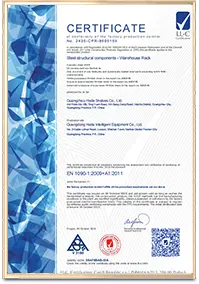
CE European Standard
Cert No. 2435-CPR-8605159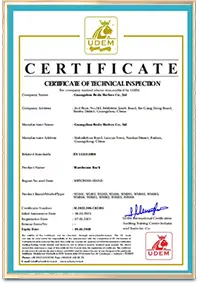
ISO 9001:2015 Quality
Reg No. 18624Q00169R0M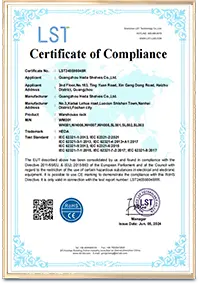
RoHS Chemical Compliance
Heavy-Metal Safe Finishes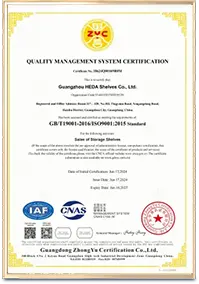
Destructive Load Testing
Safety Margin Factor 1.5 - 2.0International Procurement & Engineering FAQ
Clear, authoritative technical answers addressing metallurgical grades, international freight security, seismic displacement allowances, and installation tolerances.
Our industrial rack columns and load beams are roll-formed from certified prime cold-rolled structural steel grades Q235B and Q355B (equivalent to European S235JR and S355JR, or North American ASTM A36 and ASTM A572 Grade 50). Q235B yields a minimum yield strength of 235 MPa with tensile strength between 370–500 MPa. Q355B delivers a minimum yield strength of 355 MPa and tensile strength between 470–630 MPa, offering exceptional cold-work formability, elongation exceeding 21%, and reliable ductile behavior under sudden seismic shock loading.
Under both EN 15512 (European Storage Racking Standard) and RMI MH16.1 (Rack Manufacturers Institute), the allowable vertical beam deflection limit under nominal maximum uniformly distributed design load (UDL) is calculated as span divided by 200 ($L/200$) for standard pallet racks, or $L/250$ for high-precision automated radio shuttle and AS/RS lanes. For example, a 2,700mm beam carrying 3,000kg will not exceed 13.5mm of central vertical deflection, verified through finite element computer analysis and physical batch proof-loading before dispatch.
Prior to coating, steel components undergo an automatic 7-stage surface pre-treatment: degreasing, hot water rinsing, acid pickling to strip scale, phosphating to create an anti-corrosive crystalline conversion barrier, and demineralized neutralization. An electrostatic thermosetting epoxy-polyester hybrid powder coating (60–80 microns thickness) is applied and baked at 180°C–200°C. For coastal open bays or outdoor timber storage, components are hot-dip galvanized in accordance with ISO 1461, yielding a sacrificial zinc armor layer over 85 microns thick that withstands over 1,000 hours of continuous ASTM B117 salt spray exposure.
Yes. When supplying seismic-active regions like Japan, the Philippines, Indonesia, New Zealand, or Chile, our structural engineers calculate dynamic seismic base shear and overturn moments tailored to your specific site coordinates. Using project parameters including Peak Ground Acceleration (PGA), mapped spectral acceleration variables ($S_s, S_1$), and geotechnical soil classifications, we configure reinforced rear cross-bracing towers, heavy-gauge column baseplates with expanded footprints, and high-tensile concrete mechanical wedge or chemical epoxy anchors.
To deliver an optimized layout and structural engineering quotation, we request: (1) Architectural building layout drawing showing columns, overhead clear height under obstructions, door openings, and fire sprinkler manifolds; (2) Pallet specifications: length, depth, total laden height, and maximum gross weight; (3) Handling equipment data: forklift model, mast collapsed height, maximum lift elevation, and required minimum right-angle aisle turning radius; and (4) SKU profile, inventory turnover targets, and environmental operating temperatures (ambient, chill, or freezer).
Upright frames are assembled or flat-packed using protective wooden saddles, high-tensile steel strapping, and heavy polythene protective wrapping. Cross beams are nested in uniform steel-banded bundles separated by corrugated buffer pads. All loose connector clips, hardware, baseplates, and mechanical safety pins are sealed in reinforced poly-lined wooden export crates. In-container weight distribution is systematically calculated to prevent shifting during rough sea state transits, ensuring pristine component alignment upon site arrival.
Every international consignment includes complete step-by-step structural erection blueprints, 3D exploded assembly diagrams, load notification signage, and component identification labels. For mid-sized installations, we provide full digital engineering consultation and real-time video supervision. For complex automated radio shuttle networks or multi-tier mezzanine developments, our veteran installation engineers can deploy on-site to direct your local rigging teams, supervise anchoring torque verification, and conduct final mechanical sign-off.
Standard production lead times range between 15 to 25 working days depending on total project tonnage and whether special RAL custom colors or hot-dip galvanizing are selected. Because our central facility is located in Guangzhou adjacent to Nansha and Huangpu ports, direct ocean transit is remarkably short: 2–5 days to major Southeast Asian ports, 14–18 days to the Middle East, 20–25 days to Western Europe, and 18–26 days to North American Pacific ports, supporting both FOB China and CIF delivered logistics terms.
Transform Your Warehouse Cubic Capacity & Operational Throughput
Consult with our structural engineering team today. Send us your facility dimensions and pallet specifications for a complimentary 3D spatial simulation, load calculation, and custom factory-direct export proposal.
Contact Us