Featured Industrial Pallet Racking & Specialty Storage Systems
Engineered for harsh industrial environments, cold storage distribution, and high-density warehouse throughput. Explore our high-load capacity racking frameworks directly below.
Strategic Engineering Analysis: Single Deep Selective Racking
Evaluating volumetric efficiency, structural deflection thresholds, and lifecycle procurement costs for high-throughput logistics hubs.
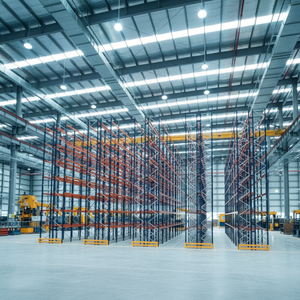
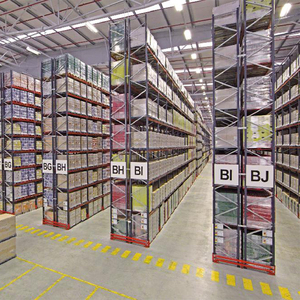
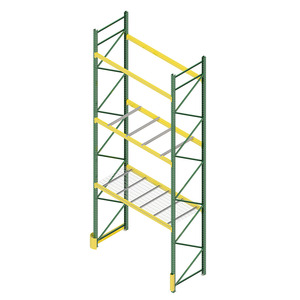
Single deep selective pallet racking represents the foundational architecture of contemporary supply chain facilities worldwide. Characterized by its unrestricted 100% immediate access to every pallet position (1.0 selectivity ratio), this system remains the undisputed benchmark for fast-moving consumer goods (FMCG), third-party logistics (3PL) distribution centers, and automotive assembly parts distribution. Unlike high-density systems such as drive-in or push-back racking that rely on First-In-Last-Out (FILO) logic, single deep configurations facilitate true First-In-First-Out (FIFO) handling with zero requirement for specialized material handling attachments.
Structural Mechanics & Deflection Criteria
Under international engineering standards (including RMI MH16.1 in North America and FEM 10.2.02 / EN 15512 in the European Union), structural integrity is governed by strict beam span deflection limits. Standard industrial beams are calculated with an allowable deflection threshold of L/200 under static working loads, while semi-automated crane interfaces require tighter tolerances of L/300 to L/400 to prevent sensor misalignment during high-speed pallet extraction.
Cold-Formed vs. Structural Hot-Rolled Sections
Global procurement directors balance cold-formed roll-formed steel (such as certified Q235B or ASTM A1011 Grade 50) against heavy hot-rolled structural steel channels. Cold-formed profiles offer an optimal strength-to-weight ratio, dramatically reducing freight expenditures and allowing 50mm / 75mm incremental vertical adjustability. Structural steel channels excel in extreme impact zones, heavy manufacturing yards, and push-back configurations where forklift bumper collisions are frequent.
Top 10 Single Deep Selective Pallet Rack Manufacturers & Factories
Based on annual manufacturing tonnage, robotic production automation, compliance certification (CE, ISO, RMI, FEM), and direct global delivery capabilities.
1. HEDA Shelves (Guangzhou Heda Shelves Co., Ltd.)
2. SSI SCHAEFER
3. Interlake Mecalux
4. Dexion (Gonvarri Material Handling)
5. Stow Group
6. Jungheinrich AG
7. AR Racking
8. Frazier Industrial Company
9. Daifuku Co., Ltd.
10. BITO-Lagertechnik Bittmann GmbH
HEDA Shelves Enterprise Advantage: Factory-Direct Powerhouse
Over 25 years of specialized storage manufacturing, operating from our integrated 30,000 m² Guangzhou production base.
Verified Global Credentials
Every structural profile is authenticated by accredited inspection bodies: CE Certificate No. 2435-CPR-8605159, ISO 9001:2015 Quality Management No. 18624Q00169R0M (valid through 2027), and strict RoHS heavy-metal compliance for eco-friendly coating powders.
Tropicalized Corrosion Defense
Unlike regional suppliers who skip crucial surface preparation, HEDA operates continuous immersion pickling and phosphating lines prior to automated electrostatic powder coating. This guarantees 10+ years of salt-mist and humidity resistance in ASEAN coastal and cold-chain conditions.
Complimentary Layout & Calculations
Clients receive free custom 2D AutoCAD architectural floor layouts, 3D structural visual renders, and finite element load calculations. Our dedicated engineering team customizes upright profiles and baseplates directly matching local seismic and geotechnical site reports.
Direct Maritime Transit Velocity: Guangzhou Port to Southeast Asian Hubs
Strategically situated adjacent to Nansha and Huangpu ports in Guangzhou, HEDA delivers factory-direct container shipments across ASEAN maritime corridors with unrivaled lead times:
Direct container loops offering the fastest import speed for agri-processing and electronics DCs.
Rapid replenishment for Luzon & Cebu warehousing hubs requiring heavy seismic tie-backs.
Supporting automotive part manufacturers along the Eastern Economic Corridor (EEC).
High-density single deep & VNA configurations for regional 3PL consolidation centers.
Extensive fulfillment installations for Selangor e-commerce and retail distributions.
Seismic-engineered structural baseplates supporting industrial estates in West Java.
10-Stage Controlled Manufacturing Process: Steel Coil to Container
Quality assurance is not a post-production inspection checklist; it is engineered into every step of the continuous production loop inside our automated Guangzhou factory:
| Stage | Manufacturing Phase | Technical Parameters & Precision Controls | Quality Metric |
|---|---|---|---|
| 01 | Raw Material Inspection | Certified prime Q235B / Q355B cold-rolled steel coils verified for chemical composition and tensile strength. | Zero defect tolerance; Mill Test Certificates verified. |
| 02 | CNC Precision Slitting | High-speed longitudinal rotary slitting lines trimming mill coils to sub-millimeter tolerances. | Width tolerance ±0.15 mm; clean burr-free edges. |
| 03 | Automated Column Punching | Multi-station high-tonnage hydraulic CNC punching presses punching diamond or teardrop patterns. | Pitch pitch deviation <0.1 mm over continuous 12m uprights. |
| 04 | Continuous Cold Bending | Progressive 18–24 stage roll-forming machines shaping open-profile omega upright columns. | Uniform cross-sectional wall thickness without stress micro-fissures. |
| 05 | Interlocking Beam Forming | Twin C-channel roll-forming and robotic hem-locking producing rigid box beam structural envelopes. | Torsional deflection resistance increased by 38% vs open beams. |
| 06 | Robotic Connector Welding | Multi-axis Panasonic / OTC industrial welding robots joining 3-, 4-, or 5-claw beam connectors. | Full penetration structural fillet welds; 100% spatter free. |
| 07 | 7-Stage Chemical Pre-Treatment | Sequential hot-degreasing, dual acid pickling, multi-rinse deoxidation, and zinc phosphating wash. | Eliminates rust, scale, and oil; creates micro-crystalline bonding. |
| 08 | Electrostatic Powder Application | Gema automated electrostatic spray booths applying thermosetting polyester powders (60–80 microns). | Consistent film thickness; high scratch and chemical resilience. |
| 09 | High-Temperature Curing Tunnel | Convection infrared curing ovens baking coatings at 180°C to 200°C for 20 continuous minutes. | Class 5B cross-hatch adhesion tested; zero chipping on impact. |
| 10 | Container-Optimized Bundling | Color-coded modular packing utilizing steel strapping, corner guards, and custom dunnage timber. | Maximized cube utilization (up to 26t per 40HQ container). |
Future Sourcing & Procurement Trends (2025–2030)
How warehouse automation, seismic building codes, and environmental durability standards are shifting global selective racking specifications.
1. Sourcing Paradigm: Total Cost of Ownership (TCO)
Global supply chain managers are shifting from initial procurement cost (Capex) toward lifecycle resilience (Opex). Low-cost suppliers utilizing recycled secondary steel or omitting pickling pre-treatments result in premature corrosion, beam sagging, and racking replacement within 4 years. Specifying prime Q235B steel with electrostatic powder coating extends working lifespan beyond 20 years, yielding a dramatically lower amortized annual storage cost.
2. AGV / AMR and Forklift Synergies
The rapid adoption of Autonomous Mobile Robots (AMRs) and Automated Guided Vehicles (AGVs) requires strict dimensional tolerances in selective racking. Traditional manual aisles allow for slight beam misalignments; automated guided forks demand tight vertical level tolerances within ±2 mm. Single deep selective frameworks must incorporate laser-guided floor levelers and reinforced ground guide rails to prevent vehicle collision.
3. Stringent Seismic Zone Compliance
Facilities across the Pacific "Ring of Fire" (including the Philippines, Indonesia, and Japan) face updated local structural codes requiring explicit dynamic response spectrum calculations. Sourcing teams can no longer accept generic load tables; upright columns must feature wider footplates (150×150mm or 200×200mm), chemical M12/M16 anchor bolts with high shear resistance, and calibrated horizontal diagonal bracing frames.
4. Smart IoT Deflection & Overload Monitoring
Next-generation distribution centers are piloting intelligent load beams integrated with embedded strain gauges and RFID sensor arrays. These smart selective systems transmit real-time telemetry alerting facility directors to dangerous beam deflection overloads, unexpected seismic settling, or direct forklift mast collisions before catastrophic rack progressive collapse can occur.
Selective Pallet Rack Layout & Forklift Clearances
Balancing aisle width, lift heights, and pallet dimensions to optimize cubic warehouse storage.
Aisle width dimensions dictate operational forklift velocity and volumetric efficiency. When calculating single deep layout designs, project directors must coordinate exact material handling vehicle specifications against the clear rack aisle width ($W_a$):
| Forklift Equipment Class | Operating Clear Aisle Width ($W_a$) | Max Operating Lift Height | Volumetric Space Utilization | Operational Dynamics |
|---|---|---|---|---|
| Standard Counterbalance (3-Wheel Electric) | 3,100 mm – 3,400 mm | Up to 6.5 meters | 35% – 40% Floor Utilization | Fastest turning speed; dual-purpose indoor/outdoor pallet offloading. |
| Standard Counterbalance (4-Wheel Heavy) | 3,500 mm – 3,800 mm | Up to 7.0 meters | 30% – 35% Floor Utilization | Handles heavy payloads (2,000kg+); requires wide operating radius. |
| Reach Truck (Pantograph / Moving Mast) | 2,600 mm – 2,900 mm | Up to 11.5 meters | 45% – 50% Floor Utilization | Ideal balance of density and speed; standard for regional retail hubs. |
| Articulated Forklift (Bendi / Flexi) | 1,800 mm – 2,000 mm | Up to 12.5 meters | 55% – 60% Floor Utilization | Pivoting mast eliminates wide turning radii; converts dead aisle space. |
| VNA Man-Up / Turret Truck | 1,500 mm – 1,700 mm | Up to 16.5 meters | 60% – 68% Floor Utilization | Guided by wire or floor angle rails; maximum vertical cubic utilization. |
Procurement & Technical Engineering FAQ
Authoritative answers to technical queries encountered by warehouse operators, consultants, and procurement managers.
What are the key technical differences between Single Deep and Double Deep selective racking?
How does HEDA Shelves ensure corrosion protection in tropical and coastal ASEAN regions?
What international certification documents should buyers require when purchasing racking from China?
Can selective pallet racking withstand seismic forces in the Philippines and Indonesia?
What information is needed to obtain a free custom warehouse CAD layout and quotation?
What is the standard allowable beam deflection under full working capacity?
How do container optimization strategies reduce ocean freight costs per pallet position?
What accessories are vital for single deep selective racking warehouse safety?
What is the typical factory production lead time for a standard 5,000-pallet position project?
Does HEDA Shelves provide installation supervision on-site?
Ready to Maximize Your Warehouse Cubic Storage?
Send our senior logistics engineering team your warehouse floor dimensions, clear roof heights, and pallet load profiles. We will supply a complete AutoCAD layout, 3D render, and factory-direct price schedule within 24 business hours.
Get a Quote