Engineered OEM/ODM Storage Rack & Industrial Shelving Systems
Precision-profiled cold-rolled steel configurations tailored for high-cube warehousing, distribution centers, cold chain facilities, and heavy-duty industrial logistics.
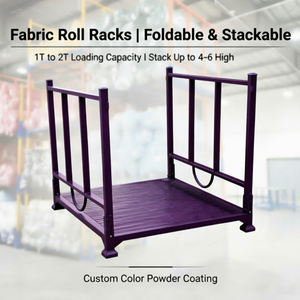
Mobile Fabric Roll Storage Rack Foldable Stackable Steel Rack
- Payload: 800 - 1,500 kg / unit
- Nestable 4-way stackable structure
- Electrostatic thermoset coating
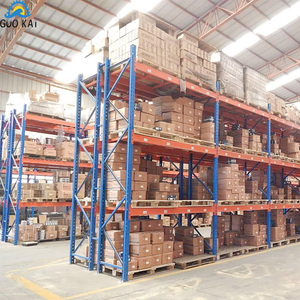
Heavy Duty Steel VNA Pallet Racking Boltless Narrow Aisle Rack
- Aisle width: 1.5 - 1.8m clearance
- Max bay load: Up to 18,000 kg
- Floor guide rails & inductive wire
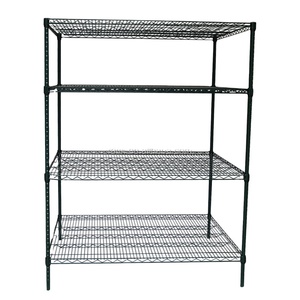
NSF Adjustable Cold Room Metal Wire Shelf Rack System
- NSF sanitation certified design
- Antimicrobial epoxy / chrome finish
- Thermal range: -38°C to +65°C
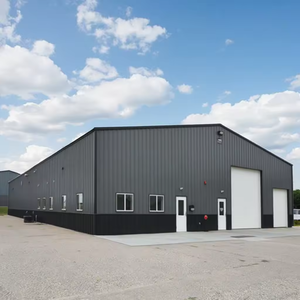
1000sqm Quick-Build Prefabricated Steel Structure Shed
- Q355B H-section portal framing
- Wind resistance: Up to Class 12
- Modular bolt-together erection
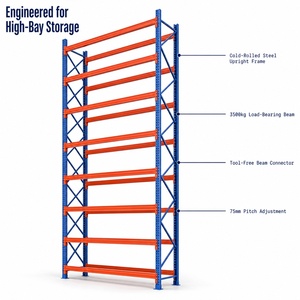
High Bay Pallet Rack System 3500kg Load 7 Levels H7800mm
- Capacity: 3,500 kg per beam pair
- 75mm adjustable pitch pattern
- Conforms to EN 15512 standards
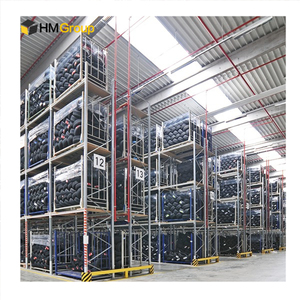
Heavy Duty Transport Folding Steel Tire Stacking Rack
- Stacking capacity: 4 to 6 tiers high
- Collapsible sides for return freight
- Heavy Q235B tubular base frame
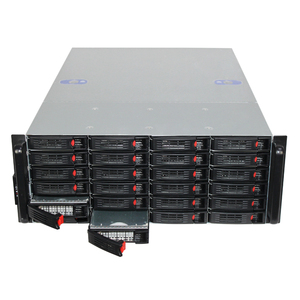
Hot Swap 4U 24-Bay High Storage Rackmount Server Chassis
- Form factor: 19-inch 4U rackmount
- 24x 3.5"/2.5" hot-swap HDD bays
- Redundant power & thermal cooling
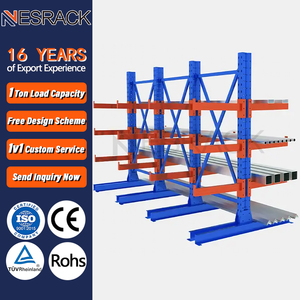
Adjustable Cantilever Racks CE Certified 500-3000kg/Arm
- Arm rating: 500 to 3,000 kg/level
- Single or double-sided upright mast
- Engineered for timber, pipe, bar stock
Why Global Supply Chain Leaders Partner with HEDA Shelves
Vertical integrated roll-forming, computerized structural engineering, and end-to-end quality assurance certified under strict international B2B logistics benchmarks.
Verified Global Certifications
Production complies with verified CE Certification No. 2435-CPR-8605159, ISO 9001:2015 No. 18624Q00169R0M, and full RoHS compliance. All calculated safety factors adhere strictly to FEM 10.2.02 and RMI MH16.1 specifications.
Complimentary 3D & CAD Engineering
Our dedicated engineering department provides turnkey structural calculations, high-density CAD floor layout blueprints, and 3D rendering simulations free of charge, accounting for forklift radii, beam deflection limits, and building column spacing.
Heavy-Duty Tropical Pre-Treatment
Utilizing a comprehensive 10-stage automated pre-treatment system—including hot alkaline degreasing, acid pickling, zinc phosphating, and deionized water rinsing—prior to 80μm electrostatic powder coating, guaranteeing zero blistering or delamination in humid coastal environments.
Direct Fast-Track Port Logistics
Positioned in Guangzhou adjacent to Nansha and Huangpu container ports, shipments reach Southeast Asian gateways (Manila, Haiphong, Singapore, Port Klang, Bangkok) within 2 to 8 days, optimizing container cube utilization by up to 98% with customized bundling skids.
Seismic Stress Site Calculations
Full engineering customizability for Pacific Rim earthquake zones (Philippines, Indonesia, Japan, Chile). Base plates, anchor bolts (grade 8.8 structural), and X-bracing geometries are dynamically calculated using FEA stress analysis software to counter ground shear forces.
Full-Cycle OEM/ODM Customization
We tailor structural beam profiles (box beams, step beams, tube beams), custom upright punch pitches (50mm, 75mm, 76.2mm teardrop), specialized column protection barriers, pallet support bars, wire mesh decks, and corporate electrostatic color-matching (RAL codes).
Technical Benchmark: Structural Storage Racking Topologies
Comparative structural matrix detailing load tolerances, mechanical interlocks, steel grade selections, and operational density metrics for enterprise procurement evaluation.
| Storage Racking System | Primary Steel Grade | Standard Bay Load (kg) | Aisle Clearance Requirement | Floor Space Utilization | Stock Rotation (FIFO/LIFO) | Applicable Certification |
|---|---|---|---|---|---|---|
| Selective Pallet Racking | Q235B Cold-Rolled | 1,000 – 4,500 kg / level | 3.0m – 3.8m (Counterbalance) | 40% - 50% | 100% Direct Access (FIFO) | EN 15512, CE, ISO 9001 |
| Very Narrow Aisle (VNA) | Q355B High-Tensile | 1,500 – 4,000 kg / level | 1.5m – 1.8m (Turret Truck) | Up to 70% | 100% Direct Access (FIFO) | FEM 10.2.02, CE, RMI |
| Drive-In / Drive-Through Rack | Q235B / Q355B Mix | 1,000 – 2,000 kg / pallet | Single Entry Point | Up to 80% | LIFO (Drive-In) / FIFO (Drive-Thru) | AS 4084-2012, CE |
| Radio Shuttle Automation | Q355B Heavy Profile | 500 – 2,000 kg / pallet | Front Charging Lane Only | 85% - 90% | Software Configured FIFO/LIFO | CE 2435-CPR, ISO 9001 |
| Heavy-Duty Cantilever Rack | Hot-rolled H-Beam / Q355B | 500 – 3,000 kg / arm | Sized to Crane / Forklift Reach | Linear Open Profile | Direct Cantilever Access | EN 15635, CE Approved |
| Multi-Tier Mezzanine Platform | Q355B Structural I-Beam | 300 – 1,200 kg / m² deck | Catwalks: 1.0m – 1.2m | Multiplies Floor x2 - x4 | High-Throughput Picking | AISC 360, CE, ISO 9001 |
Future B2B Procurement Trends Shaping Bulk Storage Infrastructure
Macro analysis of geopolitical shifts, nearshoring logistics, metallurgical price hedging, and lifecycle total cost of ownership (TCO) in industrial racking procurement.
1. Shift Toward Total Cost of Ownership (TCO) vs. Pure Initial CapEx
Historical procurement processes frequently awarded tenders to the lowest nominal bidder based on raw steel tonnage price. However, enterprise warehouse operators and 3PL conglomerates are migrating toward structural Total Cost of Ownership (TCO). This accounts for structural fatigue limits, cold-drawn yield strengths, deflection thresholds (under $L/200$ or $L/300$ criteria), and long-term corrosion resistance.
Cheaper upright profiles fabricated from unpickled, poorly phosphated secondary steel typically suffer micro-fracturing along cold-formed bends and exhibit premature coating delamination within 24 to 36 months in tropical environments. High-volume procurement directors now mandate mill test certificates (MTC) verifying certified Q235B and Q355B steel chemistries, robotic continuous seam welding, and verified 500-hour ASTM B117 salt spray testing resistance, driving down lifecycle maintenance and replacement costs.
2. Container Utilization Engineering & Ocean Freight Optimization
With volatility in transpacific and Asia-Europe container freight rates, procurement officers are working directly with OEM/ODM factories capable of nesting and flat-packing upright frames and box beams to maximize container fill rates. Traditional assembled upright shipping wastes up to 60% of container cubic volume.
Modern B2B racking procurement demands disassembled, knocked-down (KD) upright configurations packed on customized steel skids with quick-assembly high-tensile Grade 8.8 zinc-plated hardware. By engineering upright depths, beam connector claw nesting, and bundling tolerances specifically for 40HQ marine containers, HEDA Shelves routinely achieves up to 95–98% container cubing efficiency, effectively slashing per-pallet-position freight landed cost by up to 32% compared to conventional shipping profiles.
3. Fast-Track Modular Mezzanines Over Warehouse Greenfield Expansion
Escalating industrial land costs across primary distribution nodes (such as Greater Jakarta, Metro Manila, Bangkok industrial corridors, and Johor Bahru) have made greenfield logistics developments economically prohibitive for many distribution companies. Consequently, procurement strategies are emphasizing vertical cubic expansion inside existing facilities.
Procurement teams are prioritizing heavy-duty structural steel mezzanine platforms and rack-supported multi-tier catwalk systems capable of delivering an instantaneous 200% to 300% expansion of usable footprint without triggering building permit re-zoning. These platforms feature boltless modular framing, pre-cut galvanized bar grating, integrated pallet drop safety gates, and high-load stair towers that can be demounted, reconfigured, or relocated when lease agreements expire.
4. Sustainable Circular Lifecycle & Decarbonized Steel Sourcing
Global ESG mandates and European supply chain due diligence regulations (CSDDD) are trickling down to industrial warehousing equipment. Tier-1 enterprise buyers now frequently request verified environmental product disclosures, detailing the recycled content of raw coil steel, closed-loop zero-discharge phosphating recovery systems, and solvent-free TGIC polyester powder finishes.
Procurement contracts are actively favoring manufacturers with modern energy-efficient automated powder curing ovens that minimize carbon intensity per metric ton produced. Furthermore, standardized beam connector geometry (such as universal teardrop or 75mm European pitch) ensures that purchased racking systems retain high residual and asset liquidation values in secondary equipment markets.
Next-Gen Technological Trends in Industrial Warehousing Racks
The convergence of material science, seismic modeling, robotic automation interfacing, and smart structural health monitoring in heavy storage engineering.
Structural FEA & Digital Twins
Modern bulk racking design is engineered utilizing 3D Finite Element Analysis (FEA) software. Structural engineers simulate dynamic operational loads, seismic harmonic vibrations, forklift mast impacts, and second-order $P-\Delta$ deflection effects before punching a single steel coil, guaranteeing structural integrity under full capacity.
ASRS & Autonomous Shuttle Interfacing
The emergence of automated 2D and 4D radio shuttles requires ultra-tight manufacturing tolerances. Running rails, end stops, and shuttle cross-beams must maintain straightness tolerances within $\pm 1.0\text{ mm}$ over 10-meter continuous runs to prevent shuttle derailment, necessitating continuous precision CNC laser cut notches and robotic alignment.
Sub-Zero Cold Chain Formulation
Rapid growth in fresh food e-commerce and pharmaceutical vaccine storage has catalyzed innovations in sub-zero steel metallurgy. Special impact-tested steels that resist ductile-to-brittle transitions at temperatures down to $-35^\circ\text{C}$ are combined with hot-dip galvanized or specialized zinc-rich primers to eliminate micro-fracturing under intense thermal cycling.
Frequently Asked Questions: Bulk Racking Procurement & Engineering
Direct technical answers addressing the critical legal, structural, logistical, and material questions encountered by project managers and international procurement teams.
Optimize Your Logistics Footprint with Factory-Direct Engineering
Whether you are expanding a 3PL distribution hub, upgrading a multi-temperature cold chain facility, or seeking high-volume OEM/ODM manufacturing partnerships, our structural engineers provide free CAD floor layouts, structural load calculations, and competitive factory-direct pricing.