Direct Factory Supply
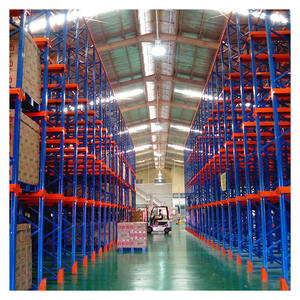
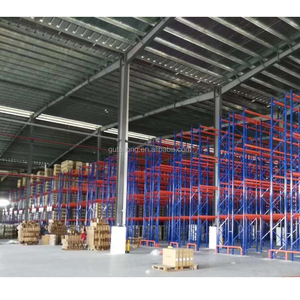
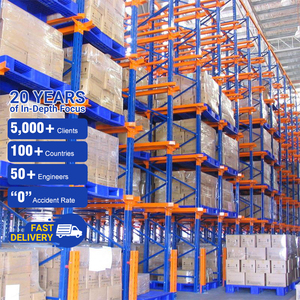
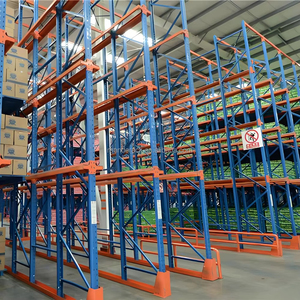
Featured Drive-In & Drive-Through Storage Systems
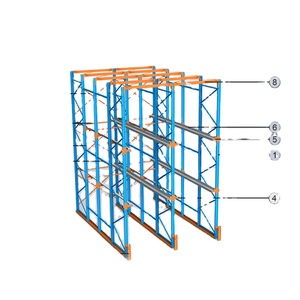
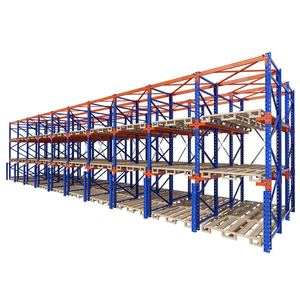
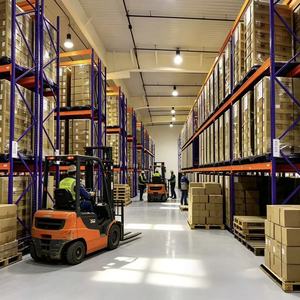
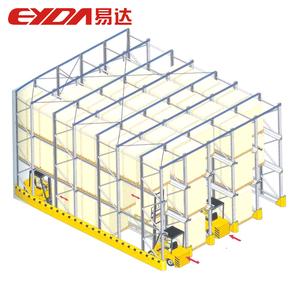
Explore our precision-rolled, high-bay pallet racking systems tailored for ambient distribution hubs, sub-zero cold chains, and FMCG manufacturing facilities requiring maximum volumetric efficiency.
Manufacturing Precision
Why Tier-1 Warehouses Partner With Our OEM Factory
Unlike trading intermediaries, our Guangzhou-based manufacturing facility handles the end-to-end metallurgical lifecycle. From cold-roll forming high-tensile steel to robotic welding and automated pickling phosphating, our structural integrity guarantees warehouse safety under maximum load factors.
Certified Structural Integrity
Fully compliant with EN 15512, RMI, CE (No. 2435-CPR-8605159), and ISO 9001:2015. All upright frames undergo rigorous Finite Element Analysis (FEA) to withstand static, dynamic, and seismic ground accelerations.
Free 3D & CAD Custom Layouts
Eliminate spatial inefficiencies before fabrication. Our senior structural engineers evaluate clear warehouse height, forklift mast collapsed heights, and egress turning radii to generate full 3D visualisations and CAD floor plans free of charge.
Tropical-Grade Pre-Treatment
Every component undergoes a 10-step chemical pickling and phosphating pre-treatment prior to electrostatic thermo-set powder coating. This prevents micro-fissure corrosion even in 80%+ humidity and sub-zero cold room environments.
Engineering Whitepaper
Drive-In vs. Drive-Through: Structural Kinematics & Spatial Analysis
Maximising cubic volume without compromising forklift cycle times demands a deep understanding of lane depths, rail geometries, and load-bearing cantilever brackets.
FIFO vs. LIFO Mechanical Configurations
While standard Drive-In Racking operates on a Last-In, First-Out (LIFO) inventory protocol where forklifts enter and exit through the same single aisle, Drive-Through Systems feature separate loading and retrieval aisles. This creates a true First-In, First-Out (FIFO) logistics corridor.
Drive-Through is vital for perishable fast-moving consumer goods (FMCG), pharmaceuticals, and chemical manufacturing where batch expiration dates and strict production lot sequencing prevent bulk dead-stock accumulation.
By removing traditional operating cross-aisles, both systems boost storage floor utilization from 35% (standard selective racking) up to an astonishing 75% - 85% of total cubic space.
Load Dispersion & Cantilever Rail Engineering
Because continuous horizontal support beams cannot run across operating forklift bays, drive-through systems rely on precision-formed cold-rolled pallet rails mounted to heavy-duty cantilever support arms. The eccentric horizontal forces exerted when fully loaded pallets (up to 1,500 kg each) rest on cantilevered arms require heavy top-tie bracing beams and top horizontal diagonal ties.
Our OEM manufacturing integrates continuous cold-stamped pallet runner rails equipped with tapered lead-in guide flanges. This design automatically centers pallet runners, protects upright profiles from side-impact buckling, and reduces driver maneuvering friction.
Engineering Parameter Matrix: Custom OEM Specifications
| Engineering Attribute | Standard Industrial Spec | Heavy-Duty Industrial Spec | Cold-Chain Sub-Zero Spec (-30°C) |
|---|---|---|---|
| Steel Substrate Grade | Q235B Cold-Rolled Carbon Steel | High-Tensile Q355B / SS400 | Low-Temp Impact Toughness Q355D / HDG |
| Upright Column Profile | 80×60mm, 90×70mm (1.8 - 2.0mm) | 100×70mm, 120×95mm (2.5 - 3.0mm) | 120×95mm Reinforced Section (3.0mm) |
| Pallet Load Capacity | 500 – 1,000 kg / pallet position | 1,000 – 1,600 kg / pallet position | 1,200 – 1,800 kg / pallet position |
| Pallet Guide Rail Type | Formed Galvanized / Painted 'C' Rail | Thick Flange Structural 'Z' Rail | Heavy-Duty Self-Centering Dual-Lip HDG |
| Surface Protection | 60–80μm Electrostatic Powder | 80–120μm Epoxy-Polyester Hybrid | Hot-Dip Galvanized ISO 1461 (65μm+) |
| Floor Guide Rail Systems | Optional Floor Angle Iron (L75×50) | Embedded Structural Channel / Box | Continuous Heavy-Wall Guide Tubes |
Industry Outlook
Future Procurement Trends in High-Density Warehouse Racking
As global supply chains face rising industrial real estate costs and accelerated automation, high-density storage procurement is moving toward four distinct structural evolutions.
Trend 01
Hybrid Radio-Shuttle Retrofitting
Modern distribution hubs are configuring drive-in channels with multi-purpose guide rails that can accommodate standard forklifts today, while allowing seamless plug-and-play integration with autonomous 4-way radio shuttles in the future without rebuilding the rack frames.
Trend 02
Cold-Chain Energy Density Optimization
With industrial refrigeration energy costs spiking, operators are phasing out low-density selective bays in favor of 8-to-12 deep drive-through lanes. This slashes empty refrigeration cubic meters by 60% and optimizes thermal mass retention across frozen storage facilities.
Trend 03
Seismic & Dynamic Impact Fortification
Global building codes (such as Eurocode 8 and IBC 2024) demand enhanced kinetic resilience. Modern drive-through procurement specifies reinforced column baseplates, wrapped column deflectors, and elastomeric impact buffers that absorb reach-truck nudges without structural degradation.
Trend 04
Total OEM Customization over Off-the-Shelf
Commodity sizes cause costly clearance losses. Procurement executives now partner directly with custom OEM factories capable of micro-adjusting beam-connector pitch (e.g., 50mm or 75mm increments), tailor-making rail depths to match non-standard EUR, GMA, and Australian pallets.
Procurement Guidance
Frequently Asked Questions by Industrial Warehouse Buyers
Key technical, logistical, and commercial considerations when importing custom drive-through pallet racking systems directly from our factory.
What is the structural difference between Drive-In and Drive-Through racking?
Drive-In racking has a single entrance/exit aisle per storage bay and operates on a Last-In, First-Out (LIFO) inventory sequence. The rear of the bay is blocked by diagonal structural X-bracing. Drive-Through racking is open at both ends, creating dedicated loading and unloading corridors for First-In, First-Out (FIFO) stock rotation. Drive-Through requires heavier overhead tie-beams to compensate for the absence of rear vertical bracing.
What forklift clearance and mast height dimensions are mandatory?
Because forklifts physically drive inside the racking matrix, clear internal lane width must exceed the widest point of the truck (chassis or carriage) by at least 75mm - 100mm per side. Furthermore, the maximum overhead guard height must maintain a minimum 150mm vertical clearance beneath the lowest pallet cantilever arm. Counterbalance, reach, and articulated narrow-aisle trucks require precise layout validation.
How do you guarantee corrosion resistance for cold storage applications?
For blast freezers and sub-zero cold rooms (-20°C to -30°C), thermal cycling creates persistent condensation. We provide two protective pathways: (1) Heavy industrial hot-dip galvanization according to ASTM A123/ISO 1461, achieving a bonded zinc coating over 65μm thick; or (2) Multi-stage chemical pickling and phosphating followed by specialized freeze-grade epoxy-polyester powder coats that resist brittle cracking under severe thermal contraction.
What is the standard production lead time and global shipping process?
Standard factory production lead time is 15 to 25 business days from technical drawing sign-off. As our factory is located close to Guangzhou and Shenzhen maritime container ports, transit times to Southeast Asian ports (Singapore, Manila, Bangkok, Port Klang, Jakarta) average 3 to 8 days, while European and North American routes average 22 to 35 days. Every shipment includes container nesting optimization, component bundling, and complete numbered CAD assembly schematics.
Request Your Free CAD Layout & Factory-Direct Quotation
Send us your warehouse dimensions, clear ceiling heights, and pallet load profiles. Our structural engineering department will prepare a complete 3D architectural render, capacity calculation, and itemized OEM quotation within 24 hours.
Get a Quote