High-Density Heavy-Duty Storage Systems for Global Logistics
Engineered for high-throughput distribution centers, cold chain facilities, manufacturing staging, and automated intralogistics. Manufactured from certified Q235B and Q355B structural steel profiles.
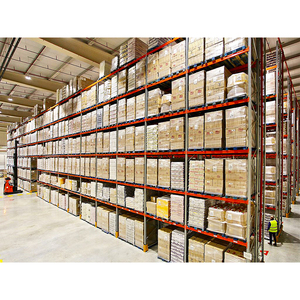
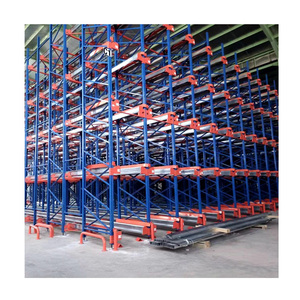
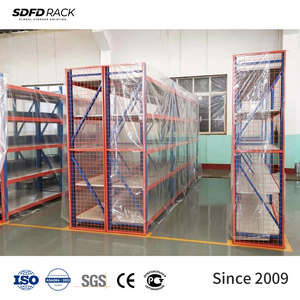
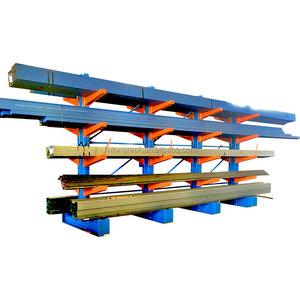
Guangzhou HEDA Shelves: Enterprise Scale & Global Compliance
Operating since 2001, Guangzhou Heda Shelves Co., Ltd. serves tier-one 3PLs, EPC contractors, and international procurement syndicates. Our 30,000 m² advanced manufacturing facility delivers rigorous structural fidelity under verifiable global safety accreditations.
Verified International Compliance
Every structural production batch holds documented CE Certification (No. 2435-CPR-8605159), ISO 9001:2015 Quality Management (No. 18624Q00169R0M), and RoHS environmental clearance. Engineered to strictly satisfy ANSI/RMI MH16.1, EN 15512, and AS 4084-2023 design metrics.
10-Step Controlled Fabrication
From prime Baosteel/Ansteel coil decoiling through automated column CNC stamping, continuous roll-forming, robotic welding, to our 9-stage chemical pickling and phosphating pre-treatment. Components receive automated thermosetting electrostatic powder coats or hot-dip galvanizing exceeding ASTM A123.
Direct Coastal Port Proximity
Strategically situated in Guangzhou adjacent to Nansha and Huangpu container ports. Direct sea voyages guarantee expedited shipping to ASEAN capitals within 2–10 days, Australian hubs in 12–16 days, Middle Eastern entry ports in 14–18 days, and European/American ports via scheduled container lanes.
Hot-Rolled Structural Channel Racking vs. Cold Roll-Formed Racking
A technical evaluation for procurement executives balancing capital expenditure against lifecycle structural integrity, forklift impact resilience, and high-bay seismic reliability.
In contemporary intralogistics procurement, specifying warehouse racking requires navigating the structural divergence between Hot-Rolled Structural Channel Racking (fabricated from heavy structural C-channels or I-beams conforming to ASTM A36 / Q235B / Q355B) and Cold Roll-Formed Racking (manufactured from light-gauge coiled strip steel pressed through progressive rolling dies). While cold-formed systems dominate general dry grocery and retail distribution due to lower upfront steel weight, structural racking represents the mandatory standard for heavy industrial yards, abusive high-velocity distribution centers, and sub-zero freezer plants.
| Evaluation Parameter | Structural Channel Racking (C-Channel / Hot-Rolled) | Cold Roll-Formed Steel Racking | Operational Significance & Life Cycle Impact |
|---|---|---|---|
| Steel Thickness & Profile | Heavy web thickness: 3.0mm – 8.0mm structural C-channels | Thin-gauge material: 1.5mm – 2.5mm folded sheet | Structural steel exhibits up to 300% greater sectional modulus against torsional buckling. |
| Forklift Mast Impact Tolerance | High Absorption Plastic deformation threshold is extremely high | Vulnerable Crinkle and dent failure leads to immediate capacity de-rating | Structural channel uprights reduce catastrophic collapse risks in busy forklift transit aisles. |
| Connection Architecture | Heavy Grade 5/Grade 8 high-tensile bolted beam-to-frame connections | Teardrop, keyhole, or slotted rivet/lug hook connectors | Bolted connections prevent beam dislodgement under violent upward fork impacts. |
| Sub-Zero / Cold Store Longevity | High resistance to brittle fracture when utilizing Charpy V-notch tested Q355D/E | Micro-cracking risks along acute cold-bent radii under cyclical thermal stress | Mandatory reliability in freezer facilities operating between -20°C and -35°C. |
| Corrosion Resistance Profiles | Thick walls accommodate heavy Hot-Dip Galvanizing (85µm+ ASTM A123) | Standard electrostatic powder coating or thin pre-galvanized strip (15–20µm) | Structural hot-dip galvanized racking delivers 25+ years rust-free life in coastal/outdoor zones. |
| Total Cost of Ownership (10-Yr TCO) | Lowest Long-Term TCO Near-zero maintenance and upright replacement | Low initial capex, but high recurring costs for upright repairs and safety lockouts | High-throughput 24/7 facilities amortize structural racking premium within 3.2 operational years. |
Future Procurement Trends in Industrial Structural Storage
Macroeconomic pressures, spatial real estate inflation, and supply chain decarbonization are fundamentally transforming how global EPCs and supply chain leaders specify structural steel systems.
1. Convergence with Pallet Shuttles & AMRs
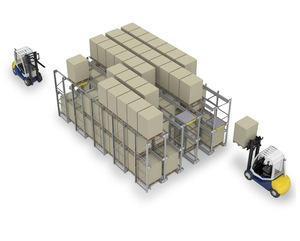
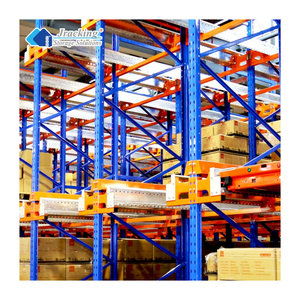
Procurement is pivoting away from static drive-in aisles toward dynamic two-way and four-way radio shuttle channels. Structural channel rails provide the rigid deflection stability required by automated shuttles travelling at 1.5 m/s, eliminating human forklift ingress into storage lanes and driving cube utilization up to 85%.
2. Cold Chain Infrastructure Expansion
Surging global demand for temperature-controlled food logistics and biopharma distribution has accelerated the deployment of high-density structural racking. High-bay structural configurations maximize the thermal efficiency of expensive refrigerated cubic volume, lowering electrical dissipation per pallet position.
3. Mandatory Seismic Site Engineering
Seismic events in the Pacific Rim, Americas, and Southern Europe have made non-linear dynamic structural calculation standard. Buyers reject generic load charts, demanding dynamic pushover analyses, thickened floor baseplates, seismic heavy-duty back bracing, and certified chemical anchor embedment depths.
4. Factory Disintermediation (Direct Sourcing)
Enterprise buyers are bypassing domestic value-added resellers to collaborate directly with qualified Chinese structural manufacturers. Factory-direct engineering unlocks end-to-end BIM/CAD coordination, custom steel profiling, and significant savings of 25–40% on large-scale logistics rollouts.
Structural Racking Innovations: Digital Design & Smart Coatings
State-of-the-art structural racking has evolved from passive mechanical steel skeletons into high-precision, instrumented logistical assets engineered via advanced computational methods.
Finite Element Analysis (FEA) Stress Modeling
We model complex stress concentrations across upright-beam junctions, baseplate anchor pull-outs, and seismic rack shear using 3D FEA simulation software. By validating second-order P-Delta effects before fabrication, structural cross-sections are mathematically optimized to eliminate steel overdesign while guaranteeing structural safety factors ≥ 1.65.
Nano-Zirconium Surface Pre-Treatment
Replacing traditional iron phosphate washes, modern structural production utilizes continuous nano-zirconium chemical baths. This microscopic passivating layer provides superior adhesion matrices for high-durability epoxy-polyester thermoset powders, withstanding 1,000+ hours of continuous ASTM B117 salt spray testing without sub-film creep or delamination.
Smart Sensor Collision Monitoring
Next-generation structural installations integrate wireless micro-electromechanical (MEMS) triaxial impact sensors into vulnerable perimeter columns. Upon severe forklift impact or structural overload, the sensor alerts facility management over LoRaWAN/industrial IoT protocols, triggering localized inspections before structural fatigue can propagate.
Frequently Asked Questions on Structural Racking Procurement
Direct technical responses addressing steel grades, seismic calculations, maritime packaging, compliance certifications, and onsite assembly protocols.
Q1 What steel grades are utilized for structural racking uprights and beams?
We primarily utilize prime Q235B (equivalent to ASTM A36) and high-yield Q355B/Q355D (equivalent to European S355JR / ASTM A572 Grade 50). All raw material is sourced from verified primary steel mills (Baosteel, Ansteel, Shougang) and delivered with comprehensive Mill Test Certificates (MTC) verifying chemical compositions, elongation parameters, and yield strengths.
Q2 How are seismic parameters calculated for international distribution centers?
Our engineering team performs non-linear dynamic and equivalent lateral force analyses according to IBC 2024, FEMA 460, ASCE 7-22, and Eurocode 8. Based on your site-specific ground acceleration parameters (Ss, S1) and soil classification, we configure reinforced baseplate footprints, oversized chemical/mechanical anchors, and reinforced horizontal/diagonal frame bracing.
Q3 What are the standard deflection allowances for heavy-duty structural beams?
In accordance with RMI MH16.1 and EN 15512 specifications, our standard load beam design adheres to a maximum vertical deflection limit of L/200 under fully distributed working loads (where L represents clear beam span). For automated shuttle applications and automated ASRS systems, tighter tolerances of L/300 or L/400 are calculated to ensure robotic alignment.
Q4 How does Guangzhou HEDA prevent corrosion during ocean shipping and tropical storage?
Structural components undergo automated 9-stage degreasing, pickling, and phosphating/zirconium pre-treatment followed by high-voltage electrostatic polyester powder curing (60–90µm). For open-air timber yards, marine docks, and wet cold rooms, we provide continuous hot-dip galvanizing per ASTM A123 / ISO 1461, yielding 85–100µm pure zinc protection capable of resisting 25+ years of corrosive exposure.
Q5 How is shipping volume optimized for 40ft High Cube (40HQ) containers?
Our structural members, frame trusses, and beams are mathematically nested using computer automated pallet packing software to achieve maximum weight (approx. 26.5 metric tons per 40HQ) without damaging powder finishes. Structural frames are typically shipped knock-down (bolted assembly on-site) or semi-welded with heavy steel dunnage, protective foam strapping, and moisture-absorbing desiccant sacks.
Q6 What design documentation and installation guidance are provided with export shipments?
Every commercial order includes full structural engineering calculations, 2D AutoCAD fabrication layout prints, 3D Navisworks/Revit BIM coordination models, step-by-step color-coded assembly manuals, and comprehensive video installation documentation. For major EPC distribution centers, our English-speaking project supervisors are deployable globally for on-site commissioning.
Start Your Warehouse Structural Engineering Consultation
Send our senior logistics engineering team your floor layout plans, pallet load profiles, and forklift handling criteria. We will return a comprehensive 3D layout rendering, detailed load engineering assessment, and factory-direct export proposal within 24 business hours.
Get a Quote