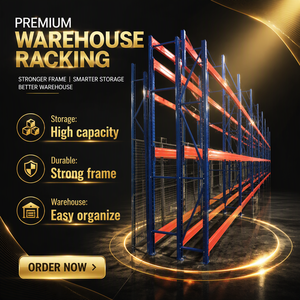
Industrial-Grade Inventory
High-Density Heavy Duty Storage Systems
Engineered with Q235B cold-rolled steel, precision roll-formed uprights, and electrostatic powder finishes complying with CE, ISO 9001:2015, and FEM/RMI international safety codes.
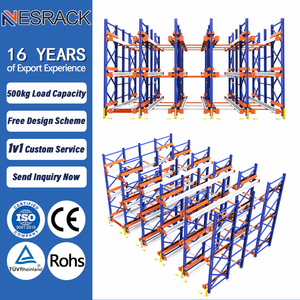
2001
Founded & Pioneering Racking
30,000 t
Monthly Output Capacity
10,000+
Completed Logistics Projects
120+
Global Export Destinations
Procurement Analysis
Future Procurement Trends for Tall Warehouse Shelving
A strategic breakdown for supply chain directors, industrial developers, and logistics engineering teams navigating structural efficiency, automation interface, and ESG mandates.
Vertical Volume Maximization (Clear Heights 12m–30m)
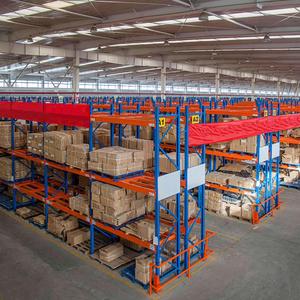
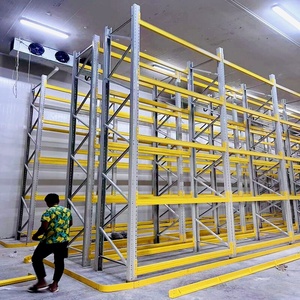
Industrial real estate yields are driving warehouses upward. Modern procurement focuses on high-bay structures exceeding 12 to 30 meters, requiring precision roll-formed upright columns with minimal cumulative twist to ensure seamless compatibility with turret trucks and stacker cranes.
Automation-Ready Interface Engineering
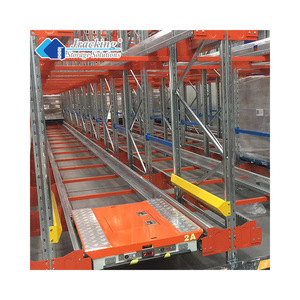
Procurement manifests are shifting away from static shelving toward hybrid infrastructure. Tall shelving systems must accommodate radio shuttles, AGV transfer points, and automated guided path markers, demanding tighter beam deflection tolerances of L/200 or L/300 under dynamic loading.
Climate-Resilient Anti-Corrosion Finishing
With massive supply chain expansions across ASEAN and coastal economic corridors, resistance to tropical humidity, thermal cycling, and salt fog is critical. Advanced pre-treatment involving pickling and phosphating followed by thermosetting powder coating is now standard procurement protocol.
Structural Engineering Evolution in High-Bay Warehouse Systems
Over the past twenty-five years, Guangzhou Heda Shelves Co., Ltd. has observed a fundamental transition in industrial warehouse design. What was once viewed simply as storage racks is now engineered as an integrated load-bearing structure. Tall warehouse shelving systems must withstand complex load dynamics, including seismic acceleration forces, horizontal braking loads from high-reach forklifts, wind exposure in clad rack buildings, and asymmetrical deadweight stress.
Our engineering division utilizes finite element analysis (FEA) to simulate stress concentrations across critical junction points—such as the three-prong or four-prong beam connector brackets. By optimizing the cold-bent profile geometry of upright columns from standard channels to complex 11-fold and 13-fold omega sections, we achieve superior inertia parameters, higher torsional stiffness, and maximized tonnage-to-steel weight ratios.
Seismic Performance Calculations
Custom structural calculations factoring in ground acceleration spectral data (Ss and S1), tailored for high-risk zones across Southeast Asia and the Pacific Rim.
Cold-Formed High-Tensile Steel
Certified Q235B and Q355B coils roll-formed on computerized 24-station production lines, guaranteeing tensile yield strengths up to 355 MPa without micro-fracturing.
Modular Boltless Adjustability
50mm and 75mm pitch column perforations punched with CNC accuracy, allowing operators to reconfigure beam levels as SKU dimensions evolve.
Impact Mitigation Systems
Integrated wrap-around column guards, heavy-duty floor-mounted aisle protectors, and anti-collapse rear safety backstops preventing operational disruptions.
Manufacturing Rigor
Why Enterprise Buyers Partner with HEDA Shelves
Delivering end-to-end reliability from engineering design and automated manufacturing to strict quality audits and rapid maritime delivery.
Complimentary 3D & CAD Engineering
Every warehouse project begins with detailed layout planning. Our in-house engineers deliver complete AutoCAD floorplans, 3D structural renderings, and load capacity simulations free of charge.
10-Step In-House Production
From raw uncoiling, precision slitting, and automated punching to robotic welding, ultrasonic washing, phosphating, and electrostatic powder coating—all processes are controlled under our roof.
Verifiable International Compliance
Fully certified with CE (Certificate No. 2435-CPR-8605159), ISO 9001:2015 Quality Management (No. 18624Q00169R0M), and RoHS environmental testing verification.
Strategic Export Hub Transit
Situated in Guangzhou with direct proximity to Nansha and Huangpu ports, allowing streamlined sea transit to ASEAN hubs in 2–10 days and container-optimized bundling.
Buyer Knowledge
Frequently Asked Questions on Tall Warehouse Shelving
Essential technical, financial, and logistical insights for procurement specialists sourcing heavy-duty racking directly from China.
Q: What technical parameters are required to calculate tall shelving structural engineering?
A: To provide accurate structural calculations and layout drawings, we require: (1) Architectural CAD floorplans indicating clear ceiling heights, building columns, and fire safety systems; (2) Pallet specifications including depth, width, total height, and maximum dynamic load per pallet; (3) Material handling equipment (MHE) data, specifically forklift mast reach height, turning radius, and minimum aisle width; and (4) Site-specific seismic and environmental parameters.
Q: How do you ensure vertical column alignment across rack heights exceeding 10 meters?
A: For tall warehouse shelving exceeding 10 to 30 meters, uprights are manufactured using precision roll-forming machines with integrated servo-punching systems to eliminate cumulative pitch errors. For multi-tier or high-bay installations requiring spliced uprights, we utilize heavy-duty inner splice sleeves secured with high-grade bolts, ensuring uniform load transfer without structural deflection.
Q: How is steel surface pre-treatment handled to prevent corrosion in humid or coastal environments?
A: Our factory employs an automated multi-stage pre-treatment line that includes degreasing, pickling, acid neutralization, and phosphate conversion coating. This chemical conversion creates an inert micro-crystalline layer on the raw steel, providing adhesion for electrostatic epoxy-polyester powder coating cured at 200°C. For extreme cold chain or coastal environments, hot-dip galvanized steel components are also available.
Q: Can structural racking components be adapted to local seismic building codes?
A: Yes. Our structural engineering team designs racking systems in compliance with seismic standards such as AS4084, FEM 10.2.02, and RMI MH16.1. Based on the seismic zone and soil foundation data of your project site, we reinforce the upright column profiles, enlarge heavy-duty baseplates, integrate horizontal and cross-bracing lattices, and utilize seismic chemical wedge anchors.
Q: What is the standard production lead time and export container packaging process?
A: Standard project manufacturing cycles range from 15 to 25 days depending on total project tonnage. All upright columns and pallet beams are color-coded, bundled using automated strapping machines, cushioned with protective corrugated corner guards, and wrapped in industrial stretch film. Uprights and beams are loaded with dedicated positioning pallets to prevent damage during container sea freight.
Ready to Maximize Your Vertical Warehouse Capacity?
Send our senior engineering team your warehouse layout drawings, pallet specifications, or operational throughput requirements for a free 2D/3D CAD design proposal and direct factory quote.
Inquire Now