Engineered Heavy-Duty Pallet Rack Frames & Modular Upright Assemblies
Manufactured from high-tensile Q235B and Q355B structural steel coils. Every upright profile undergoes cold roll-forming, continuous computer-controlled punching, and certified anti-corrosive finishing to guarantee structural equilibrium under dynamic warehouse load profiles.
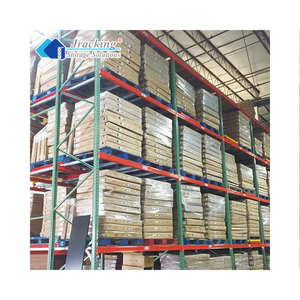
Jracking US Standard Heavy Duty Teardrop Pallet Racking System
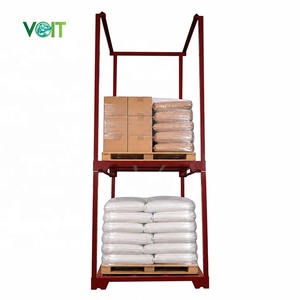
Color Customized Powder Coating Detachable Stackable Pallet Rack Frame
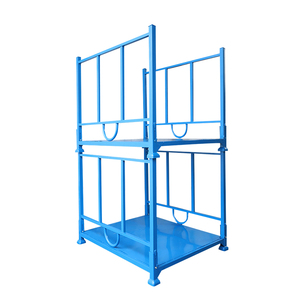
Foldable Heavy Duty Metal Pallet Stacking Frames & Modular Base
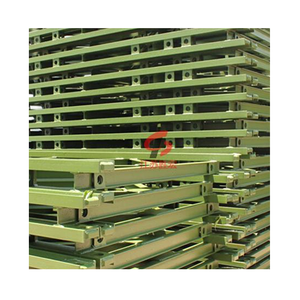
Steel Pallet Storage Rack Base Frame Structural Support
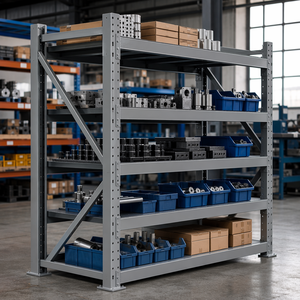
Custom OEM Storage Rack Frame | Heavy Duty Welded Fabrication
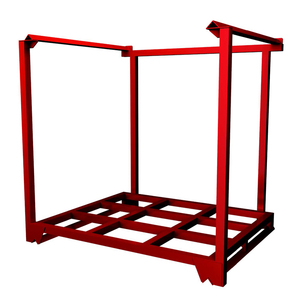
Heavy Duty Warehouse Industrial Portable Steel Pallet Stacking Frames
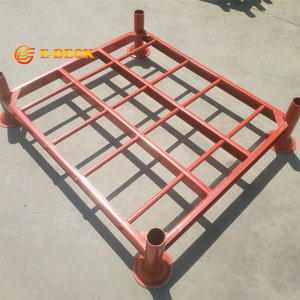
Logistic Heavy-Duty Stackable Steel Post Pallet Storage Frames
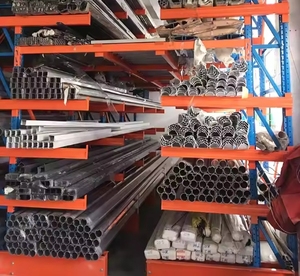
High-Bay VNA Adjustable Pallet Rack Frame Assembly with Guide Rail Support
Structural Mechanics of CE-Certified Pallet Rack Frames: EN 15512 & RMI MH16.1 Design Principles
In modern logistics infrastructure, the vertical pallet rack frame functions as a primary unbraced or semi-rigid structural column under simultaneous compression, torsional flexure, and dynamic cyclic loading. Sourcing certified frames requires looking far beyond external dimensions.
The pallet rack upright frame represents the ultimate load-bearing backbone of any industrial storage facility. Unlike conventional civil construction columns, rack frames are engineered from cold-formed, thin-walled perforated steel profiles. Because these vertical members incorporate continuous punched apertures along their front faces to allow rapid beam clip engagement at 50mm, 75mm, or 76.2mm (3-inch) pitch increments, their cross-sectional properties are inherently subject to complex buckling phenomena, including local buckling, distortional buckling, and combined global flexural-torsional buckling under EN 15512:2020 calculations.
As a premier CE-certified pallet rack frame manufacturer and factory, Guangzhou Heda Shelves Co., Ltd. subjects every roll-formed section to non-linear finite element analysis (FEA) and physical stub-column compression verification. Under European standard EN 15512 and the American RMI (Rack Manufacturers Institute) MH16.1 specifications, the maximum allowable vertical load capacity of an upright frame cannot be calculated merely through raw cross-sectional area multiplied by yield stress; rather, it requires rigorous determination of effective section properties ($A_{\text{eff}}$ and $I_{\text{eff}}$) taking into account perforations, cold-work hardening throughout the corner radii, and the semi-rigid rotational stiffness ($C_d$) contributed by diagonal and horizontal frame bracing nodes.
Omega & C-Profile Geometry
Our upright columns feature sophisticated multi-ribbed Omega (Ω) profiles with up to 12 cold-bent flanged returns. This complex geometry places steel mass furthest from the neutral axis, dramatically enhancing the radius of gyration ($r_x, r_y$) and resisting second-order $P-\Delta$ flexural buckling under maximum capacity.
Truss Bracing Optimization
Frames utilize continuous triangulated K-truss or X-truss bracing assemblies fabricated from C-shaped channel steel. The connection points are secured via M10/M12 high-tensile grade 8.8 bolts fitted with nylon lock-nuts, preventing structural loosening caused by vibrations from material handling vehicles.
Seismic Baseplates & Anchoring
Every frame relies on a precision-punched heavy-gauge footplate (4.0mm to 10.0mm thickness) designed to transfer axial thrust and overturning moments directly into the warehouse slab. Factory anchor calculations specify chemical capsule anchors or mechanical expansion bolts calibrated for local seismic acceleration parameters.
| Profile Model | Width × Depth (mm) | Material Thickness | Certified Steel Grade | Yield Strength ($f_y$) | Standard Pitch | Max Frame Capacity |
|---|---|---|---|---|---|---|
| HD-UP80 | 80 × 60 mm | 1.8 – 2.0 mm | Q235B / S235JR | ≥ 235 MPa | 50mm / 75mm | 6,500 – 9,800 kg |
| HD-UP90 | 90 × 70 mm | 1.8 – 2.3 mm | Q235B / Q355B | 235 – 355 MPa | 50mm / 76.2mm | 10,500 – 14,200 kg |
| HD-UP100 | 100 × 70 mm | 2.0 – 2.5 mm | Q355B / S355JR | ≥ 355 MPa | 50mm / 75mm | 15,000 – 19,500 kg |
| HD-UP120 | 120 × 95 mm | 2.5 – 3.0 mm | Q355B / High Tensile | ≥ 355 MPa | 75mm / 76.2mm | 21,000 – 28,000 kg |
| HD-UP140 (ASRS) | 140 × 100 mm | 3.0 – 3.5 mm | Q355B / Specialized | ≥ 355 MPa | 75mm / Continuous | 30,000 – 38,000 kg |
10-Step Controlled Factory Production Pipeline: From Raw Coil to Certified Racking Frame
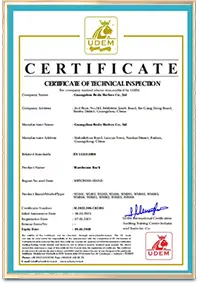
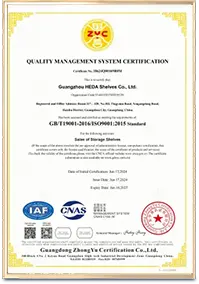
At our Guangzhou production hub, quality management is not an afterthought inspection; it is an integrated metallurgical and mechanical process governing every processing step under ISO 9001:2015 and CE certification No. 2435-CPR-8605159.

Raw Steel Assay
Mill test certificates (MTC) verified for chemical composition and tensile strength from Baosteel/Shougang.

Precision Slitting
High-speed longitudinal slitting lines cut wide master coils to strip tolerances within ±0.1mm.

CNC Punching
Continuous mechanical press dies punch teardrop, diamond, or hex apertures with zero edge-burr.

Cold Bending
Gradual multi-station profiling eliminates micro-fractures in structural corner radii.

Profile Forming
High-precision 24-station rolling mills form symmetric Omega profiles with tight dimensional control.

Deburring & Polish
Mechanical edge smoothing ensures human handling safety and uniform surface powder deposition.

Robotic Welding
Automatic MIG/MAG pulse welding for structural footplates and heavy-duty frame spacer assemblies.

Phosphating Bath
9-stage chemical pickling, degreasing, and zinc-phosphating wash ensures superior anti-corrosion bonding.

Powder Coating
Automated electrostatic spray booths apply 60–90μm thermoset polyester powder baked at 200°C.

QC & Packing
Final CMM laser dimension verification, destructive batch sampling, and sea-freight bundle strapping.
Guangzhou Heda Shelves: 25+ Years of Racking Manufacturing Authority
Founded in 2001, Guangzhou Heda Shelves Co., Ltd. has grown from a specialized engineering team into an international heavy-industry racking powerhouse. Operating our modernized 30,000 square meter intelligent manufacturing facility in Haizhu District, Guangzhou, our facility commands a sustained production output exceeding 30,000 metric tons per month.
By bypassing trading intermediaries, our global EPC contractors, warehouse logistics operators, and local distributors gain direct engineering access to our CAD and structural analysis teams. We provide complimentary full-scale warehouse layout design, finite element load verification, seismic calculations, and door-to-door CIF/FOB logistics support with transit times as fast as 2 to 7 days across major regional ports.
Send an Inquiry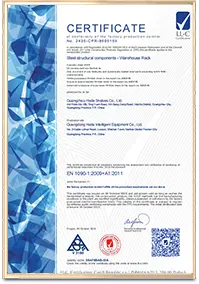
Future Procurement Trends in Warehouse Racking Frames (2025–2035)
As automated material handling systems (AMR, AGV, AS/RS) and regional environmental mandates evolve, technical requirements for structural steel rack frames are undergoing structural paradigm shifts.
AS/RS High-Tolerance Verticality
Automated crane storage demands frame straightness tolerances tighter than 1/1000 of column height. Procurement is shifting toward mill-certified laser-straightened uprights capable of supporting top-guide crane rail accelerations without resonance.
Nonlinear Ductility & Baseplates
Warehouses built in high-seismic regions (such as Indonesia, the Philippines, Japan, and the American Pacific Rim) require custom semi-rigid hysteretic energy-dissipating base connections and enhanced bracing slenderness ratios ($KL/r ≤ 120$).
Zinc-Aluminum-Magnesium Coatings
Industrial specifiers are moving toward Zinc-Aluminum-Magnesium (ZAM) hot-dip continuous coated steel. ZAM provides self-healing cut-edge rust protection in cold-chain and tropical facilities, with 40% lower lifecycle carbon footprint than batch dip galvanizing.
IoT Deflection & Impact Telemetry
Next-generation pallet rack frames integrate optical and strain-gauge telemetry embedded directly within lower column impact protectors. Sensor data flags micro-deflections from accidental forklift collision before micro-cracks propagate to system failure.
Frequently Asked Questions: Technical Sourcing of Certified Pallet Rack Frames
Critical engineering, certification, and metallurgical considerations when procuring heavy-duty warehouse racking frames directly from our factory.
Why is CE certification (EN 15512) essential for pallet rack frames?
Under European Construction Products Regulation (CPR 305/2011/EU), steel storage racking erected inside commercial premises is classified as structural steel work. CE Certification (such as HEDA's Certificate No. 2435-CPR-8605159) validates that our frame load calculations, cold-forming processes, steel mechanical properties, and weld integrity strictly conform to harmonized standard EN 15512:2020. Non-certified frames lack third-party verified limit-state calculations, exposing facility owners to serious occupational safety liability, insurance invalidation, and sudden structural buckling under maximum nominal loads.
How does the upright profile shape impact the frame's total load-bearing capacity?
A pallet rack column is an unbraced thin-walled compression member. An upright with an advanced multi-flanged Omega (Ω) cross-section incorporates 8 to 12 distinct longitudinal bends. Each additional cold-bent radius acts as a stiffener that increases the cross-section's moment of inertia and shifts the shear center closer to the centroid. This geometry elevates the critical elastic buckling load ($N_{cr}$), allowing a 2.0mm Omega frame to carry equal or higher vertical tonnage than a flat 2.5mm rectangular or open C-channel column while saving tare weight and freight costs.
What is the engineering difference between teardrop and metric punched frames?
Teardrop racking utilizes a 50.8mm (2-inch) hole pitch featuring inverted tapered keyhole slots popular throughout the United States and North American distribution centers. The beam connector's round pins seat firmly into the bottom of the taper via gravitational wedging. Metric profiles (such as 50mm or 75mm European pitch) employ rectangular, diamond, or hex apertures designed for specialized hook-type safety claw connectors. HEDA manufactures both tooling profiles in-house on dedicated CNC punching lines, providing complete interchangeability with existing warehouse racking assets.
How do you calculate the correct frame depth for standard pallets?
The fundamental rule for standard selective racking is that the pallet must overhang the front and rear load beams by 50mm to 75mm on each side. For standard Euro-pallets (1200mm depth × 800mm width) placed front-to-back, an 1100mm frame depth provides a safe 50mm overhang front and rear. For US standard GMA pallets (48" deep × 40" wide, or 1219mm × 1016mm), a 42-inch (1067mm) or 44-inch (1118mm) frame depth is required. Correct overhang ensures the pallet's bottom deckboards sit securely across the beam flanges rather than dropping between beams.
How are HEDA pallet rack frames protected against tropical humidity and cold storage corrosion?
Every frame component produced in our factory passes through a multi-stage chemical pre-treatment system before powder deposition: alkaline hot degreasing, clean water rinse, acid pickling to eliminate scale, secondary rinse, and industrial zinc-phosphating. This chemical conversion layer chemically binds our 60–90μm thermosetting epoxy-polyester powder coat, achieving over 500 hours of continuous neutral salt-spray resistance (ASTM B117). For sub-zero blast freezers (-30°C) or coastal ambient yards, we supply continuous hot-dip galvanized (HDG) steel components according to ISO 1461.
Can structural calculations accommodate local seismic zoning requirements?
Yes. Our structural engineering department utilizes advanced modeling software to evaluate seismic ground acceleration ($S_s, S_1$), soil classification, and importance factors in accordance with Eurocode 8, US IBC / ASCE 7, or regional building standards (such as NSCP in the Philippines and SNI in Indonesia). Based on your project site coordinates, we calibrate bracing configurations, increase upright steel gauge, engineer enlarged footplates, and specify high-performance Hilti anchor embedment depths to ensure seismic ductility.
What data is required to receive a comprehensive CAD layout and structural quotation?
To deliver an engineered proposal within 24 hours, our design team requires: (1) Warehouse architectural DWG/PDF drawings indicating clear internal ceiling height, column grids, and floor slab thickness; (2) Pallet specifications including width, depth, height, and maximum gross weight including cargo; (3) Handling equipment type (counterbalance forklift, reach truck, or VNA turret truck) along with its minimum aisle turning radius and maximum mast reach; (4) Required SKU throughput velocity (FIFO vs LIFO).
Optimize Your Warehouse Structural Safety & Pallet Capacity
Connect directly with Guangzhou Heda Shelves' senior structural engineers. Get a complimentary 3D warehouse layout, detailed load calculation report, and factory-direct pricing for your next expansion project.