Verified Industrial Infrastructure · White Paper & Catalog

Top Trusted Warehouse Shelving Racks Manufacturer & Supplier

Engineered Heavy-Duty Intralogistics Solutions, High-Density Systems, and Global Factory-Direct Turnkey Racking Infrastructure

2001.
Established Operational Track Record
30,000m²
Integrated Heavy Manufacturing Base
30,000t
Monthly Cold-Roll Steel Output
10,000+
Global Enterprise Storage Projects
Direct-from-Source Authority

Guangzhou HEDA Shelves: Decades of Rigorous Metallurgy & Structural Engineering

Founded in 2001, Guangzhou Heda Shelves Co., Ltd. has developed into an internationally certified powerhouse in commercial and heavy industrial warehouse storage systems. Operating from our state-of-the-art 30,000 m² automated production facility equipped with high-precision continuous cold roll-forming lines, robotic continuous welding fixtures, automated multi-stage pre-treatment, and architectural-grade electrostatic powder coating plants, we deliver robust solutions across the globe.

Our engineering division partners directly with regional logistics developers, cold chain operators, third-party logistics (3PL) conglomerates, and automated fulfillment hubs across Malaysia, Thailand, Vietnam, Indonesia, the Philippines, Singapore, North America, and Europe. By deploying customized finite element analysis (FEA) and static structural simulation, every rack system is designed to withstand seismic dynamic excitation, structural floor settlements, and stringent deflection ratios (L/200 standard limits).
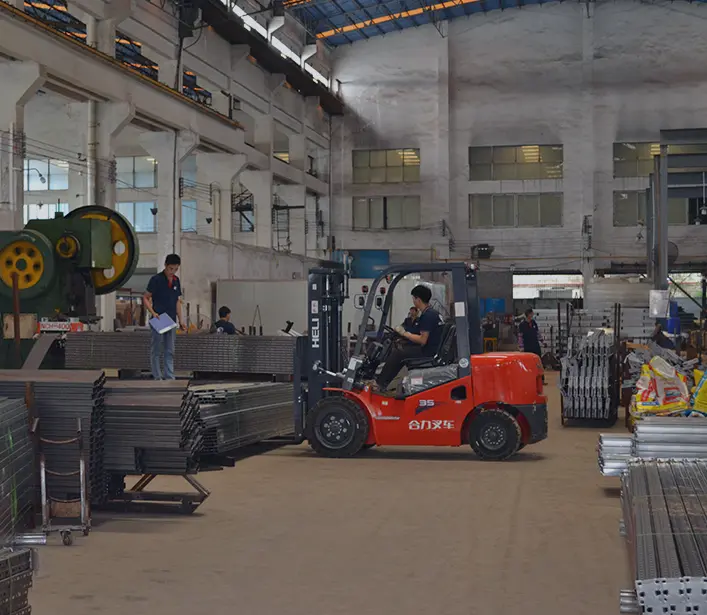
HEDA Shelves automated industrial roll forming and manufacturing line
Certified Metallurgical Integrity
We utilize certified prime cold-rolled steel (grade Q235B and high-yield Q355B). Structural uprights, step beams, box beams, and cantilever columns undergo real-time destructive load testing and yield point validation to eliminate post-yield catastrophic buckle hazards.
  • ISO 9001:2015 Quality Management
  • CE Structural Compliance (EN 1090 / EN 15512)
  • RoHS-Certified Eco Powder Pigments
Complimentary 3D & CAD Layouts
Prior to manufacturing, our senior racking architects produce zero-cost custom CAD spatial blueprints, operational fork-truck aisle clearance studies, and 3D volumetric renders, calculating load limits per shelf level and pallet footings according to floor bearing slabs.
  • Accurate forklift turning radius mapping
  • Building column avoidance matrices
  • Fire suppression & NFPA sprinkler clearance
Advanced Tropical Anti-Corrosion
All welded sub-assemblies receive a continuous 10-step chemical treatment: immersion degreasing, ultrasonic water rinsing, acid rust pickling, phosphating passivation, and high-cure electrostatic epoxy polymer powder coating, with optional hot-dip galvanizing.
  • Superior salt spray endurance (>500 Hours)
  • Resistance to extreme 95% RH environments
  • Sub-zero cold store structural durability (-30°C)
Strategic Procurement Guide

Warehouse Storage Systems: Comparative Technical Matrix

Compare mechanical characteristics, SKU density ratios, material handling speed, and capital expenditure indices across foundational racking archetypes to align with your facility's operational throughput.

Racking System Classification Direct Selectivity Floor Space Utilization Standard Load Envelope Rotation Principle Optimal Industry Application
Selective Pallet Racking 100% Instant Access 35% - 45% (Wide Aisle) 800 kg - 4,500 kg / level FIFO (First-In, First-Out) 3PL hubs, general distribution, multi-SKU retail
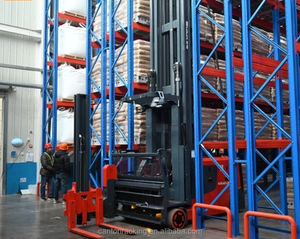
Very Narrow Aisle (VNA) 100% Guided Access 55% - 65% (Aisles 1.6m-1.8m) 1,000 kg - 3,000 kg / level FIFO (First-In, First-Out) High-bay distribution, premium urban land spaces
Radio Shuttle Automation Semi-Automated Lane 75% - 85% (Continuous block) 500 kg - 2,000 kg / pallet FIFO or LIFO flexible Cold storage, beverage bottling, FMCG bulk reserves
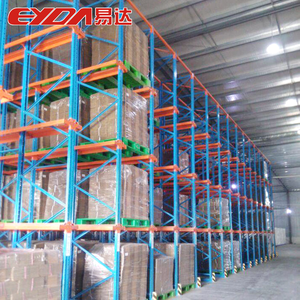
Drive-In / Drive-Through Lane Dependent 65% - 75% (No cross aisles) 1,000 kg - 2,000 kg / pallet Strict LIFO (Drive-In) / FIFO Raw material holding, low-SKU bulk seasonal items
Structural Multi-Tier Mezzanine Full Manual Picking 150% - 250% (Multiplied level) 300 kg - 1,000 kg / m² deck Batch / Zone Fulfillment E-commerce sortation, spare parts, apparel fulfilment
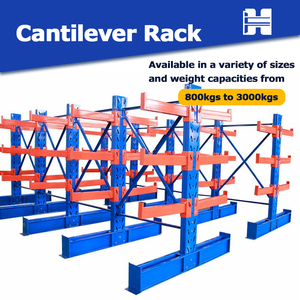
Heavy Duty Cantilever 100% Unobstructed Face 50% - 60% Linear Footprint 500 kg - 3,000 kg / arm Universal Material Access Extruded pipes, structural lumber, sheet steel coils
Future Forecasting · 2026-2030

Future Procurement Trends in Industrial Storage Engineering

Warehouse procurement is transitioning from static steel purchases to long-term operational resilience investments. Key macro shifts drive global supply chain architectural specifications:

1. AMR & Hybrid AGV-Ready Structural Tolerances
Autonomous Mobile Robots (AMRs) and Automated Guided Forklifts require tighter physical tolerances than manual forklifts. Future-proof procurement mandates high-precision cold-formed punch tooling on upright columns to limit longitudinal beam deflection to under 1/200th of span under maximum test load. Floor-to-rack base anchor geometries must integrate LiDAR reflector mount clearances and wireless sensory pathways to support both manual operations today and autonomous shuttles tomorrow without costly structural retrofitting.
2. Volumetric Optimization & Vertical Expansion
With prime logistics real estate leasing costs increasing worldwide, procurement strategies prioritize vertical density over horizontal footprint. Buyers are shifting to high-bay Very Narrow Aisle (VNA) systems reaching 15–20 meters and rack-supported multi-tier mezzanine configurations that multiply usable warehouse square footage without expanding concrete building envelopes. This vertical push increases structural focus on baseplate anchor tensile capacities, heavy-duty floor slab core-drilling, and seismic column cross-bracing.
3. Low-Carbon Steel & Sustainable Coating Lifecycle
Global corporate ESG mandates require procurement managers to evaluate product carbon footprints (PCF). Manufacturers that use energy-efficient electric arc furnace (EAF) steel sourcing, high-reclaim powder coating systems with near-zero VOC emissions, and demountable boltless beam designs achieve lower carbon profiles. Demountable systems allow logistics assets to be reconfigured, expanded, or relocated throughout a facility's lifecycle without scrap metal wastage.
Technical Innovations

Technological Advancements Reshaping High-Density Racking

Engineering breakthroughs in structural metallurgy, optical sensing, and semi-automation are setting new benchmarks for warehouse efficiency, operator safety, and load integrity.
Four-Way Radio Shuttle Fleets
Moving beyond linear 2-directional shuttles, modern high-density channels utilize omnidirectional four-way radio shuttles controlled via intelligent fleet management software. These carriers transfer pallets seamlessly between longitudinal storage channels and transverse transfer aisles, removing human forklift operators entirely from high-density channels.
Finite Element Stress Modeling
Engineering custom storage systems now relies on full FEA modeling to simulate complex combinations of dead load, dynamic impact, vertical live seismic forces, and localized asymmetric rack overload. This computer analysis prevents localized column crimping while optimizing steel thickness for an ideal strength-to-weight ratio.
Sub-Zero Cold Chain Metallurgy
Rapid global expansion of frozen food and pharmaceutical logistics requires racking steel that avoids brittle fracture at temperatures below -25°C. Specially treated structural micro-alloyed carbon steels prevent low-temperature ductile-to-brittle transitions, ensuring reliable impact absorption from handling equipment in cold conditions.
Multi-Point Locking Safety Pins
Traditional simple drop-pins are giving way to integrated multi-point interlock safety devices. Engineered into beam-end connectors with CNC precision, these connectors resist accidental upward forklift dislodgement forces exceeding 5,000 N per beam end, safeguarding personnel and protecting high-value inventory.
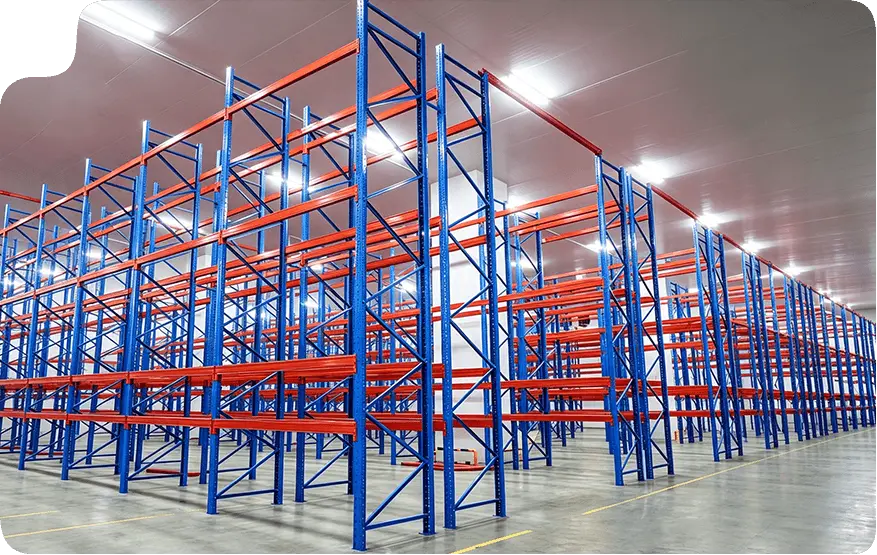
Heavy duty automated cold storage racking system layout
Turnkey Engineering Execution

From Raw Steel Coils to Commissioned Industrial Installations

Successful enterprise racking execution requires tight control over every link in the supply chain. At HEDA Shelves, we manage every phase under rigorous internal quality standards:

Phase 1: Analytical Logistics Assessment — Our structural engineers review your pallet characteristics (wooden, plastic, metal skid), clearance dimensions, SKU velocity profiles, building structural floor tolerances, fire hose lines, and equipment capabilities to design an optimal storage layout.

Phase 2: Continuous Precision Roll-Forming — Heavy uncoilers feed premium steel coils into 24-station automated roll-forming lines, producing upright posts with consistent pitch accuracy (within ±0.5 mm tolerances) across full 12-meter profiles.

Phase 3: Automated Welding & Coating — Robotic arms execute consistent structural welds joining connectors to step and box beams. Assemblies then undergo our automated 10-stage pre-treatment and 200°C curing process for maximum durability.

Phase 4: Export Bundling & Field Erection — Components are bundled with protective strapping and designated container balance points for international ocean freight. Every shipment includes step-by-step CAD installation guides, load rating safety plates, and direct engineering support.

Knowledge Base & FAQ

Frequently Asked Warehouse Shelving & Racking Questions

Detailed answers to critical engineering, procurement, load certification, and export shipping questions for facility directors and supply chain engineers.

Q1 How do you verify rack load capacities and structural safety compliance?
Every storage rack configuration undergoes rigorous static calculation and finite element stress analysis using certified software based on international standards (FEM 10.2.02, EN 15512, and ANSI/RMI MH16.1). Beam load ratings represent Uniformly Distributed Loads (UDL) with a mandatory minimum safety factor of 1.5 to 1.65. Destructive physical sample testing is routinely performed on our automated universal hydraulic test stands to measure deflection limits and beam-end connector weld capacities under excess loads.
Q2 What data is required to generate a custom CAD warehouse layout?
To provide an accurate layout and engineering quote, our design team requires: (1) Architectural building drawings showing clear ceiling heights under roof trusses, column grids, and egress doors; (2) Pallet specifications including overall dimensions (W × D × H) including product overhang and maximum loaded weights; (3) Material handling equipment specifications (forklift model, minimum turning radius, maximum mast elevation, and outrigger constraints); and (4) Throughput requirements (FIFO vs. LIFO rotation preferences).
Q3 How is equipment protected against corrosion during ocean shipping and in humid tropical climates?
For ocean freight, components are pre-treated through continuous pickling and phosphating before receiving high-adhesion electrostatic powder coatings (60–90 microns). Bundles are wrapped in heavy-gauge moisture-barrier films with industrial desiccant bags placed inside export containers. For high-humidity coastal sites or sub-zero cold storage facilities with frequent condensation, we offer hot-dip galvanized components conforming to ASTM A123/ISO 1461, delivering multi-decade rust immunity without flaking.
Q4 Can your systems be engineered for high seismic activity zones?
Yes. For earthquake-prone regions such as the Philippines, Indonesia, and parts of the Pacific Rim, our engineering department performs dynamic seismic spectral calculations based on regional building codes (IBC/Eurocode 8). We integrate reinforced upright gauge profiles, larger seismic baseplates with multiple wedge anchors per foot, heavy-duty floor anchor studs, and specialized X-bracing along spine runs to absorb shear and prevent progressive collapse.
Q5 What is the typical production and delivery lead time for export orders?
Standard manufacturing turnaround for standard selective and medium-duty shelving ranges between 15 and 20 business days from approved CAD drawings. Complex installations—such as multi-tier mezzanines or automated radio shuttle corridors—typically require 25 to 35 production days. Direct ocean transit times from our nearby port in Guangzhou are fast: roughly 3–5 days to Vietnam and the Philippines, 5–8 days to Singapore, Malaysia, and Thailand, and 14–28 days to European and North American ports.
Q6 Do you provide installation supervision and field assembly support?
Every shipment includes an engineering documentation package containing numbered component diagrams, 3D exploded assembly drawings, load rating plaque indicators, and bolt torque specifications. For medium-sized projects, we provide remote video installation guidance with technical teams. For large-scale multi-tier mezzanines, VNA installations, and radio shuttle projects, we can deploy certified senior installation supervisors to manage local assembly crews on-site.

Connect Directly with Our Structural Racking Engineers

Whether optimizing an existing facility or building an automated logistics center from the ground up, our engineering team provides free 3D volumetric drawings, structural load assessments, and factory-direct estimates within 24 hours.

Send an Inquiry