Industrial Storage Systems & Engineered Racking Portfolio
Explore our certified cold-rolled structural steel storage configurations designed to maximize cubic volume, improve material flow kinematics, and reduce cost-per-pallet position across global logistics supply chains.
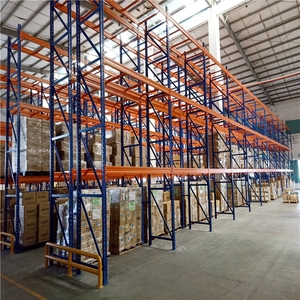
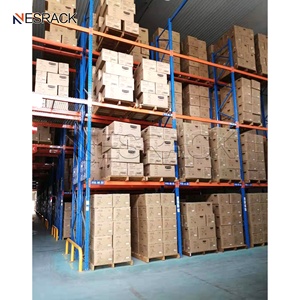
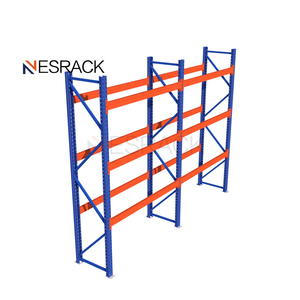
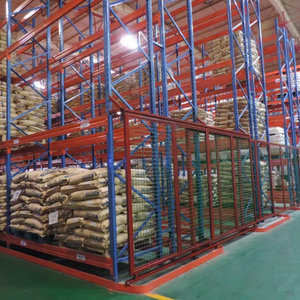
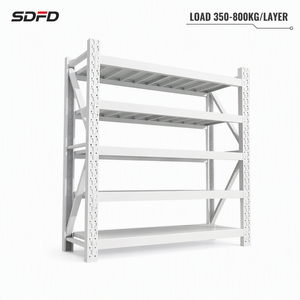
Kinematic Dynamics & Structural Architecture of Rolling Pallet Racks
In high-velocity warehouse environments, traditional static storage frequently yields excessive aisle travel times, forklift congestion, and wasted cubic air rights. Dynamic rolling pallet racking systems—incorporating inclined gravity roller tracks (Pallet Flow), mechanical cart push-back mechanisms, and motorized mobile racking carriages—bridge the gap between conventional pallet storage and full automation.
Gravity Flow Kinematics (FIFO)
Operating on an engineered pitch angle of 3% to 4% (approximately 1.7° to 2.3°), gravity pallet flow lanes utilize precision cylindrical steel rollers with integral centrifugal speed controllers. When the leading discharge pallet is unloaded, kinetic force guides trailing loads forward smoothly at controlled velocities not exceeding 0.3 m/s, preventing terminal impact shock while preserving strict First-In, First-Out sequence essential for cold chain perishables and pharmaceuticals.
Nested Cart Push-Back Mechanics (LIFO)
Push-back rolling systems eliminate internal drive-in transit aisles by stacking structural steel carts nested along inclined guide channels. Forklift operators push back previously loaded pallets using subsequent units, supporting 2 to 6 deep storage configurations. Engineered with flanged heavy-duty ball bearings and low rolling-friction coefficients, these carts ensure dependable return rollouts without binding, providing superior density for batch manufacturing.
Motorized Mobile Base Engineering
Mobile rolling pallet racks mount complete selective racking superstructures upon heavy-duty electronically driven chassis traveling on recessed floor guide rails. By displacing entire rack blocks synchronously, a single operative forklift aisle opens dynamically via PLC remote signals, converting up to 90% of warehouse floor footprint into actual active storage volume while preserving 100% individual pallet selectivity.
Engineering Comparative Matrix: Dynamic Rolling vs. Traditional Pallet Racking
| Storage System Type | Kinematic Principle | Floor Space Utilization | SKU Selectivity Profile | Forklift Cycle Time | Cold Room Cost Efficiency |
|---|---|---|---|---|---|
| Pallet Flow (Gravity Rolling) | Centrifugal braked roller beds (FIFO) | Up to 75% Active Density | 1 SKU per Lane (Bulk Run) | Fastest (Decoupled Loading/Discharge) | Maximum (Cubic Thermal Volume) |
| Push-Back Rolling Carts | Telescoping nested carts on track (LIFO) | Up to 65% Active Density | 1 SKU per Facing Lane (2-6 Pallets) | High (No aisle penetration needed) | High (Reduces refrigeration volume) |
| Motorized Mobile Racking | PLC-driven rolling base chassis | Up to 85% Active Density | 100% Direct Selectivity | Moderate (Aisle shift transition ~25s) | Superior (Optimal for sub-zero spaces) |
| Drive-In Racking (Static) | Forklift lane penetration (LIFO) | Up to 70% Active Density | Low (Last-In, First-Out batch) | Slow (Risk of upright impact collisions) | Moderate to High |
| Standard Selective Racking | Static beams with dedicated aisles | 35% - 40% Density (Aisle heavy) | 100% Direct Selectivity | Baseline Reference | Low (Large volume of chilled empty air) |
Procurement Trends & Technological Evolution (2025–2030)
Industrial supply chains are transitioning from static steel structures to intelligent, adaptable material handling nodes. Modern procurement directors look beyond raw steel price-per-kilogram, evaluating Total Cost of Ownership (TCO), carbon footprint indices, dynamic automation compatibility, and seismic hazard compliance.
1. Convergence with Autonomous Mobile Robots (AMR)
The future of rolling pallet systems lies in hybrid automation. Gravity flow and push-back rack discharge faces are being engineered with precision optical-reflector target points and calibrated laser-cut pick aprons to interface seamlessly with Autonomous Counterbalance Forklifts and AMRs. Procuring racks with millimeter-precise roller bed elevations eliminates human forklift dependency while preventing sensor occlusion errors during multi-shift operations.
2. Cold Chain Thermal Efficiency Demands
With industrial electricity tariffs rising globally, energy expenditure in sub-zero facilities (-18°C to -28°C) accounts for up to 60% of operating expenses. Procurement trends indicate a sharp migration toward high-density gravity rolling and motorized mobile systems in food logistics hubs across Southeast Asia, North America, and Europe. Maximizing pallet density directly contracts the thermal cubic envelope, delivering verified refrigeration power savings of 30% to 45%.
3. Dynamic Finite Element Seismic Resiliency
Procurement specifications in active seismic zones (e.g., the Pacific Rim, Philippines, Indonesia, and western Americas) now mandate advanced Finite Element Method (FEM) dynamic simulation under live moving loads. Rolling racks possess dynamic mass inertia that differs substantially from static racks. Modern designs integrate bidirectional elastomeric dampers, oversized anchored baseplates, and high-tensile Q355B cold-formed upright profiles certified under RMI and EN 15512 safety codes.
10-Stage Precision Manufacturing & Surface Metallurgy
Guangzhou Heda Shelves Co., Ltd. operates a modernized 30,000 m² primary manufacturing facility. From prime Baosteel coil slitting to automated continuous roll-forming and robotic welding, every component is rigorously tested to prevent deflection and fatigue failure.

Certified Prime Steel
High-grade Q235B & Q355B hot-rolled structural steel coils tested for chemical yield strength.

Precision CNC Slitting
Automated uncoiling and high-speed CNC longitudinal shearing within ±0.1mm dimensional tolerance.

Automated Punching
Continuous hydraulic progressive die punching creating 50mm / 75mm pitch teardrop or diamond beam slots.

Multi-Roll Forming
24-station continuous roll-forming mills producing omega and box profiles without internal work-hardening stresses.

Profile Calibration
Laser straightness tracking and cross-sectional calibration ensuring exact structural symmetry across all lengths.

Polishing & Deburring
Mechanical edge radius finishing eliminating stress concentration points and micro-burrs before weld fusion.

Robotic MIG Welding
Shielded gas-metal arc welding robots ensuring deep weld penetration between beam end-connectors and tube bodies.

Chemical Pre-treatment
Immersion degreasing, acid pickling, ultrasonic descaling, and zinc phosphating creating an anti-corrosion barrier.

Electrostatic Coating
Automated Swiss Gema powder application with 200°C curing oven polymerizing a 60–90µm impact-resistant finish.

QC & Container Packing
Ultrasonic weld tests, deflection batch loading, steel-banded bundling, and protective wrapping for sea freight.
International Engineering Validation & Quality Management
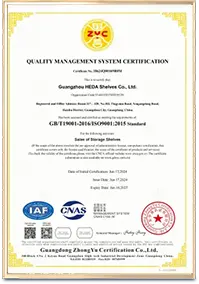
Procuring rolling pallet racks for international logistics hubs demands unassailable proof of metallurgical and structural integrity. Heda Shelves holds verified CE execution certification under EN 1090 / CPR standards and ISO 9001:2015 quality credentials, assuring full compliance with worldwide warehouse safety codes including AS 4084, FEM 10.2.02, and OSHA regulations.
Our anti-corrosion electrostatic epoxy powders are certified RoHS compliant, ensuring non-toxic, food-safe installation inside ambient and sub-zero cold food preservation facilities.
Get a Quote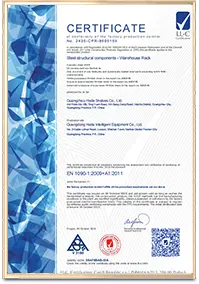 CE Certification
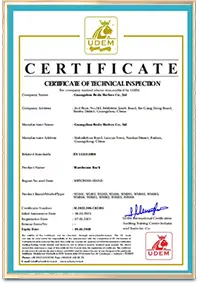 ISO 9001:2015
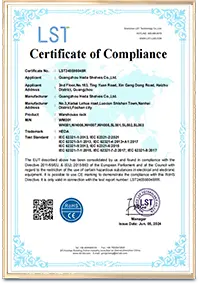 RoHS Compliant
 Load Test Verified
Frequently Asked Questions for Rolling Pallet Rack Buyers
Critical technical, economic, and logistical questions addressed directly by our structural engineering and global export team.
Accelerate Your Warehouse Intralogistics Efficiency
Whether configuring a new greenfield dynamic logistics distribution park or retrofitting an active high-density sub-zero cold room, our certified structural design team delivers exact engineering analyses, certified load calculations, and competitive direct factory export quotes.