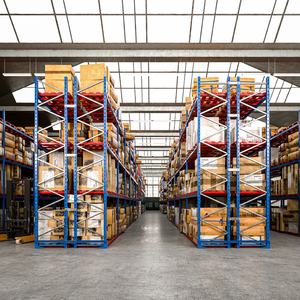
Section 1: The Engineering Physics of Gravity Pallet Flow Racking
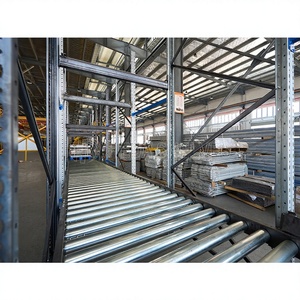
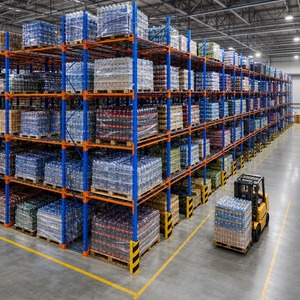
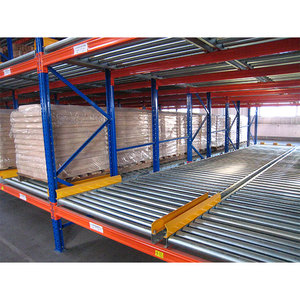
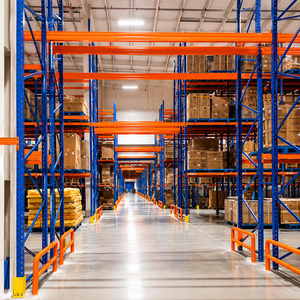
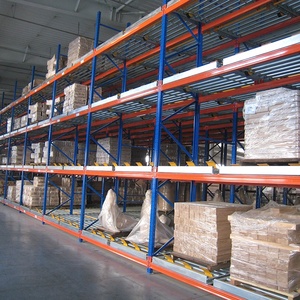
Pallet flow racking—also classified across international intralogistics as gravity flow racking or dynamic roller storage—is an engineered storage infrastructure driven entirely by controlled kinetic gravity. Operating on a slight downward incline typically calibrated between 2.5% and 4.0% (1.5° to 2.3°), standard loaded wooden, plastic, or custom metal skids travel unassisted from the charging (loading) face to the discharging (picking) face. This establishes a mathematically locked First-In, First-Out (FIFO) stock rotation sequence without mechanical drive motors or electrical cabling.
While the operating premise seems deceptively simple, the structural engineering requires rigorous mechanical force balance. When a pallet weighing up to 2,000 kg enters a flow lane spanning up to 20 or 30 pallets deep, the cumulative line pressure ($P_{line}$) generated by the queue presents catastrophic structural risk if improperly mitigated. Line pressure is calculated based on cumulative mass, pitch inclination, and rolling friction:
Kinetic Line Pressure Equation:
$P_{total} = \sum_{i=1}^{n} \left( m_i \cdot g \cdot \sin(\theta) - \mu_r \cdot m_i \cdot g \cdot \cos(\theta) \right)$ Where $m_i$ is pallet mass, $\theta$ is lane gradient angle, and $\mu_r$ is the rolling friction coefficient of the precision roller bearings. Without engineered mechanical pallet separators, this kinetic force transmits directly to the discharge beam and the picking forklift tines.
To safely govern acceleration and negate terminal impact velocity at the discharge terminal, high-integrity pallet flow designs incorporate two mission-critical mechanical subsystems: Centrifugal Brake Rollers and Automatic Pallet Separation Devices (Escapements). Centrifugal speed controllers utilize internal planetary gear mechanisms coupled with synthetic brake shoes that engage progressively as speed exceeds 0.25 m/s. This stabilizes pallet transit speed between 0.15 m/s and 0.3 m/s regardless of whether the pallet weighs 300 kg or 1,500 kg.
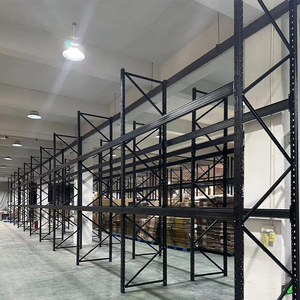
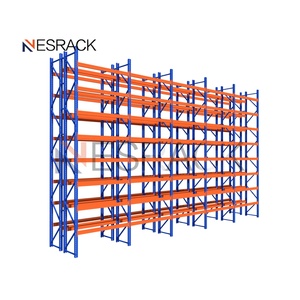
Top-tier industrial pallet flow racking performance depends strictly on certified raw materials. Uprights and horizontal beams fabricated from structural Q235B and Q355B cold-rolled steel coils must satisfy dimensional tolerances and structural deflection criteria regulated by EN 15512 and the American RMI (ANSI MH16.1) standards. Upright profile design incorporates multiple cold-formed return bends to enhance torsional rigidity against heavy horizontal dynamic impacts caused during pallet loading.
Full-Width Galvanized Rollers
Engineered with 50mm to 60mm diameter carbon steel tube, heavy-duty inner spring-loaded hexagonal shafts, and dual precision shielded bearings. Supports irregular 3-runner and perimeter-base wooden pallets without snagging.
Centrifugal Speed Controllers
Internally lubricated speed governor rollers direct-drive against the pallet bottom. Progressive centrifugal braking cushions movement, maintaining steady glide speed irrespective of varying pallet weights.
Pneumatic/Mechanical Separators
Disengages the second queued pallet from the lead pallet by 150mm–300mm. Eliminates backpressure so forklift operators can extract the discharge pallet without catching or frictional drag.
Manufactured by Guangzhou Heda Shelves Co., Ltd. (operating continuously since 2001), our industrial fabrication plant delivers over 30,000 metric tons of automated racking systems per month across a state-of-the-art 30,000 m² facility. With over 300 experienced technical, structural, and welding engineers, every racking lane undergoes precision fabrication from raw structural steel slitting through automated electrostatic powder coating.
Unlike regional brokers or trading intermediaries, our in-house facility executes end-to-end quality assurance: computerized roller dynamic balancing, weld beam fatigue testing, laser-guided column punching, and tropical climate simulation testing to guarantee racking resilience against coastal humidity, industrial chemical vapors, and sub-zero cold room environments.
CE Certificate No. 2435-CPR-8605159
ISO 9001:2015 Registered No. 18624Q00169R0M
RoHS Hazardous Material Certified
Free 3D CAD & Structural Calculations
Zero Defect Manufacturing
10 Controlled Production Phases from Steel Coil to Container
Strict in-house metallurgy and finishing ensures zero structural deformation under ultimate load limits.
01
Coil Slitting & Inspection
Direct sourcing of Q235B/Q355B prime hot-rolled coils with full mill test certificates (MTC) verifying tensile and yield parameters.
02
Automated CNC Punching
High-precision 50mm and 75mm teardrop and diamond pitch perforations punched along upright axes within 0.1mm linear tolerance.
03
Continuous Roll-Forming
Progressive 18-to-24 station roll forming dies yield rigid omega (Ω) and box beam profiles without localized material stress fractures.
04
Robotic Arc Welding
Continuous twin-torch automated robotic CO2 shielded welding ensures deep throat weld penetration between connector plates and beam tubes.
05
Shot Blasting & Degreasing
Physical surface scale removal via automated centrifugal wheel blast machines achieving Sa 2.5 cleanliness rating.
06
Pickling & Phosphating
Chemical immersion baths eliminate trace surface oxidation and apply a dense crystalline iron-phosphate conversion film for coating adhesion.
07
Electrostatic Powder Coat
Automated Swiss Gema powder application guns deposit 70–90 microns of thermoset polyester epoxy coating, followed by 200°C curing ovens.
08
Dynamic Pre-Assembly & Pack
Gravity track modules and speed brake rollers are factory test-sloped and bundled in steel cradle packaging for sea container export.
Section 2: Future Procurement Trends in Dynamic Gravity Systems (2025–2030)
As global warehousing pivots rapidly toward decarbonization, high-density cubic optimization, and resilient supply chain topology, procurement strategies for pallet flow racking are undergoing fundamental transformations. Forward-looking supply chain directors must evaluate five macro procurement shifts:
The traditional pallet flow rack was designed exclusively around manual counterbalanced or reach forklifts. Modern fulfillment centers are transitioning to hybrid gravity-automation buffers. Here, high-density gravity lanes serve as dynamic dispatch accumulation lanes where autonomous counterbalanced AGVs perform charging and picking. This necessitates ultra-precise entry centering funnels, photodetector target brackets on uprights, and heavy-duty floor stops with laser-cut positioning tabs that allow AGV forks to engage the pallet within ±2mm tolerance without human intervention.
2. Cold-Chain Deep Freeze Resilience (-30°C to -40°C)
Rapid expansion of frozen seafood, meat, and biomedical cold chains demands gravity lanes capable of uninhibited continuous rotation inside blast freezers. Conventional grease in roller bearings congeals at sub-zero temperatures, causing rollers to seize and pallets to stall mid-lane. Future-proof procurement requires specifying low-temperature synthetic fluorine lubricants, stainless steel internal bearing balls, and hot-dip galvanized structural frames that resist thermal cycling condensation without micro-pitting corrosion.
Driven by corporate ESG benchmarks and the rising electricity tariffs associated with continuous multi-tier automated storage and retrieval systems (AS/RS), dynamic gravity racking is experiencing massive procurement resurgence. With zero electrical consumption during daily pallet movement, an 8,000-pallet position gravity flow installation eliminates megawatts of power draw compared to powered conveyor chains or multi-shuttle automated racks, yielding significant Scope 2 greenhouse gas abatement.
International procurement faces wide variance in pallet quality—from premium smooth-bottom plastic pallets in pharmaceutical logistics to fractured, multi-runner disposable wooden skids in agricultural exports. Leading manufacturers now engineer tri-track and staggered split-roller assemblies. By placing continuous support tracks across the left, center, and right skid stringers, wheel contact surface area increases by 45%, preventing bottom board deflection from blocking flow even under maximum rated tonnage.
Total Cost of Ownership (TCO) & Engineering ROI Model
When evaluated over a 10-year operating horizon, pallet flow racking demonstrates superior economic metrics compared to conventional selective aisles and high-maintenance powered automation. Consider the comparative formula for Total Storage Cost per Pallet Movement ($C_{cycle}$):
$C_{cycle} = \frac{CapEx_{amortized} + OpEx_{labor} + OpEx_{fleet} + M_{maintenance}}{T_{annual\_throughput}}$
Because pallet flow racking separates loading traffic completely from retrieval traffic, forklift travel distance decreases by up to 50%. Forklift fleet requirements decline from 8 reach trucks to 4 counterbalanced units, saving up to $160,000 annually in operator wages, lithium battery maintenance, and lease depreciation.
Expert Technical Guidance
Frequently Asked Questions for Warehouse Engineers & Buyers
Direct structural and engineering answers regarding dynamic flow lanes, slope calibration, and seismic design.
Q: How is the correct roller bed incline determined for mixed pallet loads?
The optimal track angle depends on pallet runner material, bottom board flatness, and weight variance. Typically, our engineering team calibrates between 3.0% and 3.5% (approx. 1:30 slope). Light pallets (300kg–500kg) require a slightly steeper grade or closer roller spacing, while heavy loads (1,000kg–1,500kg) generate higher rolling kinetic energy and require additional centrifugal brake rollers spaced every 2 to 3 pallet positions to maintain uniform speed.
Q: What prevents pallets from crushing the lead pallet in deep 20-pallet lanes?
In deep-lane configurations, dynamic line pressure can exceed several tons. HEDA Shelves incorporates physical mechanical pallet separators (escapements). When the lead pallet reaches the discharge stop, it triggers a floor lever that raises an automatic mechanical brake barrier behind it, isolating the full weight of the queue. Only after the forklift extracts the front pallet does the escapement release the next pallet forward safely.
Q: Can pallet flow racking handle plastic or irregular perimeter-base pallets?
Yes. While standard wooden pallets with longitudinal bottom boards glide effectively on twin roller tracks, plastic pallets with perimeter bases or nine-block footings can snag if the roller bed is misaligned. For these applications, we implement full-width roller beds or high-density triple-track galvanized steel rollers with precision end-caps to ensure continuous surface contact without bottom sag.
Q: How does HEDA engineer racking systems for high seismic risk zones?
For installation sites in earthquake-prone areas (such as the Philippines, Indonesia, and the Pacific Rim), structural calculations incorporate site-specific peak ground acceleration (PGA) metrics. Upright frame depth is reinforced with heavy tubular horizontal and diagonal bracing, baseplate thickness is scaled up to 16mm–20mm, and mechanical anchor bolts are specified with chemical epoxy anchoring to resist uplift shear forces.
Q: What is the standard lead time and sea transit to major global seaports?
Production for customized pallet flow projects generally spans 15 to 25 days depending on total tonnage. Shipped directly from our Guangzhou / Nansha port facilities, sea transit averages 2–5 days to Vietnam, 3–5 days to Manila, 5–7 days to Singapore / Thailand, 6–8 days to Malaysia, and 14–22 days to Australian, European, and Middle Eastern ports under flexible FOB or CIF container terms.
Q: What pre-treatment is used to prevent corrosion in humid or coastal facilities?
Prior to coating, steel parts pass through an industrial 8-stage automated chemical pre-treatment cycle comprising degreasing, water rinsing, acid pickling, surface conditioning, and phosphating. This chemically bonds a corrosion-inhibiting conversion layer to the raw steel, maximizing powder adhesion and preventing blistering even under continuous relative humidity exceeding 85%.
Factory Direct Structural Engineering
Transform Your Warehouse Capacity with Gravity Flow Racking
Provide your building floor plan, clear ceiling height, pallet specifications, and target throughput. Our senior structural engineers will prepare an optimized 2D/3D CAD layout, roller slope simulation, and factory-direct quotation within 24 hours.