Featured Live Pallet Racking & High-Density Storage Solutions
Explore our heavy-duty gravity flow racks, automated sliding roll systems, and complementary storage configurations manufactured under ISO 9001:2015 and CE certification standards for maximum structural stability.
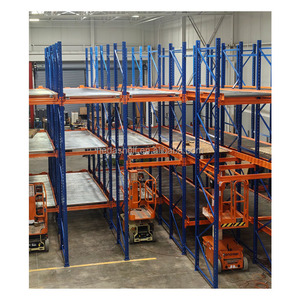 FIFO Flow
Heda Heavy Duty Steel Gravity Flow Rack Customizable Warehouse System FIFO
Industrial-grade gravity bed roller tracking designed for rapid FIFO pallet movement with magnetic speed control rollers and entry guides.
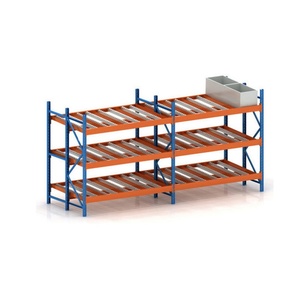 Automated Roll
Automated Retrieval Flowing Rolling Rack First-In-First-Out Sliding Storage Rack
High-cadence rolling storage optimized for fast pick-face replenishment in multi-channel fulfillment centers and high-SKU distribution hubs.
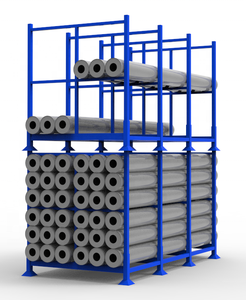 Specialized Stack
Custom Commercial Stack Metal Pallet Racking Fabric Roll Shelves Display Rack
Engineered stackable cradle pallet configuration ensuring crush-free horizontal storage for textile rolls, cylindrical products, and heavy drums.
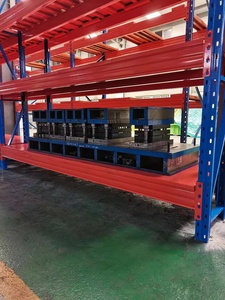 Heavy Duty
Heavy Duty Pallet Rack Triple-Upright Frame Spray-Coated Steel Decks
Ultra-reinforced deep upright profile with electrostatic powder-coated steel panels designed for maximum bearing support under point loads.
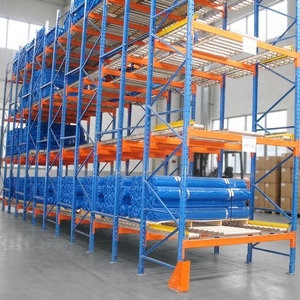 Perishables FIFO
First in First Out Design Perishable Goods FIFO Gravity Flow Racking
Strict FIFO rotation bed for dairy, seafood, produce, and pharmaceuticals, built with corrosion-resistant finish options for low-temperature environments.
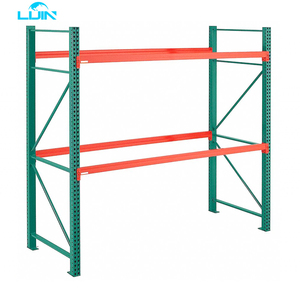 Universal Spec
Long Span Adjustable Heavy Weight Storage Pallet Shelves Tear Drop Rack
Universal interchangeability teardrop punching standard for fast boltless assembly, flexible beam height adjustment, and global compatibility.
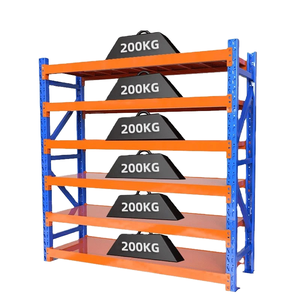 Dense Bulk
High Density Adjustable Warehouse Storage Racking Heavy Duty Drive in Rack
Continuous lane configuration where forklifts enter directly into rack bays, maximizing volumetric efficiency for homogeneous bulk commodities.
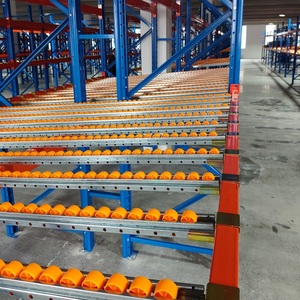 Zero-Energy Flow
Space Saving Pallet Flow Rack Dynamic Gravity Fed Storage Racking System
High-efficiency dynamic incline bed with integrated centrifugal braking rollers and end-stops for smooth, controlled pallet descent.
How Live Pallet Racking Works: Engineering the Mechanics of Gravity Flow
Live Pallet Racking—widely known across international material handling engineering as Pallet Flow or Gravity Roller Storage—is a compact, high-density storage methodology that relies strictly on dynamic gravitational kinetics. By mounting inclined roller tracks on structural pallet rack frames at a precise gradient (typically between 3% and 4%), pallets loaded at the upper charge face autonomously glide toward the lower discharge picking face without requiring electrical drive motors, onboard conveyor power, or forklift transit down individual storage lanes.
Unlike conventional selective racking where aisles consume over 60% of total facility floor footprint, a dynamic live flow system merges all internal lanes into a unified block. This architectural configuration segregates loading and retrieval operations entirely: replenishing forklifts operate exclusively at the rear charge corridor, while dispatch and order-picking trucks remain at the front discharge aisle.
Core Structural Parameters
-
Bed Slope Ratio: Calibrated at 3.0% to 3.5% for standard timber/plastic skids; 4.0% for heavy steel cages.
-
Terminal Velocity Regulation: Centrifugal brake rollers maintain constant speed ≤ 0.3 m/sec.
-
Dynamic Lane Depths: Engineered from 2 to 25 pallets deep per tier with pallet separators.
-
Steel Chemistry: High-yield Q235B / Q355B cold roll-formed uprights and high-tensile box beams.
Centrifugal Speed Controller Rollers
As pallet weight scales from 300 kg to over 1,500 kg, uncontrolled gravitational acceleration introduces catastrophic impact hazards. Our systems integrate internally geared centrifugal brake rollers strategically spaced along the lane. As roll velocity climbs, internal flyweights expand against brake linings, dynamically dissipating kinetic energy and locking descent speeds at an engineered, uniform cadence.
Mechanical Pallet Separator Systems
In deep lanes exceeding 5 to 20 pallets, cumulative static line pressure pushes against the leading unit at the discharge end. A mechanical pallet separator decouples the first pallet from the trailing queue until the leading pallet is lifted free by the forklift mast. This relieves thousands of kilograms of forward thrust, safeguarding mast assemblies and avoiding jammed pallets.
Self-Centering Entry Guides & End Stops
Entry funnels at the charge face mechanically steer misaligned pallets into the center of the dynamic roller channel before full release. At the discharge end, reinforced structural steel end stops distribute kinetic deceleration evenly across bottom pallet runners, paired with polyurethane buffer pads to prevent frame stress fractures over decades of cycling.
High-Density Storage Systems Comparative Matrix
Quantitative evaluation across key volumetric, operational, and capital metrics to assist supply chain engineers in selecting the correct density profile.
| Storage Racking Architecture | Inventory Rotation | Floor Utilization | Handling Velocity | Forklift Rack Intrusion | Energy Requirement |
|---|---|---|---|---|---|
| Live Pallet Racking (Gravity Flow) | Strict FIFO | Up to 85% | Rapid / Continuous | None (Aisles only) | 0 kW (Pure Gravity) |
| Drive-In / Drive-Through Racking | LIFO (FIFO rare) | Up to 75% | Slow (Drive inside) | High Risk (Deep bay entry) | 0 kW |
| Push-Back Racking (Nested Carts) | Strict LIFO | Up to 70% | Moderate | None (Front load only) | 0 kW |
| Radio Shuttle Automation | FIFO & LIFO | Up to 88% | High Speed | None (Shuttle cart) | Battery / Recharge |
| Standard Selective Pallet Racking | 100% Selectivity | 35% - 45% (Low) | Aisle Dependent | None | 0 kW |
Technological Breakthroughs Shaping Dynamic Gravity Systems
How modern engineering is transforming passive mechanical roller racks into intelligent, hybrid, and environmentally resilient logistics infrastructure.
Eddy-Current Magnetic Braking Rollers
Conventional centrifugal brake rollers rely on mechanical friction shoes that inevitably wear and produce micro-particulates over years of intense cycling. Leading-edge live pallet racking is rapidly transitioning to magnetic eddy-current brake rollers. These non-contact braking mechanisms harness electromagnetic counter-induction: as pallet speed accelerates, magnetic braking resistance increases automatically without surface contact, eliminating brake pad maintenance entirely.
AS/RS Stacker Crane & AMR Integration
Live pallet racking is no longer an isolated manual system. High-throughput mega-hubs are deploying hybrid designs where automated stacker cranes (AS/RS) deposit incoming pallet blocks at the elevated rear charge face, while autonomous mobile robots (AMRs) or automated guided forklifts (AGVs) pick continuously from the discharge face. This provides a zero-energy gravity accumulation buffer that insulates automation hardware from dispatch surges.
Sub-Zero Cold Chain Bearing Formulation
With exponential growth in frozen food e-commerce, live racking deployed in deep-freeze environments (-25°C to -30°C) demands metallurgical and lubrication breakthroughs. Modern roller assemblies incorporate specialized low-temperature synthetic lubricants that resist viscosity freezing, paired with zinc-nickel or hot-dip galvanized tracks that prevent condensation micro-rust and track seizure during defrost cycles.
Global Strategic Procurement Trends for Warehouse Racking
Key decision drivers and total cost of ownership (TCO) benchmarks shaping capital expenditure for enterprise logistics buyers through 2030.
Zero-Power Density vs. Rising Kilowatt Costs
With industrial electricity tariffs climbing globally, fully powered conveyor buffers and active automated shuttle storage incur significant recurring operational expenditure. Dynamic live racking offers a purely passive mechanical solution requiring zero ongoing electrical power. Procurement teams evaluate this as a major hedge against escalating utility costs, delivering rapid payback periods within 18 to 24 months.
Industrial Land Scarcity & Footprint Consolidation
Prime warehousing rent in logistics hubs across Southeast Asia, Europe, and North America has climbed sharply. Facilities can no longer afford wide 3.5-meter forklift aisles every two pallet rows. By consolidating 10 to 20 lanes deep, live pallet racking increases floor space capacity from 40% up to 85%, allowing companies to defer new warehouse construction or lease commitments.
Severe Forklift Collision Elimination
In conventional drive-in racking, forklifts repeatedly drive into narrow rack channels, causing severe structural column impacts and dangerous racking collapse risks. Strategic health and safety procurement directives favor live racking because operators never enter the rack matrix—forklifts strictly stay within dedicated loading and retrieval peripheral aisles, dramatically reducing OSHA/workplace insurance liabilities.
Frequently Asked Technical & Sourcing Questions
Direct answers from our senior warehouse engineering team regarding pallet compatibility, maintenance schedules, structural integrity, and global shipping.
Ready to Maximize Your Warehouse Cubic Capacity?
Connect directly with Guangzhou Heda Shelves engineering specialists. Receive an engineered warehouse CAD layout, 3D structural rendering, and comprehensive factory-direct pricing tailored to your exact SKU profile and throughput requirements.