Featured Industrial Cantilever & Logistics Systems
Precision-fabricated utilizing premium Q235B/Q355B structural steel, tailored for timber, steel tubing, PVC profiles, sheet goods, and automated fulfillment workflows.
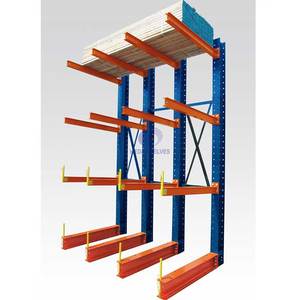 Heavy Duty
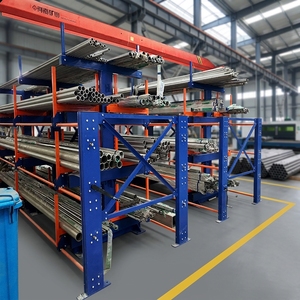 Adjustable
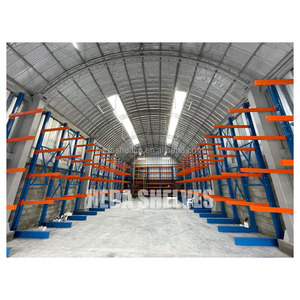 Single-Sided
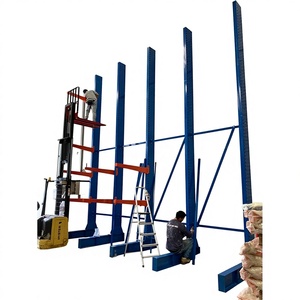
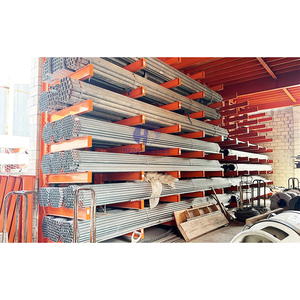 Lumber & Pipe
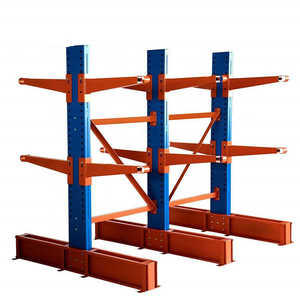
 Double-Sided
 Automotive
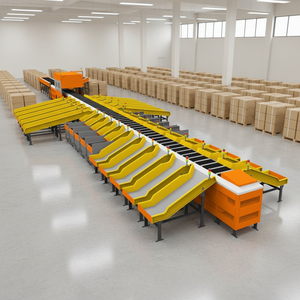 Automation
 Material Handling
Engineering Integrity: The Mechanics of Modern Industrial Cantilever Racking
In modern supply chains, the handling and buffering of non-palletized, long-span, or awkward footprint items represent one of the highest structural challenges for industrial facilities. Standard selective pallet racking depends entirely on front vertical columns, which introduce rigid boundary conditions that restrict the insertion of unbroken lengths of timber, extruded aluminum profiles, structural steel beams, PVC conduits, or vehicle chassis components. Cantilever racking eliminates the front column barrier altogether, presenting an uninterrupted horizontal storage plane anchored solely by heavy rear central spines or wall-anchored upright columns.
At Guangzhou Heda Shelves Co., Ltd. (HEDA Shelves), cantilever architecture is developed through rigorous structural mechanics, dynamic Finite Element Analysis (FEA), and strict compliance with global codes including ANSI/RMI MH16.1, FEM 10.2.09, and EN 15512 / EN 1993-1-1 (Eurocode 3). Unlike generic warehousing racks, a cantilever system operates under continuous eccentric cantilever arm moments that translate heavy torsion and combined bending-compression forces directly down into the column uprights and base plate anchorages.
Structural I-Beam vs. Roll-Formed
We manufacture both cold roll-formed profiles for cost-effective medium storage and continuous hot-rolled structural H/I-beams (Q235B/Q355B) capable of absorbing massive point loads and severe dynamic forklift strikes without buckling.
Precision Articulated Arm Design
Our proprietary arm-to-column socket interfaces utilize high-tensile Grade 8.8 bolts or self-locking safety pin connections. When an errant forklift fork strikes an arm from underneath, our pivoted connection allows the arm to deflect upward without twisting the main structural spine.
Dual-Finish Climate Protection
Standard components undergo a strict 8-stage pre-treatment (pickling, degreasing, and zinc phosphating) before receiving high-build electrostatic powder coating. For open timber yards and humid equatorial coastlines, full hot-dip galvanization to ISO 1461 guarantees over 25 years of corrosion resistance.
Comparative Engineering Matrix: Selecting the Optimum Cantilever Configuration
Specifying the appropriate cantilever system demands an engineering balance between uniform distributed load (UDL) requirements, allowable column deflection thresholds (δ ≤ H/300), vertical material handling clearances, and site-specific seismic coefficients. The table below delineates the structural differentiation across our core manufacturing lines:
| System Classification | Material Specification | Arm Load Capacity (UDL) | Max Column Height | Primary Industrial Applications | Standard Compliance |
|---|---|---|---|---|---|
| Light-Duty Roll-Formed | Cold-Rolled C-Profiles (2.0 - 2.5mm) | 150 kg – 450 kg / arm | 4,500 mm | PVC extrusions, lightweight molding, retail carpet rolls, manual pick zones | ISO 9001 / CE |
| Medium-Duty Modular | Cold-Formed Box / Double C Sections | 500 kg – 1,100 kg / arm | 6,500 mm | Furniture assemblies, standard timber packs, automotive body panels, boxed pipes | CE / EN 15512 |
| Heavy-Duty Structural I-Beam | Hot-Rolled Structural H-Beam (Q235B/Q355B) | 1,200 kg – 3,500+ kg / arm | 12,000+ mm | Steel coils, structural H-beams, oil & gas tubing, heavy machinery casting, vehicle scrap | EN 1090 / AISC / RMI |
| Mobile Base Automated Cantilever | Dual Hot-Rolled Welded Uprights on Motor Carts | Up to 30 Tons / Base Bay | 9,000 mm | High-density space optimization, temperature-controlled cold stores, expensive urban warehouses | CE Machinery Directive |
Future Procurement Trends in Industrial Cantilever Systems (2025–2030)
Strategic capital expenditure directors and supply chain operations leaders are transitioning away from treating cantilever racking as static hardware. Procurement data across over 10,000 international installations highlights three fundamental shifts defining the next half-decade:
1. Motorized High-Density Mobile Cantilever Platforms: As urban logistics land rates escalate globally across key corridors in North America, Western Europe, and ASEAN trade hubs, static warehouse footprints become cost-prohibitive. Mobile cantilever installations mount structural H-beam columns onto motor-driven floor carriages operating over flush-floor embedded steel rails. By collapsing non-active access aisles into a single dynamically commanded opening, warehouse density jumps by 80% to 110% within the exact same structural volume.
2. Integration with Automated Stacker Cranes & AS/RS: Modern heavy industrial manufacturers no longer rely exclusively on multi-directional sideloader forklifts. We are observing sharp acceleration in Automated Storage and Retrieval Systems (AS/RS) purpose-built for cantilever profiles. Computer-controlled mast cranes equipped with hydraulic telescoping extractor forks interact directly with heavy cantilever arm notches, utilizing laser rangefinding and RFID SKU positioning to automate pipe and bar retrieval at speeds exceeding 2.5 meters per second.
3. Structural Health Monitoring & IoT Strain Sensor Telemetry: High-risk environments—particularly those subjected to seismic acceleration or heavy overhead gantry crane operations—are adopting cantilever columns embedded with strain gauge sensors and wireless inclinometers. These systems feed real-time telemetry to facility Warehouse Management Systems (WMS), issuing automatic warnings if accidental forklift impacts or uneven loading induce plastic deformation or exceed allowable bending tolerances.
Evolutionary Path: Material Science, Modular Geometry & Green Manufacturing
The progression of cantilever manufacturing has advanced from rudimentary welded angle iron frames of the late 20th century to highly engineered, micro-alloyed modular structures. The continuous development cycle at HEDA Shelves addresses three primary evolutionary drivers:
Advanced Micro-Alloy Steel Metallurgy: By utilizing micro-alloyed Q355B high-tensile steels infused with precise trace percentages of vanadium and niobium, our engineering team achieves an elevated yield strength (≥ 355 MPa) while decreasing structural deadweight by up to 14%. This lightweighting reduces intercontinental container shipping tonnage, simplifies site handling, and enhances overall seismic resilience without compromising safety margins.
Tapered Cantilever Arm Geometry: Historical designs employed uniform rectangular tubes across the entire arm reach. Today, precision robotic laser plasma cutters fabricate tapered cantilever arms that naturally mirror the bending moment diagram—maximizing cross-sectional depth at the column connection where bending moment is peak, and tapering toward the free end. This optimization yields increased usable vertical clearance between storage tiers, allowing warehouse planners to fit an extra storage level within standard eaves clearance heights.
Zero-VOC Eco-Friendly Surface Finishing: Environmental sustainability mandates require elimination of toxic solvent releases. Our automated 30,000 m² Guangzhou production facility operates closed-loop powder recovery booths with dry electro-deposition thermoset polymers, producing negligible waste, zero volatile organic compound (VOC) emissions, and a durable surface finish that resists industrial lubricants, mild acids, and mechanical abrasion.
Technical Inquiries & Structural Clarifications
Direct, transparent answers from our lead structural and project engineering teams.
Under European FEM 10.2.09 and American ANSI/RMI MH16.1 codes, cantilever arm vertical elastic deflection under full uniform distributed load (UDL) is typically constrained to δ ≤ L/200 or L/250, where L is the unsupported arm length. For sensitive automated AS/RS or long delicate items, we design to tighter tolerances of L/300 to L/400. In addition, vertical column mast drift under extreme combined dead load, live load, and wind/seismic forces is verified to not exceed H/350 to ensure mechanical stability.
Cantilever arm ratings are fundamentally established based on a Uniform Distributed Load (UDL) positioned across the entire arm reach. When cargo is placed exclusively at the outer tip of the arm, the resultant bending moment doubles relative to a centered load, de-rating the arm's safe working load (SWL) by approximately 50%. Our free CAD and layout engineering support includes comprehensive load curve analysis to establish safe loading envelopes based on your specific pallet or bundle geometries.
Single-sided cantilever racks are designed to sit flush against interior perimeter walls or building columns, featuring an extended forward-reaching stabilizer base to counteract tipping moments. Double-sided racks feature a central structural spine with arms extending from both faces; when loaded symmetrically, the opposing bending moments cancel each other out, creating superior structural equilibrium. Double-sided units offer the lowest capital expenditure per linear meter of storage and are best suited for central warehouse aisles.
Yes. Every export order destined for active tectonic zones is modeled against site-specific seismic parameters (PGA values, soil classification, and building occupancy importance factors). We incorporate heavy-gauge gusset stiffeners, enlarged base plates, reinforced cross-aisle and down-aisle X-bracing towers, and certified dynamic chemical mechanical anchor bolts (such as Hilti HAS or Fischer anchors) to ensure life-safety structural continuity during seismic events.
For fully outdoor installations, lumber storage carports, and coastal storage zones subject to airborne chlorides, standard powder coating is insufficient long-term. We recommend our Hot-Dip Galvanized (HDG) finish in accordance with ISO 1461. The structural steel components are immersed in a 450°C bath of molten zinc, creating a metallurgically bonded zinc-iron alloy layer exceeding 85 to 120 microns in thickness, providing decades of self-healing rust protection.
We engineer our articulated arms with a vertical pivot connection. If an operator accidentally lifts a fork mast into the bottom flange of an empty arm, the arm smoothly swivels upward along a radius pin, absorbing the vertical shock without transferring destructive torsional forces to the structural column spine. Once the fork clears, the arm returns to its horizontal seating position. For bottom runs, heavy structural floor-mounted guide rails are routinely deployed to keep sideloader and reach trucks safely separated from column uprights.
Guangzhou HEDA Shelves: 25 Years of Factory Direct Excellence
Direct structural engineering partnerships with zero intermediary distributor markups.
Fully Audited Production Base
Operating a modernized 30,000 m² smart fabrication complex in Guangzhou, China, equipped with robotic beam welding arms, CNC multi-axis punch presses, and continuous roll-forming lines producing 30,000 metric tons monthly.
Third-Party Certified Verification
Every structural profile is authenticated under CE Certificate No. 2435-CPR-8605159, ISO 9001:2015 Quality Management No. 18624Q00169R0M, and RoHS green compliance, satisfying global project tender criteria.
Optimized Intermodal Logistics
Located near major South China container ports (Nansha, Guangzhou, Shenzhen), offering direct port-to-port sea transit across Southeast Asia in 2 to 10 days, with worldwide direct shipping and tailored bundle packaging.
Accelerate Your Warehouse Capacity With Certified Engineering
Submit your facility floor plan, clear ceiling heights, and SKU profile. Our certified structural engineers will generate comprehensive 2D CAD layouts, full 3D visual renderings, and precision load calculations within 24 to 48 hours.
Contact Us