Light-to-Medium Duty
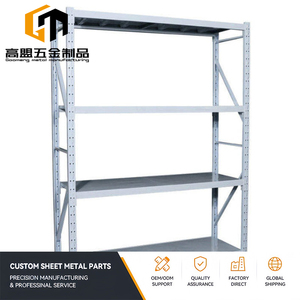
Engineered to comply with rigorous international racking safety codes (RMI MH16.1, EN 15512, and FEM 10.2.02). Every component is manufactured from high-yield structural steel coils, subjected to automated punch perforation and continuous cold-roll forming to guarantee structural resilience under heavy cyclic loading.
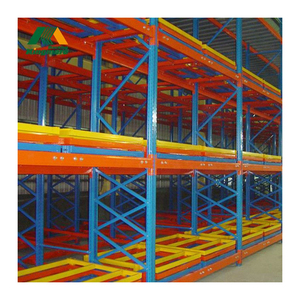
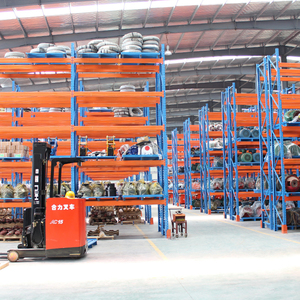
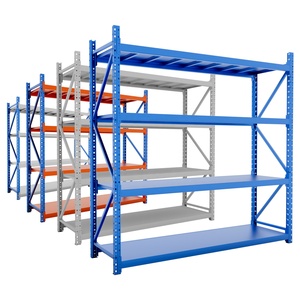
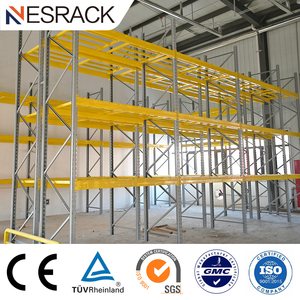
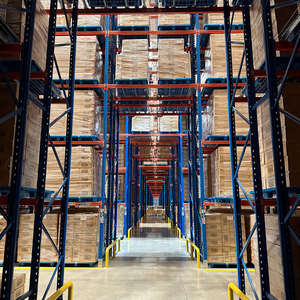
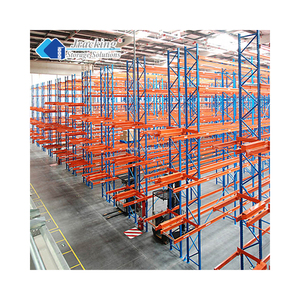
High bay warehousing has transitioned from standard static storage to tall, dynamically loaded steel frame structures. Modern distribution hubs require racking heights spanning from 12 meters to more than 40 meters, operating under tight engineering tolerances where floor settlement, elastic deflection, and seismic resonant frequencies govern system safety.
Structural upright frames utilize continuous-cast low-alloy high-strength Q355B and Q235B hot-rolled strip steel, cold-formed through multi-stand rolling lines. The inclusion of micro-alloying elements like vanadium and titanium refines ferrite grain boundaries, providing an exceptional yield strength of ≥355 MPa and tensile limits up to 510 MPa without sacrificing elongation under dynamic seismic cycles.
The cross-sectional geometry of high bay upright columns incorporates multi-bend Omega (Ω) profiles with inward-stiffened return flanges. This cold-formed profile significantly shifts the shear center closer to the centroid, suppressing torsional-flexural buckling under combined axial compression and biaxial bending moments defined by EN 15512 design algorithms.
Beam-to-column connections are modeled as semi-rigid spring joints rather than simple pinned hinges. High-precision 4-prong and 5-prong stamped connector hooks deliver calculated rotational stiffness values (C_d) ranging between 50 and 180 kNm/rad. This mitigates second-order (P-Delta) sway displacements throughout high bay corridors during peak forklift velocity passes.
| Storage Architecture Type | Maximum Practical Height | Floor Space Utilization | Selectivity Profile | Handling Machinery Class | Seismic Response Factor (R) |
|---|---|---|---|---|---|
| Selective Pallet Racking | Up to 12.5 meters | 40% – 45% | 100% Direct Access | Reach Trucks / Counterbalance | R = 4.0 (Standard Ductility) |
| Very Narrow Aisle (VNA) High Bay | Up to 18.0 meters | 60% – 65% | 100% Direct Access | Wire / Rail-Guided Turret Cranes | R = 3.5 – 4.0 (High Precision) |
| Drive-In / Drive-Through | Up to 11.0 meters | 70% – 80% | Batch LIFO / FIFO | Drive-in Counterbalance | R = 2.5 (Braced Framing) |
| Radio Shuttle High Bay | Up to 24.0 meters | 80% – 88% | Deep-Lane FIFO / LIFO | Automated Shuttles + Lift Mast | R = 4.5 (Dynamic Ductility) |
| Clad-Rack AS/RS Monolith | Up to 45.0 meters | 88% – 94% | Automated System Directed | Rail-Mounted Stacker Cranes (SRM) | R = 5.0 (Custom Dynamic FEA) |
Strategic warehouse procurement requires balancing capital deployment against operational agility. Global supply chains face rising urban real-estate rents, localized labor shortages, and aggressive net-zero decarbonization mandates, making structural racking a core physical driver of digital automation.
Traditional human-operated forklift aisles are being replaced by modular automated infrastructures. Modern high bay configurations are designed with sub-millimeter beam deflection tolerances (L/300 or L/400) to support robotic shuttles moving horizontally along high-precision guide rails, working alongside vertical lifts for high-throughput cube utilization.
Procurement teams are increasingly choosing rack-supported clad construction over conventional pre-engineered metal buildings. By utilizing the vertical high-bay upright structural frames to support the roof trusses, exterior wall cladding, and wind bracing, industrial facilities can save 20% to 35% in overall structural steel expenditures while accelerating project completion schedules.
With the expansion of cold-chain pharmaceutical networks and fresh food e-commerce hubs, cold-formed steel profiles must resist brittle-ductile transition shocks down to -30°C. Modern engineering specifications demand zinc-rich phosphating baths and heavy-duty thermoset powder finishes that maintain elasticity, preventing micro-cracking and rust creep caused by condensation.
Procurement departments are writing active structural monitoring clauses into engineering bids. Fiber-optic strain gauges and tri-axial wireless accelerometers embedded inside critical upright base plates feed live stress data into building management systems, notifying safety managers of impact damage or structural overloading in real time.
Environmental, Social, and Governance (ESG) guidelines are shifting procurement audits toward the mill origin of the steel coils. Manufacturers utilizing scrap-based Electric Arc Furnace (EAF) production methods with renewable energy matrices are preferred over traditional blast furnace lines, significantly lowering the embodied carbon score per pallet position.
For over a quarter of a century, Guangzhou Heda Shelves Co., Ltd. has stood at the forefront of heavy structural racking and industrial shelving manufacturing. Operating out of a state-of-the-art 30,000 square meter intelligent production complex in Guangzhou, China, our team delivers factory-direct engineering and turnkey logistics systems across 120+ countries.
Strict chemical & tensile verification of certified Q235B and Q355B coils.
CNC high-speed automatic uncoiling and precision slitting to exact strip tolerances.
High-tonnage progressive presses ensure pitch accuracy across 12m+ column lengths.
24 to 28 rolling passes shape cold steel into high-moment Omega profiles without residual stresses.
Flying saw synchronized cut-off within ±0.5mm length accuracy specifications.
Robotic gas metal arc welding (GMAW) joins connector claws to box beams cleanly.
Mechanical shot-blasting and edge profiling eliminate stress risers and sharp burrs.
Multi-tank chemical immersion removes mill scale, forming a protective zinc-phosphate substrate.
Automated Swiss Gema powder application followed by a 200°C cross-linking bake oven.
100% weld verification, coating thickness checks, and container-optimized packaging.
Industrial buyers and engineering consultants require verifiable proof of safety compliance for municipal permitting, fire marshal sign-offs, and insurance underwriting. Guangzhou Heda Shelves Co., Ltd. holds auditable, fully certified compliance credentials:
Certificate No. 2435-CPR-8605159: Formally authorizes compliance with EN 1090-1 execution of steel structures and EN 15512 industrial racking structural calculations for all Member States of the European Union and regional projects requiring European engineering standards.
Registration No. 18624Q00169R0M: Demonstrates stringent quality control protocols governing raw material traceability, robotic tooling tolerances, dimensional consistency, and weld seam integrity across all manufacturing units.
Directives 2011/65/EU and 2015/863: Verifies that all polyester and epoxy thermoset powder formulations are completely non-toxic, lead-free, and heavy-metal-free, making them safe for food storage, pharmaceutical hubs, and LEED-certified logistics centers.
Key engineering, financial, and logistical insights to guide project directors and procurement managers during the RFP design and vendor selection process.
Connect with our technical design team. Provide your warehouse dimensions and SKU profiles, and we will prepare a full CAD floor plan, 3D structural model, and detailed load calculations within 24 to 48 hours — completely free of charge.