Precision-Engineered Industrial Warehouse Racking Systems
Discover our high-density static and dynamic structural storage equipment. Manufactured strictly according to CE (EN 15512) and ISO 9001:2015 standards for seamless international logistics.
Engineered Reliability: Why Global Enterprises Choose HEDA
From initial structural FEA simulations to precision roll forming and turnkey global delivery, discover how our factory-direct capabilities de-risk your material handling infrastructure.
Structural FEA & Seismic Design
Full compliance with RMI, FEM 10.2.02, and EN 15512. Engineered with seismic-grade anchorage, moment-resisting base plates, and computer-verified deflection parameters for extreme earthquake-prone regions.
Certified European Standards
Verified through CE Certification No. 2435-CPR-8605159, ISO 9001:2015 Quality Management System No. 18624Q00169R0M, and comprehensive environmental RoHS compliance.
Tropicalized Pre-Treatment
10-stage automated surface preparation with pickling, iron phosphating, and electrostatic epoxy-polyester powder coating resisting >85% humidity, coastal salt-fog, and condensing environments.
Turnkey Export Packaging
Direct export from Guangzhou port (Nansha/Huangpu) with sea transit of 2–8 days to major Southeast Asian ports and containerized packing designed to achieve 98% cubic space utilization.
Push Back Racking Systems: Industrial Engineering, Kinematics, and Operations
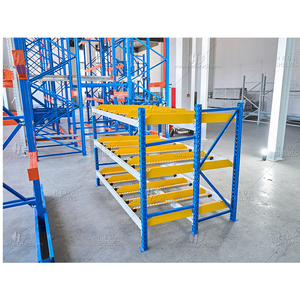
Dynamic push back pallet racking represents a transformative high-density material handling methodology that balances volumetric efficiency with rapid selectivity. Unlike static drive-in systems where lift truck operators must navigate deep inside structural bays—a process historically fraught with rack impact liabilities and slow operational cycle times—a modern push back rack system relies on gravity-driven kinematics operating within a single access aisle.
The operational premise utilizes a series of nested rolling carts gliding upon inclined structural channel tracks. The first pallet is positioned directly onto the top cart by a counterbalance or reach truck. When loading the second pallet, the operator gently pushes the initial pallet back, exposing the underlying nesting cart. For deep systems accommodating up to 6 pallets deep per lane, this progression repeats until the final pallet rests safely on the heavy-duty structural steel structural rails themselves.
Structural Kinematics and Load Bearing Physics
The mechanical integrity of push back systems hinges entirely on precision track gradient engineering and carrier wheel bearing performance. Guangzhou Heda Shelves Co., Ltd. incorporates low-profile rolling chassis assemblies manufactured from high-yield cold-rolled steel coils (Q235B and Q355B grades). The track gradient is tightly calculated at 1.5% to 2.2% declination:
- Controlled Gravitational Velocity: Sufficient inclination ensures pallets return smoothly to the aisle pick-face without manual assistance while preventing velocity acceleration that could compromise structural pallet stability.
- Sealed Bearings for Low-Temperature Resilience: Each nested cart utilizes heavy-duty flanged steel rollers containing hermetically sealed, self-lubricating ball bearings engineered to operate seamlessly from ambient distribution environments down to -30°C blast-freezer temperatures.
- Anti-Pinch and Lift-Off Restraints: Integrated multi-directional catch hooks prevent carts from jumping their tracks under dynamic forklift loading or abrupt directional shocks, ensuring unyielding warehouse safety.
Comparative Material Handling Matrix: High-Density Methodologies
When selecting a high-density warehouse storage architecture, project engineers must balance capital expenditure (CapEx), operational expenditure (OpEx), SKU selectivity, and operational cycle times. The table below illustrates the critical differentiation among core systems:
| Storage Architecture | Density Index | Stock Rotation | Aisle Requirement | Operational Velocity | Forklift Risk Profile |
|---|---|---|---|---|---|
| Push Back Racking (2-6 Deep) | 80% - 90% | LIFO (Lane Basis) | Single Loading / Pick Aisle | High (Forklift never enters rack) | Extremely Low (Protected Aisle) |
| Selective Pallet Racking | 50% - 60% | FIFO / 100% Direct | Multiple Dedicated Aisles | Moderate (Dependent on travel distance) | Low (Exposed uprights require guards) |
| Drive-In Racking | 85% - 95% | LIFO | Single / Double Lane Aisles | Low (Forklift navigates inside bays) | High (Direct rack upright impacts) |
| Gravity Pallet Flow Rack | 85% - 92% | Strict FIFO | Dual (Dedicated Charge & Pick Aisles) | High (Continuous gravity feeding) | Low (Separated entry/exit lanes) |
| Radio Shuttle Automation | 90% - 95% | FIFO / LIFO Hybrid | Single or Dual Working Aisles | High (Autonomous shuttle carrier) | Extremely Low (Electric shuttle handles lane) |
Future Procurement Trends: 2026–2030 Strategic Horizon
The global material handling equipment sector is experiencing rapid technological evolution spurred by escalating land acquisition costs, specialized cold storage expansion, and systemic labor constraints across Tier-1 logistics hubs. Procurement strategies are shifting toward dynamic modularity:
1. Total Cost of Ownership (TCO) Prioritization
Modern 3PL operators and enterprise warehouse executives are looking past basic steel weight quotations to evaluate total operational lifecycle costs. While drive-in racking offers lower initial steel procurement costs, its recurring maintenance overhead—caused by structural upright damage, pallet jams, and prolonged forklift driving hours—dramatically increases the 5-year TCO. Push back systems mitigate rack-entry collision risks, delivering documented operational ROI within 18 to 24 months through accelerated truck cycle times and reduced downtime.
2. Cold Chain and Blast Freezer Densification
The exponential growth of frozen food, cold dairy, meat processing, and biopharmaceuticals demands extreme cubic efficiency. Cooling one cubic meter of sub-zero volume consumes considerable electrical energy. Push back racking allows operations to increase pallet position density by 75% compared to selective racking without necessitating complex electrical infrastructure within -25°C compartments, establishing it as the most dependable mechanical densification solution on the market.
3. Hybridization with Automated Guided Vehicles (AGVs & AMRs)
The transition toward dark warehouses and autonomous transport is redefining push back engineering. Future-ready push back designs feature optical docking points, ultra-precise cart alignment sensors, and reinforced bumper interfaces that allow reach-truck AGVs and counterbalanced autonomous mobile robots to execute charge and discharge cycles without manual human intervention.
Strategic Manufacturing Advantages: Guangzhou Heda Shelves Co., Ltd.
With an established heritage dating back to 2001, Guangzhou Heda Shelves Co., Ltd. has established itself as an authoritative global manufacturer in high-capacity pallet racking, custom mezzanine platforms, and dynamic storage installations. Headquartered in Guangzhou, China, our advanced 30,000 square meter industrial campus delivers end-to-end engineering excellence:
- Integrated Production Chain: From high-precision slitting and automated CNC multi-station hole punching to advanced roll forming lines, robotic welding, and automated continuous powder coating, all manufacturing steps are executed on-site under strict ISO 9001:2015 controls.
- High-Throughput Output: With a robust production capacity exceeding 30,000 metric tons per month, we easily accommodate fast-track turnkey deliveries for large distribution facilities.
- Compliant Metallurgy & Finishes: All load-bearing members are manufactured using authenticated hot-rolled structural steel from premier mills, treated via automated acid pickling and phosphating lines to guarantee superior powder coat adhesion and corrosion resistance against severe tropical humidity and saline air.
- Global Technical Project Deployment: Over 10,000 completed installations deployed across 120+ countries, supported by full CAD spatial layouts, 3D structural modeling, and optional on-site engineering supervision.
Frequently Asked Questions (FAQ)
Technical guidance covering push back racking procurement, installation tolerances, maintenance, and international freight logistics.
What is the maximum depth and weight capacity of HEDA push back systems?
Our standard nested cart push back configurations accommodate 2, 3, 4, 5, and 6 pallets deep per lane. Load capacities range from 500 kg to 1,500 kg per pallet position, with heavy-duty structural designs supporting up to 2,000 kg per position upon custom structural review.
Can push back racks accommodate different pallet sizes in the same lane?
Yes. Because the carts can be custom engineered with full-perimeter support surfaces, wire mesh decks, or secondary crossbars, our push back systems can safely support GMA, Euro (EUR 1, 2, 3), and standard industrial Asian (1100x1100mm, 1200x1200mm) pallets within the same bay framework.
How do push back racks perform in low-temperature cold storage?
They excel in cold chain facilities. Unlike complex electronics that can experience battery loss or sensor failure at sub-zero temperatures, push back systems operate using reliable mechanical gravity. We utilize low-temperature lubricants and zinc-galvanized track finishes to withstand condensation and eliminate corrosion.
What floor levelness tolerances are required for push back racking?
While push back systems are more forgiving than Very Narrow Aisle (VNA) or automated AS/RS cranes, industrial slabs should comply with DIN 18202 or ACI 117 standards. Shimming plates and adjustable base assemblies are provided to calibrate the channel rails to the precise design gradient.
What shipping options, lead times, and port departures are available?
Production cycles average 15 to 25 days depending on project tonnage. We ship under EXW, FOB, CFR, and CIF terms from Guangzhou or Shenzhen ports. Direct sailing times range from 2 to 5 days to Vietnam and the Philippines, and 5 to 8 days to Singapore, Malaysia, and Thailand.
What documentation is provided for local building permit applications?
We supply full structural calculation packages, raw material mill test certificates (MTC), CE Declaration of Performance (DoP), 2D architectural CAD floor plans, and comprehensive 3D system assemblies to satisfy local structural code and building authority requirements.
Transform Your Warehouse Volumetric Capacity Today
Connect with our senior logistics structural engineers. Receive a bespoke CAD layout, 3D structural rendering, and comprehensive factory-direct export proposal within 24 business hours.
Send an Inquiry