Featured Industrial Pallet Racking & High-Density Storage Systems
Standardized cold-rolled structural steel, certified powder coating, and precision roll-formed components manufactured to FEM 10.2.02, EN 15512, and AS 4084 engineering tolerances.
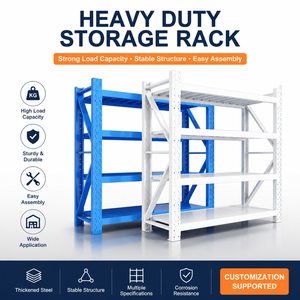
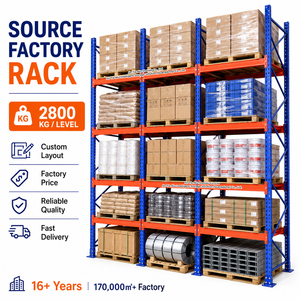
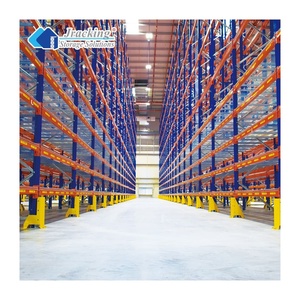
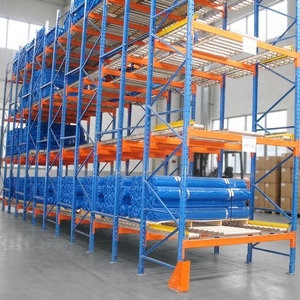
Structural Engineering, Metallurgy, and Compliance Benchmarks
Navigating global structural design codes requires profound insight into cold-formed thin-walled steel profiles, post-buckling behavior, and seismic dissipation parameters.
Steel Grade Specification (Q235B vs. Q355B)
The structural integrity of industrial racking starts at primary coil sourcing. For upright vertical columns carrying immense static and dynamic operational loads, premium Chinese exporters utilize certified continuous-cast Q355B high-tensile hot-rolled steel (minimum yield strength $f_y \ge 355\text{ MPa}$, tensile strength $470\text{–}630\text{ MPa}$). For horizontal cross-beams and bracing diagonals, Q235B grade ($f_y \ge 235\text{ MPa}$) provides optimal ductility, preventing brittle rupture under severe seismic or impact loading cycles.
Global Structural Design Codes
Top China racking manufacturers design their cross-sections, perforations, and connections to align rigorously with international mechanical codes:
- EN 15512:2020: European standard for adjustable pallet racking systems, governing finite-element joint non-linearity, global second-order effects, and torsional warping.
- RMI MH16.1: The American National Standard for the design, testing, and utilization of industrial steel storage racks, factoring in perforated section properties.
- AS 4084:2023: Australasian code mandating stringent limit-state design criteria, base-plate anchor pullout coefficients, and mandatory annual audit clearances.
Advanced Anti-Corrosion Finishing Protocols
In coastal zones, maritime logistics hubs, and tropical climates (e.g., Southeast Asia, Latin America), surface preparation determines structural lifespan. Standard cheap dipping leads to premature sub-surface blistering. Professional manufacturers employ an automated 10-Stage Pickling & Phosphating Pre-treatment line, removing mill scale and applying zinc phosphate conversion crystals. This is cured with an electrostatic Thermosetting Polyester Hybrid Powder Coating (60–90 μm) tested for 500+ hours in ASTM B117 salt-spray chambers.
Comparative Matrix: Tier-1 China Factory vs. Trading Agents vs. Local Integrators
Understanding where your Capex goes: Direct engineering accountability versus intermediate handling markups.
| Evaluation Parameter | Tier-1 China Factory (e.g., HEDA Shelves) | Export Trading Middleman | Local Domestic Reseller |
|---|---|---|---|
| Direct Material Traceability | Direct Coil Heat Number | Vague / Multi-Workshop Blends | Secondary Documentation Only |
| Structural Load Engineering | In-house CAD, 3D BIM, FEM FEA Calculations | Generic Template Data Sheets | Outsourced Third-Party Consulting |
| Manufacturing Scale & Speed | 30,000 Tons/Month, 10–20 Day Lead Time | Subject to Subcontractor Capacity | Warehouse Stock Limited (Slow Restock) |
| Quality Certifications | CE (No. 2435-CPR-8605159), ISO 9001:2015 | Often borrows manufacturer's certificate | Local compliance stamps only |
| Custom Profile Flexibility | Fully custom upright pitches, gauge, hole punches | Restricted to standard catalog options | High tooling surcharge for bespoke heights |
| Container Shipping Packing | Engineered 40HQ bundled steel nesting plan | Sub-optimal stuffing, damage risks | Domestic road transport freight charges |
| Unit Cost per Pallet Position | $14 – $22 / Pallet Direct FOB | $22 – $32 / Pallet Position | $38 – $65 / Pallet Position |
Future Procurement Trends in Industrial Warehouse Storage (2025–2030)
The confluence of high industrial land costs, soaring distribution wages, and omnichannel supply chain velocity is rapidly altering procurement specifications.
1. Transition from Static to Automated Shuttle Racking
Warehouses are transitioning away from traditional Drive-In racking toward semi-automated Radio Shuttle Systems and fully autonomous 4-Way Multi-Shuttle AS/RS platforms. This shift minimizes forklift transit inside racking aisles, reduces beam impact structural damage by 94%, and delivers 80% higher storage density within identical cubic dimensions.
2. Ultra-Tight Tolerances for AMR & AGV Navigation
Autonomous Mobile Robots (AMRs) require millimeter-level precision across base-plate leveling, floor anchor verticality, and beam deflection limits. While traditional human-operated lift trucks accommodate $\pm 5\text{mm}$ misalignments, robotic pickers demand beam deflections clamped strictly to $\le L/300$ or $L/400$, pushing factories toward continuous cold-roll profiling with laser inspection.
3. Low-Carbon Steel & ESG Procurement Mandates
Multinational enterprise buyers operating under Science Based Targets initiative (SBTi) now track Scope 3 embodied carbon across storage assets. Chinese mills are responding with electric-arc furnace (EAF) recycled scrap steel processing, solvent-free heavy powder finishes, and ISO 14001 certified environmental production loops.
4. Modular Mezzanines & Flexible Catwalk Platforms
E-commerce parcel volume fluctuations require adaptive vertical cube utilization. Rack-supported mezzanine platforms and multi-tier picking towers with modular perforated galvanized steel decking allow logistics operators to double or triple usable square footage without renegotiating warehouse leases or laying foundation slabs.
The 10-Step Quality Assurance Lifecycle: From Coil Slitting to Export Loading
Full vertically integrated fabrication across 30,000 m² of automated factory infrastructure guarantees structural reliability.
High-speed CNC slitting lines unwind primary Q235B/Q355B coils into custom profile strip widths with $\pm 0.1\text{mm}$ edge tolerance.
Multi-station automated punch presses stamp teardrop, diamond, or 75mm/50mm pitch connector slots with zero thermal stress.
Up to 24-stand sequential cold-rolling rolls heavy strip into complex multi-bend Omega columns with exceptional load-carrying geometry.
Double-C interlocking beam profiles rolled and seam-welded to create high torsional rigidity and uniform distributed load strength.
Multi-axis OTC welding robots fuse 3-claw/4-claw beam end connectors with deep weld penetration and zero human fatigue defects.
Immersion baths remove all organic lubricants, oxides, and roll-forming contaminants, exposing pure crystalline steel.
Conversion coating applies microcrystalline zinc phosphate layer, boosting powder adhesion and stopping creeping corrosion.
Reciprocating automatic spray booths coat profiles uniformly with solvent-free polyester powder charged at 60–80 kV.
200°C curing tunnel achieves polymer cross-linking, resulting in impact-proof, chip-resistant, industrial-grade hard coat.
Software-assisted packing bundles uprights, beams, and pallet supports, maximizing 40HQ volume up to 26 metric tons safely.
Industrial Rack Sourcing & Engineering FAQ
Clear, authoritative guidance addressing structural engineering parameters, international testing standards, and logistics management.
What is the standard beam deflection limit for selective pallet racking?
Under international engineering codes including EN 15512 and RMI MH16.1, the permissible vertical deflection limit under full uniformly distributed design load (UDL) is clamped at $\delta \le L/200$ for standard forklift-operated warehouses (where $L$ is the clear span distance between upright columns). For example, a standard 2700mm beam carrying two 1000kg pallets may deflect a maximum of $13.5\text{mm}$. In automated crane or AMR warehouses, this threshold is tightened to $L/300$ or $L/400$ to ensure sensor clearance.
How are racks engineered for high seismic zones (e.g., Philippines, Japan, US West Coast)?
In seismic risk territories, racks behave as non-building structures requiring dynamic modal response spectrum analysis. We calculate seismic base shear coefficients ($V$) in accordance with ASCE 7 or Eurocode 8, incorporating site ground accelerations ($S_s, S_1$). Structural countermeasures include oversized heavy base-plates ($180\times 150\times 10\text{mm}$ or thicker), double high-tensile chemical wedge anchors ($M12\times 120\text{mm}$), reinforced tubular horizontal/diagonal bracing, and heavier upright steel gauges ($2.5\text{mm}$ or $3.0\text{mm}$).
Why is hot-dip galvanizing (HDG) preferred over powder coating in cold stores?
In deep freeze and cold-chain warehouses operating between $-20^\circ\text{C}$ and $-30^\circ\text{C}$, relative humidity fluctuations during defrost cycles cause intense condensation and frost formation on steel surfaces. Standard powder coating can develop micro-cracks over repeated thermal expansion/contraction cycles, trapping moisture and triggering unseen sub-film oxidation. Hot-Dip Galvanizing creates an alloyed zinc-iron metallurgical bond (80–120 μm thickness) that sacrifices itself to protect the underlying steel, providing 30+ years of rust-free life in sub-zero environments.
How many metric tons of racking fit into a standard 40HQ shipping container?
Because structural upright frames and box beams have high rigidity and nesting potential, an experienced exporter packs steel profiles systematically using customized wooden Dunnage and steel strap bindings. A standard 40-foot High Cube (40HQ) container will safely accommodate approximately 22 to 26 metric tons of pallet racking components, equating to roughly 400–700 pallet positions depending on height and bay design, keeping ocean freight per pallet position below $2.50 across major sea routes.
What project parameters are necessary to obtain a free CAD layout and load calculation?
To produce an authoritative, turnkey AutoCAD layout and 3D architectural rendering, our engineering team requires: (1) Architectural warehouse boundary CAD file showing clear internal height under lowest roof beams/sprinklers, column locations, and dock doors; (2) Exact pallet parameters including width, depth, overall load height (including wooden runner), and gross weight; (3) Forklift specifications including mast lift height, collapsed mast height, and minimum turning radius (right-angle stacking aisle width); (4) Desired throughput target and SKU storage profile.
What documentation accompanies an international export shipment from Guangzhou?
Full commercial and technical packages include: Verified Bill of Lading (B/L), Commercial Invoice and Packing List, Certificate of Origin (Form E for ASEAN zero-tariff, CO, or Form A), EN 10204 3.1 Mill Test Certificates for raw steel coils, Third-Party Salt Spray Test Reports, CE Declaration of Performance (DoP), structural load rating signage plaques, and step-by-step CAD isometric 3D installation blueprints with marked component numbering.
Plan Your Warehouse Storage Project with Senior Engineers
Whether you are engineering a 25,000 m² distribution hub, converting clear vertical height into a multi-tier mezzanine, or retrofitting a cold-storage facility, our Guangzhou engineering headquarters provides full structural calculations, certified layouts, and factory-direct volume pricing.