
Top 10 Industrial Pallet Racking Systems Factories & Suppliers: Global Benchmarking Report
The global warehousing and logistics ecosystem is undergoing an unprecedented structural transformation. Driven by cross-border omnichannel e-commerce, automated fulfillment hubs, pharmaceutical cold storage mandates, and multi-national supply chain diversification, the demand for industrial pallet racking systems has escalated from basic structural steel assembly to highly calculated, seismic-engineered spatial optimization systems. Navigating the world’s leading racking manufacturers requires evaluating production capacity, steel fabrication precision, cold-formed roll tooling, international standard compliance (such as EN 15512, RMI MH16.1, and AS 4084), and surface anti-corrosion chemistry.
Industrial racking systems represent the structural backbone of high-throughput distribution centers. Selecting the correct manufacturing partner directly affects storage density, warehouse safety, fire code compliance, pallet cycle velocity, and long-term capital expenditure amortization. Below is the comprehensive technical comparison of the Top 10 industrial racking manufacturing powerhouses shaping the modern intralogistics supply chain:
| Manufacturer / Supplier | HQ / Production Base | Primary System Focus | Certifications & Structural Codes | Engineering Advantage |
|---|---|---|---|---|
| HEDA Shelves (Guangzhou HEDA) | Guangzhou, China (Export Hub) | Heavy-Duty Selective, Radio Shuttle, Mezzanine, Drive-In | CE (2435-CPR-8605159), ISO 9001:2015, RoHS | Direct-from-factory pricing, 2-7 days ocean transit to ASEAN, free 3D/CAD layout, custom roll-forming. |
| SSI SCHAEFER | Neunkirchen, Germany | Automated High-Bay Pallet Racking, ASRS, Cantilever | EN 15512, FEM 10.2.02, ISO 9001 | Turnkey automated systems integration, ultra-tall clad-rack structures exceeding 40 meters. |
| Mecalux S.A. | Barcelona, Spain | Pallet Shuttle, Movirack Mobile Bases, Drive-In | EN 15512, RMI, ISO 14001 | WMS software native synergy, extensive European distribution logistics, high modularity. |
| Dexion (Gonvarri Material Handling) | Kastrup, Denmark / Germany | Selective Pallet Racking, Dynamic Flow, P90 Multi-Tier | EN 15512, FEM, ISO 9001 | Pioneered early slot-in beam connections, deep European footprint, heavy-duty load tables. |
| Interlake Mecalux Inc. | Chicago, IL, USA | Roll-Formed & Structural Steel Pallet Racks, Push Back | RMI Certified, ANSI MH16.1 | Dominant North American footprint, severe fork-truck impact absorption structural channels. |
| Daifuku Co., Ltd. | Osaka, Japan | Unit-Load ASRS, Crane-Integrated High-Bay Racking | JIS B 8941, ISO 9001 | Extreme seismic dampening engineering, tight-tolerance robotics interfacing for automotive and electronics. |
| Stow Group (Movu Robotics) | Dottignies, Belgium | Conventional Selective, Stow Atlas Shuttle, Pallet Flow | EN 15512, FEM, ISO 9001 | Proprietary shuttle carriers, standardized automated manufacturing lines throughout Europe. |
| Ridg-U-Rak, Inc. | North East, PA, USA | Slotted & Tear-Drop Pallet Racking, Seismic Column Base | RMI, ANSI MH16.1 | Pioneering cylindrical column base isolates, proprietary hook-and-slot design for rapid assembly. |
| Frazier Industrial Company | Long Valley, NJ, USA | 100% Structural Steel Channel Pallet Racking | AISC, RMI Certified | Heavy structural hot-rolled C-channel construction resisting high-velocity forklift collisions in grocery hubs. |
| AR Racking | Zamudio, Spain | High-Density Drive-In, Shuttle, Galvanized AR Systems | EN 15512, ISO 3834-2 | Pre-galvanized upright frames as standard, extensive structural testing laboratories in alliance with universities. |
Within this tiered landscape, Guangzhou Heda Shelves Co., Ltd. serves as the crucial direct-manufacturing link bridging Western-grade structural standards with scalable manufacturing cost efficiencies. Operating from an integrated 30,000 square meter industrial campus in Guangzhou, China, HEDA Shelves addresses the critical pain point of lead-time bottlenecks and prohibitive distributor markups across Southeast Asia, the Middle East, Oceania, and the Americas.
Enterprise Strengths & Structural Reliability: The HEDA Engineering Ecosystem
Industrial pallet racking is not merely a steel commodity; it is an engineered life-safety structure subjected to static, dynamic, seismic, and operational impact stresses. Sourcing directly from Guangzhou Heda Shelves Co., Ltd. provides global procurement directors with certified technical superiority, guaranteed steel integrity, and specialized engineering support designed around site-specific floor-slab dynamics.
25+ Years Industrial Heritage
Established in 2001, HEDA Shelves has accumulated over two decades of technical mastery, deploying over 10,000 warehousing projects worldwide with zero structural failures under rated load envelopes.
30,000 m² Production Campus
Featuring automated continuous cold-roll-forming mills, robotic CO2 shielded welding bays, and specialized CNC punching machines producing up to 30,000 metric tons of certified racking monthly.
Verifiable Quality Certifications
Full regulatory compliance backed by European CE Certification (Certificate No. 2435-CPR-8605159), ISO 9001:2015 Quality Management System (No. 18624Q00169R0M), and comprehensive RoHS environmental safety.
Complimentary Engineering & 3D Layout
Our dedicated structural engineering team provides complimentary warehouse floor-plan analysis, 3D spatial simulations, and static/dynamic deflection calculations prior to commercial contracting.
Rapid ASEAN & Global Shipping Corridor
Direct positioning at Guangzhou and Nansha ports guarantees shortest ocean routes: 2-5 days to Haiphong/Cat Lai (Vietnam), 3-5 days to Manila, 5-7 days to Singapore & Laem Chabang, 6-8 days to Port Klang, and 7-10 days to Jakarta.
Tropical Surface Anti-Corrosion
A rigorous 10-stage pre-treatment featuring chemical pickling, alkaline degreasing, and phosphating prior to electrostatic polyester powder thermosetting, guaranteeing 500+ hours salt-spray resistance in 85%+ relative humidity.
Structural Reliability Guarantee: Every beam connector engineered by HEDA Shelves utilizes an interlocking multi-claw hook bracket with high-shear carbon steel safety pins, completely mitigating the risk of accidental forklift tine beam dislodgement under high-velocity warehouse picking routines.
From Raw Steel Coil to Container: The 10-Step Controlled Manufacturing Process
Quality in structural racking cannot be added via inspection at the loading dock—it must be rolled, punched, and baked directly into the steel profile. HEDA Shelves enforces a standardized, end-to-end 10-step fabrication protocol to eliminate micro-cracking, dimension drift, and coating delamination:
Prime Steel Coils
Certified Q235B & Q355B cold-rolled steel from premier domestic steel mills with mill test certificates.
Precision Slitting
CNC slitting lines accurately slice coils into custom strip widths with laser edge-burr removal.
Automated Punching
High-speed continuous CNC punch presses punch pitch teardrop, diamond, or butterfly holes at ±0.1mm tolerance.
Roll Forming
Progressive 18 to 24-station cold roll-forming lines shape upright omega columns and step/box beams without residual stress.
Automated Cut-Off
Flying hydraulic shears cut uprights and beams at exact design heights while roll lines run at full velocity.
Robotic Welding
Automated 6-axis robotic arms weld beam connectors, footplates, and truss spacers with CO2 shielding gas.
Weld Polishing
Mechanical seam dressing and shot blast conditioning remove weld splatter and mill scale across all structural joints.
Pickling & Phosphating
A multi-stage chemical submersion cleaning removes all trace grease and deposits a crystalline zinc phosphate conversion layer.
Powder Coating
GEMA electrostatic powder spray guns apply 60–80 micron high-durability epoxy-polyester powder, followed by 200°C curing.
QC & Bundling
Deflection load-testing, dry-film thickness measurement, barcode marking, and container-optimized nesting.
Engineering Configuration Spectrum: Matching System Architecture to SKU Profiles
Specifying the appropriate racking configuration is an optimization balance between inventory selectivity, SKU throughput velocity, and cubic building utilization. Industrial warehouses typically deploy a hybrid combination of the following systems:
1. Selective Pallet Racking (100% Direct Accessibility)
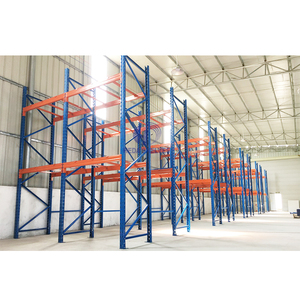
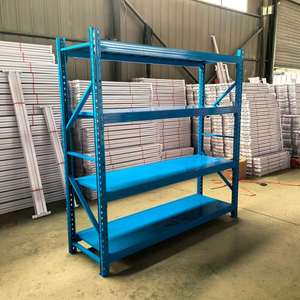
The global benchmark for multi-SKU fulfillment centers, selective racking provides immediate uninhibited accessibility to every individual pallet position. Configured in single-deep or double-deep layouts, selective racks accommodate standard counterbalanced forklifts, reach trucks, and VNA (Very Narrow Aisle) man-up equipment reaching heights up to 16 meters. Ideal for 3PLs, retail distribution, and FMCG operations where SKU diversity is vast.
2. Radio Shuttle High-Density Racking (Semi-Automated Pallet Carrier)
Radio shuttle systems combine the storage density of drive-in racking with superior operational velocity and safety. Pallets are placed onto deep lane rails by forklift trucks and transported independently by an intelligent, battery-powered radio shuttle cart. Forklifts never enter the racking channels, dramatically reducing frame damage, accelerating loading and dispatch cycles, and enabling rapid switching between FIFO (First-In, First-Out) and LIFO (Last-In, First-Out) modes. Highly recommended for sub-zero cold chain and food processing facilities where refrigerated cubic space costs are steep.
3. Heavy-Duty Cantilever Racking Systems
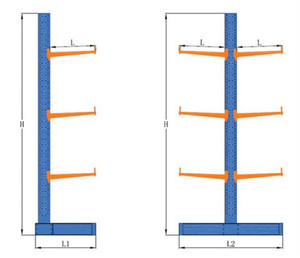
Engineered without front vertical upright columns, cantilever racks provide uninterrupted horizontal storage levels for extra-long, irregularly shaped, or bulky materials. Featuring central structural columns with bolted or wedge-pinned adjustable cantilever arms rated up to 3,000 kg per level, this system is the premier choice for timber merchants, PVC and steel pipe manufacturers, rebar fabricators, and building material distributors.
4. Heavy-Duty Drawer-Type Roll-Out Racks
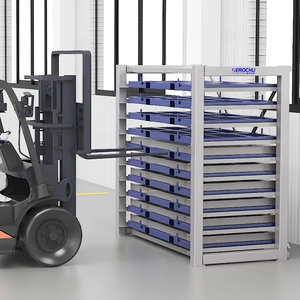
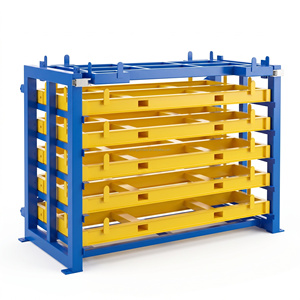
Designed for tooling storage, stamping dies, injection molds, and heavy machinery components, roll-out racking features extendable drawer decks capable of holding 1,000 to 5,000 kg per level. Operators can pull drawers outward smoothly via mechanical gearing, enabling direct overhead hoist or overhead bridge crane access, radically reducing tool-changeover downtime in automotive stamping and metal fabrication shops.
Future Procurement Trends in Industrial Pallet Racking (2026–2035)
Procurement directors and facility developers must anticipate systemic technology shifts over the 15-to-20-year operational lifecycle of modern racking infrastructure. The following five macro trends are redefining procurement specifications worldwide:
ASRS & AMR Automation Readiness
Future-proof racking procurement prioritizes tighter structural manufacturing tolerances (±0.5mm beam bow) and guide rail provisions to facilitate seamless retrofit integration with Autonomous Mobile Robots (AMRs) and automated crane lifters.
Decarbonization & Green Steel
ESG reporting mandates are impelling European and multinational enterprises to demand low-embodied-carbon steel profiles produced using electric arc furnace (EAF) scrap-melting processes and solvent-free, non-toxic powder coating formulations.
Rack-Supported Building Enclosures
To curb skyrocketing industrial land and construction costs, developers are turning to rack-clad buildings, where the heavy-duty racking framework itself supports the exterior cladding panels, purlins, and roof trusses, eliminating standalone structural pillars.
Dynamic Seismic Base Isolators
Regions situated along the Pacific Rim of Fire (such as the Philippines, Indonesia, and western North America) are specifying seismic dissipative baseplates and ductile anchorages that deform to absorb ground motion without catastrophic rack collapse.
IoT Structural Health Monitoring
High-bay logistics centers are beginning to install beam-deflection sensors, vibration monitors, and ultrasonic impact sensors along main transit aisles to continuously monitor post-collision strain and prevent localized buckling.
Factory-Direct Modular Supply Chains
Procurement teams are cutting through local distributor tiers, working directly with primary Chinese production plants like HEDA Shelves for turnkey custom engineering, containerized shipping, and bilingual technical field guidance.
Frequently Asked Questions: Industrial Pallet Racking Procurement
Authoritative technical answers to common engineering, structural validation, and cross-border shipping questions encountered by warehouse planners and purchasing agents:
What is the engineering difference between cold-rolled and structural steel racking?
Cold-rolled racking is fabricated from high-tensile sheet coils (typically Q235B or Q355B) rolled into intricate, lightweight, high-strength omega profiles and box beams with adjustable hook-in pins. Structural racking uses hot-rolled structural C-channels with bolted connections, offering extreme resistance against heavy forklift impacts at a higher weight and material cost.
How do you calculate safe working load limits and maximum beam deflection?
Under international design standards (EN 15512 and RMI MH16.1), maximum vertical deflection of a pallet rack beam loaded to design capacity must not exceed L/200 (length divided by 200) for standard operations, or L/300 when interfaced with automated handling equipment. All load ratings assume an evenly distributed load (UDL) acting downward on two parallel beams.
How does HEDA protect pallet racking against tropical humidity and coastal salt-mist?
Prior to coating, steel members undergo multi-stage chemical pickling to dissolve surface oxidation, followed by zinc-iron phosphating to build an anti-corrosion barrier. Components are then coated with thermosetting polyester-epoxy powder cured at 200°C. For sub-zero freezers and coastal outdoor setups, hot-dip galvanized finishes can be specified.
Can your structural calculations accommodate seismic loads in the Philippines & Indonesia?
Yes. HEDA Shelves engineers compute dead load, live load, and seismic inertia forces matching local building codes (such as NSCP in the Philippines or SNI in Indonesia). Our designs feature reinforced frame bracing, enlarged baseplates, and certified chemical or expansion wedge anchors calculated against site ground acceleration values.
What critical data must a client provide to receive an engineered CAD layout?
We require: (1) Architectural floor plan showing column locations, doors, clear height to truss undersides, and sprinkler drop levels; (2) Pallet dimensions (width × depth × overall loaded height and weight); (3) Forklift model, mast collapsed height, and turning radius (AST); (4) Operating ambient temperature; (5) Required total pallet position target.
How are shipping containers packed to prevent transit deformation and lower freight costs?
Upright frames are flat-packed or nested with structural dunnage, while beams are strapped into bundles using protective corner board caps and wooden spacers. All loose hardware is palletized in heavy-duty wooden crates. This optimized packing achieves maximum weight and volume utilization in 40HQ containers, lowering freight cost per pallet position.