Engineered Warehouse & Retail Storage Product Portfolio
Precision-fabricated industrial racking components, flow modules, and display systems direct from verified manufacturing facilities.
1. Carton Flow Shelving Mechanics: Kinematic Principles & Physics
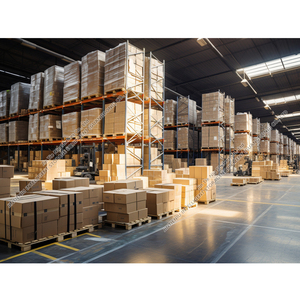
Carton flow shelving relies on dynamic gravity-fed inclined roller beds or skate wheel tracks configured inside structural upright frames. Unlike conventional static shelving that forces pickers and replenishment personnel to negotiate the same warehouse aisle, a carton live storage racking system establishes a dedicated First-In, First-Out (FIFO) mechanical separation: cartons and totes are fed from the rear loading aisle and roll down controlled gradients to the front pick face.
The operational efficiency of carton flow systems hinges on rigorous mechanical calculations:
- Track Pitch & Inclination Angle: The industry standard gradient varies from 2.5° to 4.5° (approximately 35 mm to 65 mm drop per meter of track length). Under-inclination induces carton stalling, requiring hazardous operator intervention, while over-inclination leads to high terminal velocity and package damage at the discharge tray.
- Roller Composition and Wheel Diameter: High-impact polypropylene, engineering-grade acetal resin, or zinc-plated steel rollers are selected based on the package envelope. For paper corrugated boxes prone to humidity sagging, cylindrical continuous steel or plastic rollers with larger surface contact areas prevent carton deflection, whereas rigid plastic tote bins operate reliably on staggered polypropylene skate wheels.
- Load Capacity per Shelf Level: Dynamic load configurations typically span 200 kg to 1,200 kg per bed level. Engineered box beams and intermediate tie bars must withstand static vertical loading combined with cyclic impact forces during carton drop-in feeding.
Full-Width Steel Rollers
Engineered for irregular carton bases, paper boxes sensitive to bottom deflection, and heavy manufacturing kitting up to 1,200 kg/level.
Skate-Wheel Track Modules
Low-friction polymer wheels staggered across aluminum or galvanized steel rails, ideal for standardized plastic container logistics and rapid re-profiling.
Integrated Pick-to-Light (PTL)
Digitally addressed LED indicator light strips and optical sensors embedded within front pick profiles to reach order picking velocities exceeding 600 lines/hour.
2. Global Benchmark: Top 10 Carton Flow Shelving Factories & Suppliers
Selecting an industrial storage supplier demands an objective comparison of structural manufacturing tolerance, anti-corrosion chemical treatment, modular reconfigurability, and export lead times. Below is the technical assessment of the 10 leading global carton flow shelving manufacturers and direct factories.
| Manufacturer / Supplier | Primary Manufacturing Base | Key Technical Strengths | Quality Standards | Target Application |
|---|---|---|---|---|
| 1. HEDA Shelves (Guangzhou) | Guangzhou, China (30,000 m²) | Direct mill steel roll-forming, pickling & phosphating, heavy-duty dynamic loading, 2-10 days ASEAN transit | CE / ISO9001 / RoHS | Global 3PL, Cold Storage, FMCG, E-Commerce, Factory Kitting |
| 2. Interroll Group | Sant'Antonino, Switzerland / Global | High-precision roller bearings, flow speed controllers, ergonomic magnetic speed limiters | EN 15512 / ISO 9001 | High-speed parcel hubs, automotive manufacturing |
| 3. SSI SCHAEFER | Neunkirchen, Germany | Integrated dynamic live storage, heavy industrial container integration, automated buffering | FEM / EN / DIN | Large-scale automated fulfillment distribution centers |
| 4. BITO Storage Solutions | Meisenheim, Germany | Boltless carton track clipping, high-density flow shelves, modular plastic bin compatibility | RAL-RG 614 / ISO 9001 | European pharmaceuticals, high-SKU picking |
| 5. UNEX Manufacturing | Lakewood, New Jersey, USA | SpanTrack drop-in roller lane technology, custom knuckle trays for ergonomic angle picking | RMI / ANSI MH16.1 | North American retail fulfillment, manufacturing lines |
| 6. Dexion (Gonvarri Material Handling) | Castellón, Spain / Germany | Heavy-duty carton live flow racking, pallet-supported hybrid integration, durable powder coating | EN / FEM 10.2.02 | Automotive component centers, retail distribution |
| 7. Mecalux | Barcelona, Spain / Chicago, USA | Extensive standard component catalog, easy integration with picking cars and conveyor loops | ISO 9001 / RMI | Global general merchandising and wholesale warehousing |
| 8. Nedcon (Steel King Group) | Doetinchem, Netherlands | High structural integrity, precision cold-formed sections, specialized mezzanine-supported flow systems | EN 1090 / ISO 3834 | Complex multi-tier warehouse mezzanine picking towers |
| 9. Apex Warehouse Systems | West Chicago, USA | Robust structural steel channels, heavy impact end-stops, durable cold chain carton tracks | RMI / AISC | Heavy manufacturing parts, cold-room live storage |
| 10. Frazier Industrial Company | Long Valley, New Jersey, USA | 100% structural steel tube construction, high impact resistance against warehouse machinery | RMI Certified | Industrial beverage distribution, harsh abuse operations |
3. Next-Gen Technological Evolution: 2025–2030 Procurement Trends
The global intralogistics procurement landscape is undergoing three monumental structural pivots that directly impact how supply chain directors specify carton flow systems:
A. Seamless AMR (Autonomous Mobile Robot) Interfacing
Modern fulfillment hubs are phasing out manual picking carts in favor of autonomous robots. Carton flow shelving now requires specialized discharge decks configured with optical sensor cutouts and zero-clearance drop-down stops. AMRs equipped with robotic arms or transfer conveyors dock directly at the carton flow pick face to extract cartons autonomously. Suppliers must design flow beds with millimeter-level dimensional repeatability to prevent robotic grip errors.
B. Anti-Static (ESD) Tracks for Microelectronics and EV Battery Manufacturing
With cleanroom production expanding in Southeast Asia and North America for semiconductors, precision sensors, and lithium-ion cells, conventional nylon and PVC rollers are obsolete due to static charge accumulation. The new engineering standard demands conductive carbon-infused polypropylene rollers with conductive ground wires tied to the steel frame, ensuring electrical resistance remains below 106 Ohms.
C. Climate-Resilient Surface Metallurgy & Cold-Chain Durability
Carton flow shelving deployed in tropical Southeast Asian distribution nodes (Malaysia, Vietnam, Thailand, Indonesia) faces constant ambient relative humidity above 80%, while chilled/frozen food distribution centers operate down to -28°C. Inferior standard powder coatings quickly develop micro-fractures, leading to subsurface rust creep and roller axle seizure. High-performance factories employ multi-stage chemical immersion—specifically acid pickling and zinc phosphating—prior to electrostatic thermosetting polyester powder coating, or hot-dip galvanizing for roller brackets and frame columns.
4. Total Cost of Ownership (TCO) & Common Sourcing Pitfalls
Procurement teams evaluating supplier quotations often commit critical specification blunders by prioritizing initial equipment purchase price over life-cycle structural durability:
- Overlooking Corrugated Box Bottom Sagging: Cheap systems with excessive roller spacing (e.g., 75 mm pitch) cause humidified corrugated boxes to bow between rollers, causing carton jams. Rigorous engineering calculations require roller pitch to be sized so that a minimum of three rollers support the shortest carton at all times.
- Inadequate End-Stop Engineering: At the front pick face, heavy cartons rolling down from a 4-meter depth accumulate considerable kinetic momentum. Thin sheet-metal stops quickly deform. Top-tier manufacturers supply integrated heavy-gauge impact stop plates with continuous welded reinforcements or spring-damped decelerators.
- Structural Deflection Under Dynamic Live Load: Upright and beam deflection must strictly adhere to L/200 or L/250 criteria under full dynamic loading to ensure tracks do not bow inwards, which pinches carton flow lanes and halts operations.
Founded in 2001, Guangzhou Heda Shelves Co., Ltd. has grown into an international powerhouse in warehouse storage systems, heavy pallet racking, carton flow shelving, and multi-tier mezzanine engineering. Operating from an integrated 30,000 square meter intelligent manufacturing facility in Guangzhou, China, HEDA combines high-volume production throughput with bespoke structural design.
30,000 Tons Monthly Capacity
High-precision automated continuous cold roll-forming lines, robotic welding stations, and high-speed CNC punching ensure on-time delivery for multi-thousand square meter fulfillment centers.
Tropical & Cold-Chain Chemistry
Proprietary 10-step surface finishing featuring intensive acid pickling, phosphating rust eradication, and electrostatic curing resisting coastal salt-fog, 80%+ humidity, and sub-zero condensation.
Direct Sea Logistics & Engineering
Free CAD structural layouts, 3D stress simulations, and rapid containerized shipping: 2-5 days to Vietnam, 3-5 days to Manila, 5-7 days to Singapore, and 6-8 days to Port Klang.
5. Carton Flow Shelving Procurement: Engineering FAQ
Engineer Your High-Density Gravity Storage Solution
Connect directly with HEDA Shelves' technical racking engineering department in Guangzhou. Get complimentary 2D/3D CAD layouts, dynamic carton flow load calculations, and competitive factory-direct pricing for your fulfillment center.