Heavy Duty
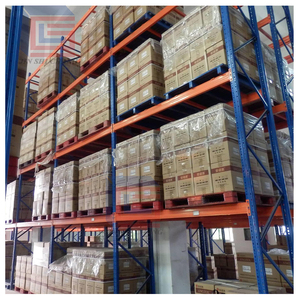
Manufactured strictly in compliance with international racking standards (FEM 10.2.02, EN 15512, ANSI MH16.1, and AS4084-2023). Every beam and upright assembly is verified through automated finite element analysis (FEA) to guarantee structural integrity across static, dynamic, and seismic operational loads.
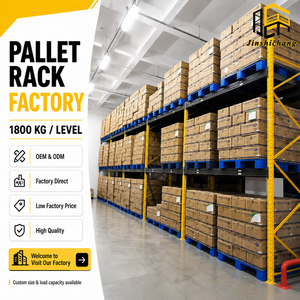
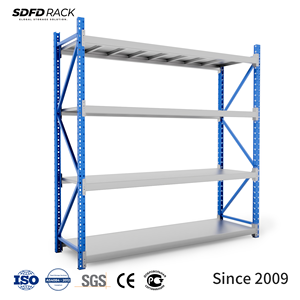
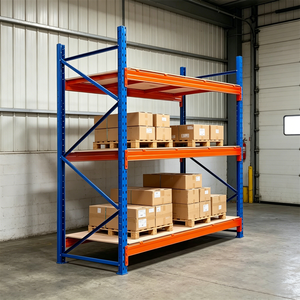
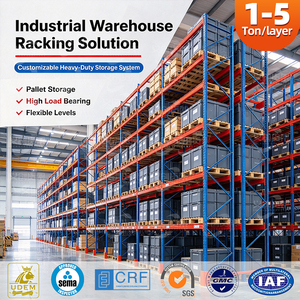
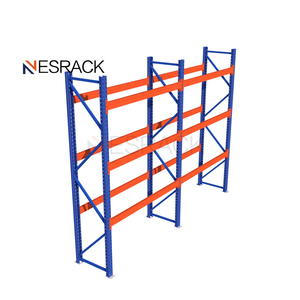
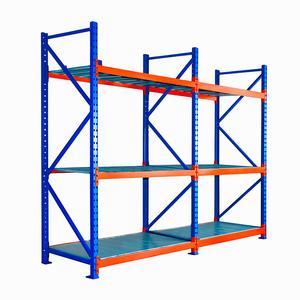
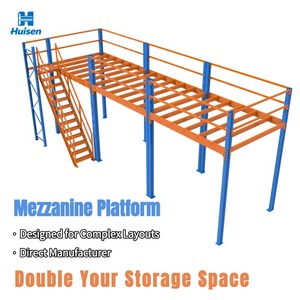
Wide pallet racking systems represent the critical interface between real estate investment and operational velocity. Achieving maximum volumetric cubic density while preserving absolute warehouse safety requires stringent structural compliance, accurate moment-resisting beam calculations, and specialized cold-formed steel manufacturing.
We engineer our wide upright frames and load beams utilizing premium Q235B and high-strength Q355B structural steel (equivalent to ASTM A572 Grade 50 and EN 10025 S355JR). The higher yield point of Q355B (minimum yield strength $\ge 355\text{ MPa}$) provides exceptional tensile resilience for multi-tier configurations exceeding 12 meters in clear height, while preventing fatigue failure under cyclic forklift impact and heavy dynamic loading.
Verified Chemical Composition: C ≤ 0.20%, Mn ≤ 1.60%, Si ≤ 0.55%
Under European FEM 10.2.02 and US RMI MH16.1 design codes, wide-span beam deflection is strictly capped at $\delta \le L / 200$ under allowable working load (and $\delta \le L / 250$ for automated AS/RS interfaces). Our dual-C interlocked box-beam profile delivers maximum section modulus ($W_x$) and moment of inertia ($I_x$), guaranteeing zero permanent plastic deformation across spans spanning up to 3900mm carrying tandem 1500kg pallets.
Integrated Safety Factor: 1.5 to 1.65 on ultimate yield tensile limit
In high seismic acceleration regions across Southeast Asia (such as the Philippines and Indonesia), horizontal spectral response accelerations ($S_s, S_1$) dictate frame design. We deploy oversized CNC-welded ductile baseplates anchored with heavy-duty M12-M16 chemical or mechanical wedge anchors, matched with portal top-ties and heavy tubular diagonal bracing to absorb dynamic ground displacements without progressive collapse.
Seismic Modeling: Full Response Spectrum Analysis via SAP2000
Selecting the correct racking architecture requires balancing floor area utilization, capital expenditure per pallet position, selectivity, and materials handling equipment (MHE) compatibility.
| Racking System Typology | Pallet Selectivity | Aisle Width (MHE) | Floor Space Utilization | Max Storing Height | Relative Cost Index | Primary Industrial Applications |
|---|---|---|---|---|---|---|
| Selective Wide Pallet Racking | 100% Immediate | 3.0m – 3.5m (Reach/CB) | 40% – 50% | Up to 12.0m | Standard Baseline (1.0x) | General Distribution, FMCG, 3PL Warehousing, Retail DCs |
| Double Deep Pallet Racking | 50% Semi-Selective | 3.1m – 3.6m (Pantograph) | 55% – 65% | Up to 11.5m | Moderate (1.25x) | Batch Manufacturing, Paper & Packaging, Dry Bulk Storage |
| Very Narrow Aisle (VNA) | 100% Immediate | 1.6m – 1.9m (Turret/Man-Up) | 60% – 70% | Up to 16.0m+ | High Rigidity (1.45x) | High-Density E-Commerce, Pharmaceutical, Expensive Real Estate Hubs |
| Drive-In / Drive-Through | LIFO / FIFO (Batch) | Aisles Eliminated | 70% – 80% | Up to 10.0m | Moderate-High (1.35x) | Cold Storage Freezers, Seasonal Harvest Goods, Uniform Raw Materials |
| Radio Shuttle High-Density | Semi-Automated (LIFO/FIFO) | Single Transfer Aisle | 80% – 88% | Up to 15.0m | Advanced Automation (2.2x) | Cold Stores (-25°C), High-Throughput Food & Beverage, Automated Logistics |
| Rack-Supported Mezzanine | Multi-Tier Pick & Store | Manual Cart / Hand Truck | 150% – 200% Floor Area | Multi-Level (2–4 Floors) | High Value Add (1.8x) | Apparel Fulfillment, Automotive Spare Parts, Small-to-Mid Piece Picking |
At our Guangzhou production headquarters, total quality control starts at raw steel slitting and extends through automated cold-roll profiling, continuous robotic seam welding, chemical pre-treatment, and international container stuffing.










Global supply chain disruptions, soaring logistics real estate pricing, aggressive ESG corporate mandates, and rapid adoption of autonomous mobile robots (AMRs) are permanently altering industrial pallet racking procurement strategies.
Procurement is pivoting from static manual racks toward semi-automated radio shuttle racking and full AS/RS integration. Wide-span racking designs now require ultra-tight beam fabrication tolerances ($\pm 1.0\text{mm}$) to interface seamlessly with laser-guided AGVs, pallet shuttles, and automated high-bay crane masts without mechanical sensor interference.
With global temperature-controlled food, pharmaceutical, and biological storage expanding at >11% CAGR, buyers demand metallurgical stability down to -30°C. Standard commercial mild steel undergoes ductile-to-brittle transition in freezer vaults; our cold-chain configurations utilize grain-refined Q355D/E steels combined with hot-dip galvanizing to eliminate micro-cracking and rust.
Tier-1 multinational enterprises (3PL, retail, FMCG) increasingly mandate Scope 3 carbon emission accounting across their capital equipment. We support our overseas procurement clients through transparent mill test certifications (MTCs), EAF (Electric Arc Furnace) recycled steel options, non-toxic heavy-metal-free thermoset powder coatings, and container nesting that slashes sea-freight emissions.
Uncertain economic cycles have rendered single-purpose racking obsolete. Modern buyers demand modular, reconfigurable racking designs capable of converting from standard selective pallet berths into long-span multi-tier mezzanine picking platforms or wire-mesh decked carton picking bays with simple connector pin adjustments and zero structural cutting on site.
Combining over 25 years of specialized racking manufacturing with deep industrial export engineering, our Guangzhou headquarters serves as the preferred direct OEM/ODM hub for warehouse contractors, distributors, and Fortune 500 logistics integrators.
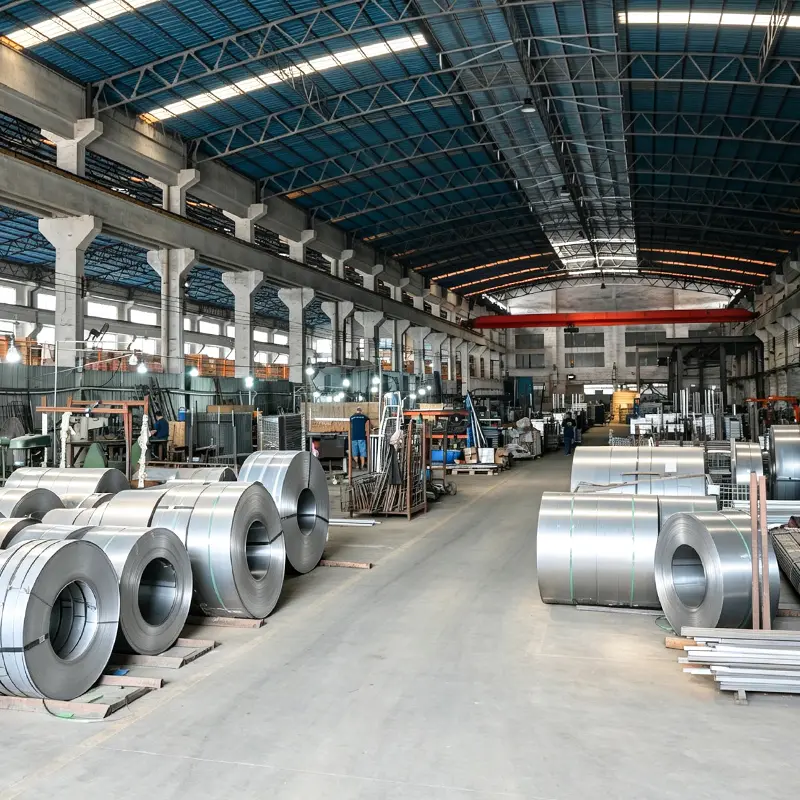
Established in 2001, our specialized production facility spans 30,000 square meters, supported by 300+ seasoned technical and production staff capable of delivering up to 30,000 tons of structural steel racking per month.
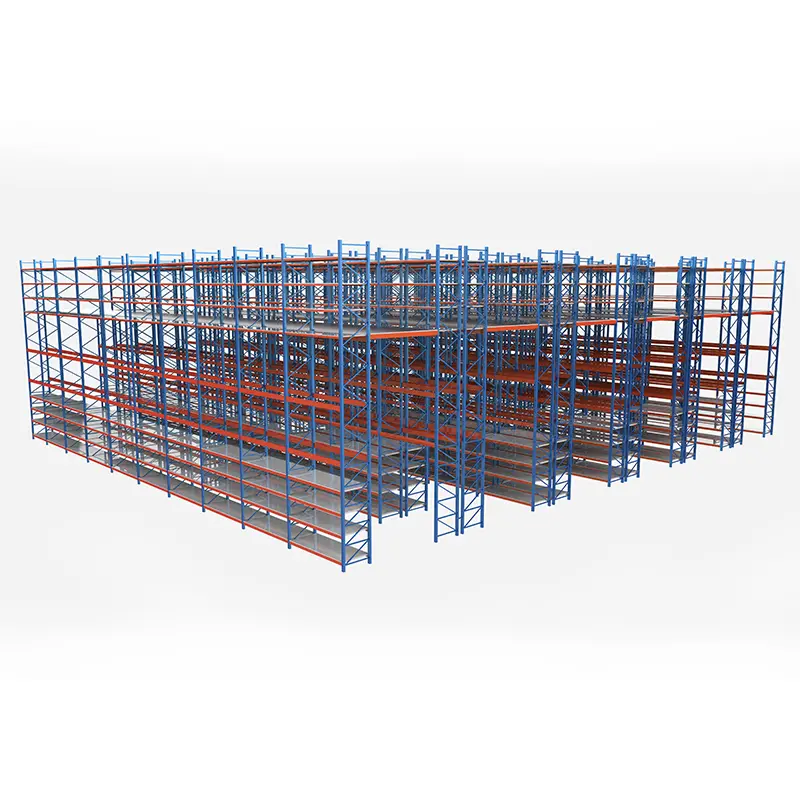
Our senior structural engineering team prepares comprehensive AutoCAD floor layouts, 3D digital twin renderings, and structural beam load calculations within 24–48 hours, fully tailored to your MHE turning radii and building column grids.
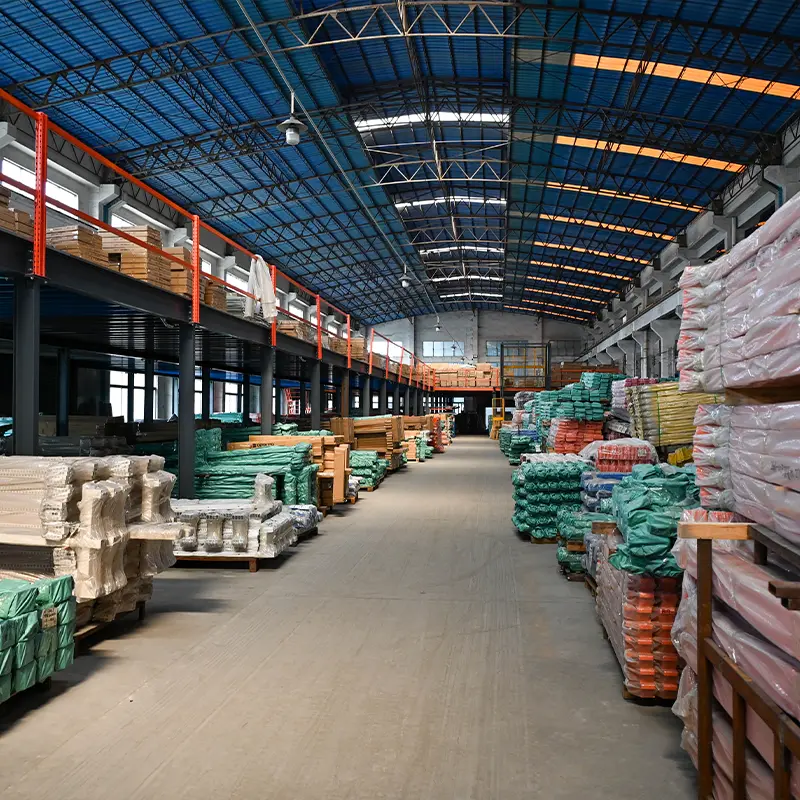
Components undergo an automated 5-stage acid pickling and zinc-phosphating bath before receiving electrostatically applied polyester powder coating cured at 200°C. Resists blistering and peeling even in 85%+ relative tropical humidity.
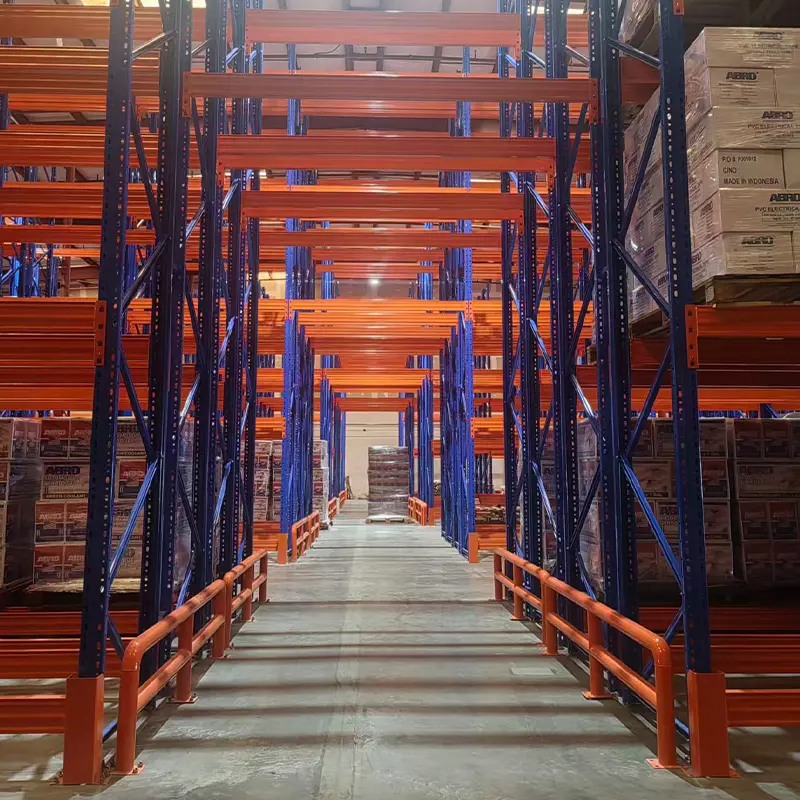
Export bundles are engineered to maximize container cubic capacity (40'HQ & 20'GP). Steel frames are protected with bubble wrap, corrugated cardboard edging, and non-marking steel strapping to guarantee zero transit damage during sea voyages.
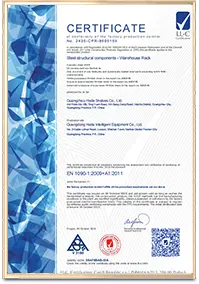
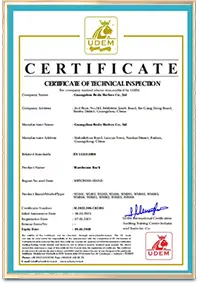
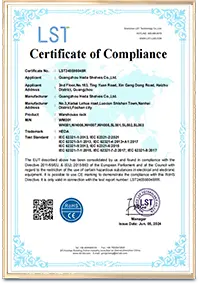
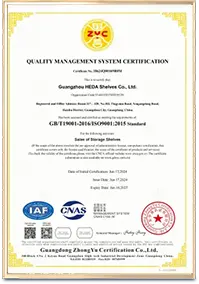
All export production undergoes rigorous mechanical testing in accordance with ISO 9001:2015 quality management procedures. We supply verifiable certificate dossiers to support your municipal building filings, civil engineering reviews, and commercial project tenders:
Authoritative, engineering-backed answers addressing the most critical concerns of warehouse project managers, supply chain directors, and overseas logistics importers.
In accordance with FEM 10.2.02 (Federation Europeenne de la Manutention) and ANSI/RMI MH16.1, the maximum allowable vertical deflection ($\delta$) of a pallet racking load beam under uniform distributed load (UDL) must not exceed $1/200$ of the clear span length ($L/200$). For example, on a standard 2700mm wide pallet beam holding two 1000kg pallets (total 2000kg load), the vertical sag must not exceed $13.5\text{mm}$. When integrating high-bay automated cranes (AS/RS) or turret trucks, a stricter limit of $L/250$ or $L/300$ is required to avoid pallet snagging on extraction. When the load is fully removed, the beam must return to zero deflection with no permanent plastic deformation.
Q235B (yield strength $f_y \ge 235\text{ MPa}$) is the global standard for low-to-medium rise selective racking up to 7–8 meters in clear height where beam capacities fall within standard limits. However, Q355B (yield strength $f_y \ge 355\text{ MPa}$) is engineered for:
Standard paint finishes quickly blister and peel under the 80–90% relative humidity typical of tropical regions (such as Southeast Asia, Latin America, and coastal logistics zones). We counter this with an automated multi-stage pre-treatment protocol:
Clearance calculations are governed by the Right-Angle Stacking Aisle ($A_{st}$) specification of your specific forklift model plus a mandatory safety cushion (generally 200mm minimum):
In seismic zones (such as the Pacific Ring of Fire, Indonesia, the Philippines, Japan, and the Western United States), warehouse racks behave as flexible skeletal steel structures. We perform dynamic spectral analysis according to FEM 10.2.08 and EN 16681:
Under NFPA 13 (Standard for the Installation of Sprinkler Systems), maintaining unobstructed chimney-like vertical openings is critical for ceiling ESFR (Early Suppression Fast Response) sprinklers to detect heat and suppress rack fires:
Yes. As a direct OEM/ODM manufacturer, we operate high-speed modular CNC punching dies capable of producing all global perforation standards: Teardrop pitch (US market standard 50.8mm / 2-inch pitch), European Diamond/Hexagonal 50mm and 75mm pitch, and Australian AS4084 76.2mm (3-inch) pitch. If you are an overseas distributor or system integrator looking to add bays or provide replacement beams for legacy installations (Dexion, Stow, Interlake, Redirack, Schaefer patterns), our tooling team can match your original profile geometries, hole pitches, beam end-connector claw arrangements, and custom RAL brand colors perfectly.
Every international export order dispatched from our facility includes a comprehensive documentation pack: Commercial Invoice, Packing List with piece-level container loading diagrams, Bill of Lading, Certificate of Origin (Form E for ASEAN tariff exemption, Form A, or RCEP certificates), Mill Test Certificates (EN 10204 3.1), and CE/ISO declarations of conformity. Sea transit from Guangzhou/Nansha/Shenzhen ports is fast and direct: 2–5 days to Vietnam, 3–5 days to Manila, 5–7 days to Singapore/Laem Chabang, 6–8 days to Port Klang, 7–10 days to Jakarta, and 12–18 days to Australia/Middle East. Third-party pre-shipment inspections by SGS, TÜV, or Bureau Veritas are fully welcomed.
Send our senior engineering team your warehouse architectural floor plans, ceiling clearance height, pallet dimensions, and lift truck specifications. We will deliver a free comprehensive AutoCAD layout, 3D structural rendering, and fixed OEM/ODM FOB/CIF quote within 24 to 48 hours.