High-Performance Storage Racking Configurations
Manufactured using high-tensile cold-rolled steel coils with precision automatic roll-forming. Each racking assembly is engineered for seismic endurance, certified load tolerances, and effortless vertical expansion.
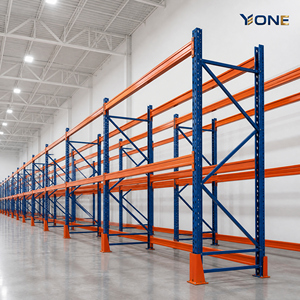
Heavy Duty Pallet Racking System Q235B Steel for Freight Distribution
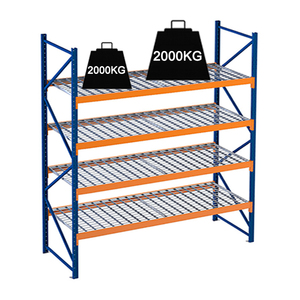
Stackable Storage Rack Pallet Racking Systems (1-3 Tons Tier Rating)
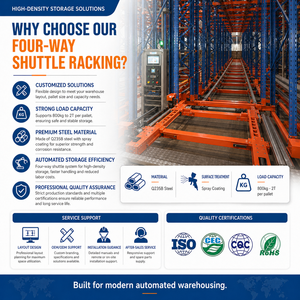
Automated Four-Way Shuttle ASRS Heavy-Duty Anti-Rust Storage System
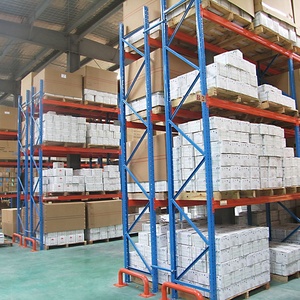
Customizable Boltless Steel Storage Double Deep Selective Pallet Racking
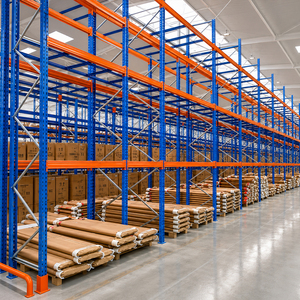
Selective Pallet Rack Q235B Beam Shelves Warehouse Storage System
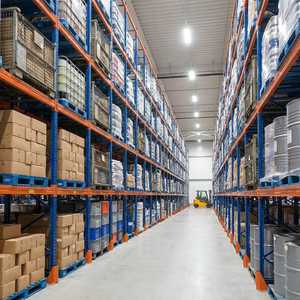
Heavy Duty Adjustable Selective Pallet Racking System for Manufacturing
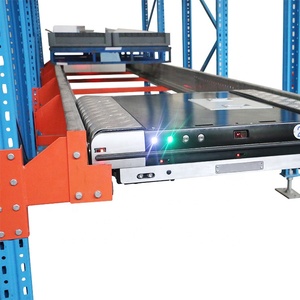
High Density Automated FIFO/FILO Pallet Radio Shuttle Racking System
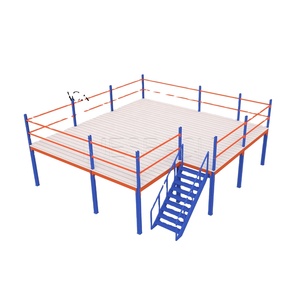
Customized Heavy Duty Multi-Tier Steel Mezzanine Platform Floor
Precision Steel Fabrication, Engineering Rigor & Rigorous Quality Control
Operating as a primary direct factory source since 2001, we deliver complete architectural, structural, and mechanical manufacturing services for distributors, contractors, logistics developers, and multinational brands worldwide.
Certified Structural Steel (Q235B / Q355B)
We source certified prime hot-rolled and cold-rolled steel coils exclusively from premier domestic mills like Baosteel and Shougang. Every mill batch undergoes ultrasonic thickness analysis, tensile yield testing, and chemical composition assay to verify compliance with EN 10025-2 standards.
Automated Continuous Roll-Forming Lines
Our workshop houses multi-stage roll-forming lines featuring computerized pitch punchers (50mm, 75mm, and 76.2mm international patterns). Automated cold-bending achieves micro-millimeter tolerance along 12-meter continuous upright posts without structural micro-fissuring.
10-Stage Surface Pre-Treatment & Coating
Prior to electrostatic coating, all steel elements pass through continuous acid wash descaling, alkaline degreasing, hot water rinsing, and silane or zinc-phosphate conversion coating. This guarantees 1,000+ hour salt-spray endurance and extreme resistance in humid or maritime zones.
Compliant Seismic & FEA Design
Our in-house design office utilizes Finite Element Analysis (FEA) software to simulate dynamic pallet impacts, live wind loads, seismic ground acceleration (UBC Zone 4, IBC 2021), and asymmetric localized loading patterns before cutting the first steel coil.
International Validated Compliance
We maintain full audit compliance with CE (EN 15512:2020), ISO 9001:2015 quality management systems, and ISO 14001 environmental frameworks. Our exported components match or surpass North American RMI (Rack Manufacturers Institute) and Australian AS4084 specifications.
Direct Sea Logistics & Packing Optimization
Situated in close proximity to major shipping terminals (Guangzhou / Nansha / Shenzhen), our specialized crating and bundling methodology optimizes container cubing (40HQ) by over 28% compared to standard loose stuffing, driving down intercontinental freight costs per pallet tier.
Warehouse Storage Systems: Comparative Technical Specifications
Evaluate load envelopes, spatial footprint efficiency, selectivity rates, and operational equipment requirements across our primary industrial racking product lines.
| Racking Architecture | Floor Space Use (%) | Direct Selectivity | Standard Load / Tier | Forklift / Automation Compatibility | Optimal Industry Application |
|---|---|---|---|---|---|
| Standard Selective Racking | 40% - 45% | 100% Immediate | 800 kg – 4,500 kg | Standard Counterbalance, Reach Truck | High SKU variety, fast FMCG, general 3PL hubs |
| Double Deep Pallet Racks | 55% - 65% | 50% (2-Deep Filo) | 1,000 kg – 3,200 kg | Deep-Reach Pantograph Forklift | Batch manufacturing, cold storage staging |
| Drive-In / Drive-Through | 70% - 80% | 20% - 30% (LIFO/FIFO) | 1,000 kg – 2,000 kg | Narrow-Chassis Counterbalance | Homogeneous bulk goods, seasonal warehousing |
| Semi-Automated Radio Shuttle | 80% - 88% | High in Deep Lanes | 500 kg – 2,500 kg | Radio Shuttle Cart + Standard Reach | Sub-zero freezers, meat & dairy, raw material buffer |
| 4-Way Shuttle ASRS Rack | 90% - 95% | 100% Automated Matrix | 300 kg – 1,500 kg | Automated 4-Way Shuttles & Vertical Hoists | Dark warehouses, pharmaceuticals, high-throughput DCs |
| Heavy Duty Mezzanine Platform | Doubles/Triples Footprint | 100% Floor Access | 300 – 1,000 kg/m² | Pallet Jacks, Vertical Cargo Lifts, AGVs | E-commerce sortation, assembly workshops, parts stores |
Future Procurement Trends in Industrial Warehousing (2025–2030)
As industrial rents escalate and supply chains demand higher velocities, the procurement of warehouse shelving and racking is undergoing a generational shift from static steel storage to intelligent, hybrid structural solutions.
Rise of Shuttle-Ready Hybrid Structural Infrastructure
Global warehouse operators are increasingly moving away from pure static drive-in systems due to high forklift impact damage and labor bottlenecks. Procurement specifications now routinely demand modular guide rails, reinforced column splices, and electrical conduits integrated into standard racking uprights. This allows logistics hubs to transition from manual forklifts to autonomous shuttle fleets without replacing structural frames.
High-Yield Thin-Walled Steel Profiling (Decarbonization)
With corporate Scope 3 carbon reduction mandates and volatile global freight rates, procurement heads are specifying ultra-high-yield micro-alloyed steel (e.g., Q355B and high-strength European grade S355MC). Complex roll-formed geometry with localized stiffening ribs maintains or improves load bearing and torsional rigidity while reducing raw material weight by 12% to 18% per pallet location.
Strict Tropical & Extreme Temperature Coating Compliance
The global boom in food-grade cold chains and e-commerce distribution in tropical coastal markets (such as Southeast Asia, the Middle East, and Latin America) has revealed major weaknesses in conventional single-dip paint. Procurement mandates have tightened to require automated multi-stage phosphate baths followed by hybrid epoxy-polyester architectural powders with a minimum cured thickness of 70–90 microns.
Prefabricated Rack-Supported Mezzanine vs. Civil Build
Skyrocketing land acquisition costs and protracted municipal building permit cycles have catalyzed heavy investment in rack-supported mezzanine platforms and clad rack structures. Buyers are bypassing conventional concrete-and-brick civil construction by utilizing structural steel racking frames that carry roof purlins, insulated sandwich walls, and multi-tier catwalk picking decks simultaneously.
Dynamic Sensor-Equipped Impact and Deflection Monitoring
Modern warehouse safety guidelines under OSHA and EN 15635 are shifting toward proactive structural health monitoring. Smart racking buyers are requiring factory-drilled mount points for IoT triaxial accelerometer sensors and impact collars on aisle end-frames. These early-warning devices immediately log accidental forklift strikes, registering deflection and structural stress alterations in warehouse management software.
Standardized Modular Interoperability for 3PL Elasticity
Because third-party logistics (3PL) providers handle fluid customer contracts with varying pallet dimensions (Euro 800x1200, US 40x48, Asian 1100x1100), fixed beam racking is becoming a commercial liability. Modern buyers insist on universal connector lugs, drop-in wire decks with deep waterfall flanges, and multi-slotted column profiles that can be reconfigured in hours without structural welding.
Frequently Asked Questions: Warehouse Shelving & Racking Procurement
Critical structural, metallurgical, and logistics answers compiled by our senior engineering team to assist industrial buyers, facility planners, and project procurement managers.
What are the structural differences between Q235B and Q355B steel in heavy racking?
Q235B possesses a nominal yield strength of 235 MPa and a tensile strength of 370–500 MPa, making it the most cost-effective, malleable steel grade for standard pallet racking, light industrial shelving, and short-span beams. Q355B (equivalent to ASTM A572 Grade 50 or European S355) offers a higher yield strength of 355 MPa. We specify Q355B for high-bay upright columns exceeding 9 meters, heavy mezzanine primary support columns, seismic baseplates, and extreme-load drive-in rails where localized deflection must be strictly suppressed without adding dead weight.
How are deflection limits calculated according to FEM and RMI standards?
Under both FEM 10.2.02 and RMI MH16.1 specifications, horizontal beam deflection under maximum working load must not exceed L/200 (where L is the clear span distance between uprights). For example, a 2,700mm beam bearing two 1,000kg pallets is permitted a maximum vertical deflection of 13.5mm. For automated shuttle racking and catwalk mezzanine support beams, our factory applies an even stricter deflection safety factor of L/300 to L/400 to prevent rail binding and secondary dynamic harmonics during shuttle transit.
What engineering parameters are mandatory for initiating an OEM/ODM proposal?
To produce an authoritative structural CAD layout, 3D render, and verified bill of materials (BOM), our design office requires: 1) Architectural CAD floor plan showing clear ceiling height, column grid spacing, sprinkler clearances, and floor joint locations; 2) Pallet specifications (width, depth, overall height including cargo, and true tare weight); 3) Handling equipment data (forklift turning radius, mast lift height, outrigger spacing); 4) Environmental conditions (ambient temperature, seismic zone, soil/slab concrete core test rating).
How does your factory ensure corrosion protection for coastal or freezer applications?
We provide two industrial finishing tiers: For ambient warehouses, components undergo automated shot-blasting (Sa 2.5), 10-stage chemical rinsing, and electrostatic thermo-cured epoxy powder coating (70–90 µm) passing ASTM B117 salt spray tests. For cold chain sub-zero facilities (-25°C to -30°C) or open marine sheds, we deliver Continuous Hot-Dip Galvanizing (HDG) compliant with ISO 1461, yielding a zinc layer of 60–85 µm that completely arrests rust under continuous condensation.
Can you engineer racking systems to meet strict seismic design codes?
Yes. We regularly engineer racking for high-risk seismic environments across Japan, the Philippines, New Zealand, and the Western United States. Using response-spectrum analysis according to IBC Chapter 16 and ASCE 7, our engineers integrate enlarged anchor footplates, double-anchor studs, heavy-gauge C-channel back-to-back portal ties, and diagonal cross-bracing towers that safely absorb ground shear forces without column shearing.
What is the standard production cycle and sea export packing methodology?
Standard fabrication lead time for a 10 to 50 container project is typically 18 to 25 calendar days. Racking uprights are bundled with steel strapping and protective edge cardboard, nested on bottom steel skids for forklift offloading. Beams are stacked in custom wooden crates with non-abrasive PE film interleaving to prevent powder scratching. Small components (baseplates, row spacers, shims, safety pins) are packed in reinforced wooden cases labeled with corresponding structural drawing numbers.
End-to-End OEM/ODM Project Delivery Process
From architectural discovery to final site load sign-off, our structured engineering protocol ensures zero dimensional mismatches and seamless installation speed.
Site Audit & CAD
Review of building drawings, pallet dimensions, and operational throughput targets.
FEA & Calculation
Finite element analysis, seismic stress verification, and member gauge selection.
Roll-Forming
Computerized cold-roll stamping, cutting, and robotic CO2 dual-beam welding.
Pre-Treatment
De-greasing, acid descaling, and phosphating in automated dip immersion baths.
Powder Coating
Electrostatic spray application and 200°C curing for high scratch and chemical defense.
QC Inspection
Weld seam ultrasound, thickness checks, drop tests, and dry test pre-assembly.
Export Crating
High-density containerization with bundle tracking tags and protective framing.
Site Deployment
Detailed 3D step-by-step installation blueprints with on-site engineer supervision.
Ready to Optimize Your Warehouse Volumetric Capacity?
Connect directly with our senior structural engineering team. Submit your warehouse dimensions, pallet configurations, or architectural drawings to receive a free, comprehensive CAD layout, 3D visualization, and detailed factory-direct quotation within 24 hours.