Engineered Load Systems
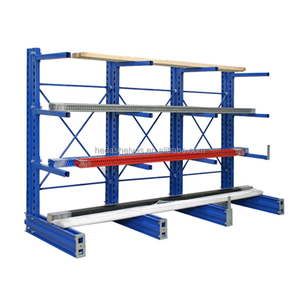
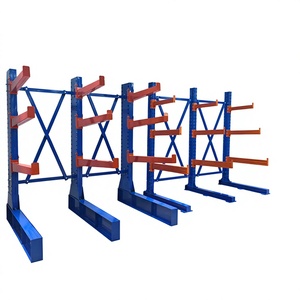
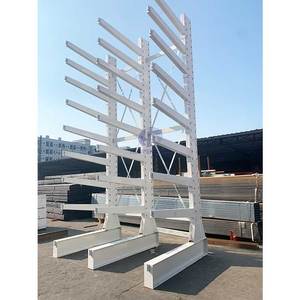
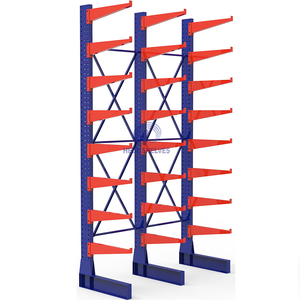
Featured Industrial Cantilever Storage Configurations
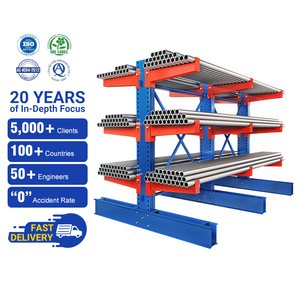
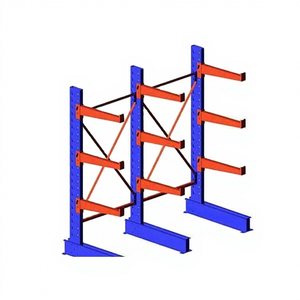
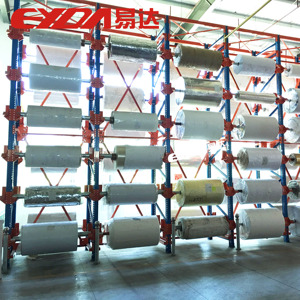
Standardized roll-formed and structural H-beam cantilever rack installations engineered to ISO 9001 and CE execution classes. Built for high-density horizontal material warehousing.
2001
Established Since
30,000 m²
Manufacturing Footprint
30,000 t
Monthly Steel Capacity
10,000+
Global Projects Built
Engineering Intelligence
Structural Principles of Industrial Cantilever Racking Systems
Cantilever racking represents the premier mechanical engineering solution for storing longitudinally extended, irregular, or non-palletized cargo. Unlike traditional selective pallet racking restricted by restrictive front-column uprights, cantilever designs provide unbroken horizontal storage bays. This uninterrupted horizontal accessibility eliminates frontal structural interferences, thereby allowing forklifts, side loaders, and overhead crane spreaders to handle timber packs, extruded aluminum, structural steel bars, PVC piping, conduit tubing, and sheet metal plates without risk of collision against vertical frame posts.
From a structural load-path perspective, cantilever systems transfer dynamic and dead loading via load-bearing arms anchored directly into heavy vertical uprights, secured horizontally by high-strength bolted base profiles. Upright columns are subjected primarily to extreme bending moments and axial compressive forces. High-yield Q235B and Q355B cold-rolled or hot-rolled structural steel profiles (such as universal wide-flange H-sections) are selected depending on clear height requirements, tier configurations, and maximum arm deflection parameters governed by FEM 10.2.02 and ANSI MH16.2 standards.
Roll-Formed vs. Hot-Rolled H-Beams
Roll-formed profiles provide an economical, fully adjustable design for medium loads (300kg to 1,000kg/arm), whereas heavy structural H-beams endure heavy shock loads and exceed 3,000kg per arm level in heavy metallurgy and timber processing operations.
Moment-Resisting Arm Connections
Our bolted and pivot-pin arm designs eliminate rigid weld points subject to fatigue under dynamic forklift impact. Pin-connected pivot arms can deflect upward and outward when bumped during lifting, mitigating severe structural damage to upright shafts.
Multi-Axis X-Bracing Assemblies
Structural stability relies on longitudinal cross-bracing bays consisting of structural C-channel or tension-rod bracing. This dynamic framework distributes horizontal shear loads evenly across the structural bay group during seismic excitation and high-velocity wind events.
Strategic Procurement 2026-2030
Global Procurement Trends in Heavy Material Warehousing
Macroeconomic industrial shifts, global port logistics dynamics, and the proliferation of Narrow Aisle operations are radically altering supply chain expectations for long-cargo management systems.
Automated Guided Cantilever Cranes & Stacker AS/RS
Procurement teams are shifting away from manual diesel counterbalance trucks. High-bay cantilever installations now interface directly with guided automated side loaders and automated storage and retrieval systems (AS/RS), necessitating sub-millimeter tolerances on arm leveling and column plumbness.
Climatic-Specific Anti-Corrosion Finishing
With industrial expansion into high-humidity and coastal manufacturing hubs (e.g., ASEAN, the Gulf Coast, and Mediterranean ports), buyers specify multi-stage pickling, phosphating, electrostatic powder baking, or full Hot-Dip Galvanizing (HDG) per EN ISO 1461 to guarantee 25+ years of outdoor service life.
Full Container-Optimized Modular Packing
Rising ocean freight rates have elevated container cubing efficiency to a top procurement metric. Buyers demand flat-pack, knocked-down structural modularity, where arms, columns, and bracing nests together to achieve 98% internal 40ft High Cube container cube utilization without transit abrasion.
Factory Excellence Since 2001
Guangzhou HEDA Shelves: Enterprise Manufacturing Authority
As a dedicated OEM/ODM warehouse storage manufacturer, Guangzhou Heda Shelves Co., Ltd. transforms structural engineering challenges into robust physical logistics assets.
30,000 m² Integrated Production Facility
Our Guangzhou mega-facility houses fully automated cold-bending roll-forming lines, automated column punch presses, robotic laser cutting units, dual-torch submerged arc welding fixtures, and continuous automated powder-coating lines, producing up to 30,000 tons monthly.
Full Free Engineering: 2D CAD & 3D Rendering
We do not offer generic catalog racks. Our engineering team reviews your site drawings, building clearances, aisle parameters, and forklift turning radii to return detailed 2D CAD layout schemes, finite element load models, and photorealistic 3D warehouse visualizations without charge.
Verified International Certification
We provide auditable documentation: CE Certification No. 2435-CPR-8605159, ISO 9001:2015 Quality Management No. 18624Q00169R0M, and comprehensive RoHS compliance. Every export project carries certified mill test certificates and full structural calculation sheets.
Procurement Guidance
Industrial Cantilever Racking: Technical FAQ
Critical structural, operational, and regulatory questions answered directly by senior warehouse racking project engineers.
How do we accurately determine cantilever arm length and load ratings?
Arm length must precisely match or slightly exceed the depth of the stored bundle or profile (commonly 800mm, 1000mm, 1200mm, or 1500mm). The safe working load per arm is calculated by dividing total package weight by the number of supporting arms, assuming a Uniformly Distributed Load (UDL). Overhang should not exceed half the distance between adjacent arms to prevent deflection failure.
When should a facility choose Single-Sided versus Double-Sided cantilever racks?
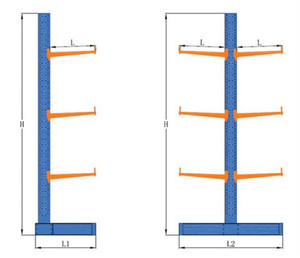
Single-sided cantilever systems are engineered to sit flush against building walls or warehouse perimeter envelopes. Double-sided cantilever columns feature a central spine with arms projecting in opposing directions. Double-sided installations offer superior mechanical balance, as opposing load moments cancel each other out, doubling linear storage density in central floor aisles.
What surface protection is recommended for outdoor industrial pipe storage yards?
For exposed outdoor yards subject to direct UV radiation, acid rain, or coastal salinity, Hot-Dip Galvanizing (HDG) per EN ISO 1461 is the engineering standard. Uprights, bases, and arms are submerged in a 450°C bath of molten zinc, metallurgical bonding an 85–100 micron protective shield. For controlled interior storage, electrostatically applied thermo-cured epoxy polyester powder coating provides superior impact resistance.
Can cantilever racks safely support short or fluctuating-length pallets?
Yes. By outfitting the cantilever arm tiers with continuous steel wire mesh decking, structural roll-formed steel shelf panels, or heavy-duty transverse support beams, the uninterrupted arm span transforms into continuous heavy shelving. This permits safe mixed-mode storage of standard wooden pallets, heavy crates, metal toolings, and short scrap cut-offs alongside long bar materials.
What concrete slab and anchoring specifications are required for cantilever columns?
Because cantilever racks exert concentrated overturning moment forces at the column base, they require a reinforced concrete slab (minimum C25/30 compressive strength, typically 150mm to 250mm thickness). Heavy chemical resin capsules or mechanical wedge anchor bolts (M16/M20/M24 grade 8.8) are installed to secure high-tensile baseplates against dynamic uplift and shear forces.
What is the typical FOB/CIF manufacturing lead time and transit schedule?
Standard production runs for 1 to 5 full 40HQ container loads are completed in 15 to 25 days at our Guangzhou manufacturing facility. Ocean transit from Guangzhou/Nansha ports ranges from 2–5 days to Vietnam, 3–7 days to the Philippines and Singapore, 6–8 days to Malaysia, and 18–28 days to European and North American primary sea terminals.
Design Your Custom Cantilever Infrastructure Today
Submit your warehouse floor layout, beam elevation parameters, and material load profiles. Our senior structural racking engineers will furnish a comprehensive 2D CAD blueprint, 3D render, and detailed bill of materials within 24 hours.
Get a Quote