Heavy Duty Selective
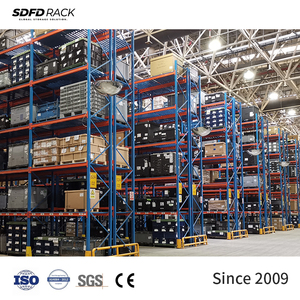
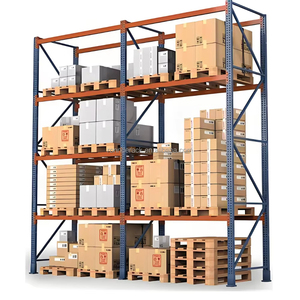
Heavy Duty Industrial Warehouse Selective Pallet Rack System
Load: 1,000–5,000 kg/tier
Cold-Rolled Q235B
Manufactured to FEM 10.2.02, RMI, and AS 4084 structural engineering codes. Directly configurable for pallet flow beds, automated shuttles, and narrow-aisle inventory profiles.
A rigorous engineering analysis of how gravity flow, centrifugal deceleration, and load separators resolve inventory rotation bottlenecks in cold-chain and FMCG warehousing.
In a true First-In, First-Out (FIFO) gravity-fed live pallet storage system, palletized loads travel down an inclined roller track using gravitational potential energy. The optimal slope gradient typically falls between 2.5% and 3.5% (approx. 1.5° to 2.0°), depending on pallet bottom construction (skids, 9-block, perimeter base) and unit gross weight.
Without engineered resistance, terminal velocity at the discharge face poses severe safety risks to operators and upright frames. To maintain controlled transit speeds between 0.25 m/s and 0.35 m/s, our OEM systems integrate internal centrifugal brake rollers at calculated intervals (usually every pallet position). These rollers dynamically exert resisting torque directly proportional to pallet velocity, preventing runaway impacts regardless of whether a lane is loaded with 400 kg or 1,500 kg loads.
One of the primary failure modes in poorly engineered FIFO racks is "line pressure accumulation." In a 10-pallet deep lane holding 1,000 kg pallets, the static forward thrust pressing against the front pallet at the picking face can exceed 350–500 kgf. This continuous horizontal load makes forklift extraction difficult, crushes fragile packaging, and threatens forklift mast integrity.
HEDA Shelves eliminates line pressure through mechanical pallet separator systems. When the front pallet reaches the discharge stop, a mechanical trigger disengages the roller section behind it, physically latching the second pallet 150mm upstream. Only when the first pallet is lifted clear by the forklift operator does the separator auto-trip, allowing the subsequent queue to advance by exactly one position under full deceleration control.
| Storage Methodology | Stock Rotation | Floor Space Utilization | Direct SKU Accessibility | Forklift Travel Time | Capital Cost per Pallet |
|---|---|---|---|---|---|
| FIFO Gravity Flow Racks | 100% Strict FIFO | Up to 80% (Ultra High) | 1 SKU per Lane | Minimized (Dedicated Faces) | Medium – High (Long-term ROI) |
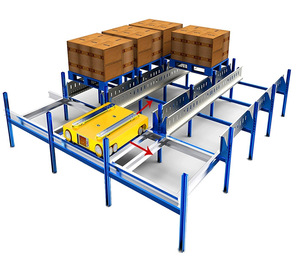
| Radio Shuttle Automation | Hybrid (FIFO / LIFO) | Up to 85% (Maximum) | 1 SKU per Channel | Extremely Low (Automated) | High (Fast Capital Recovery) |
| Drive-In Racking | Strictly LIFO | 65% – 75% (High) | Low (Batch Dedicated) | High (Forklift Enters Lanes) | Low – Moderate |
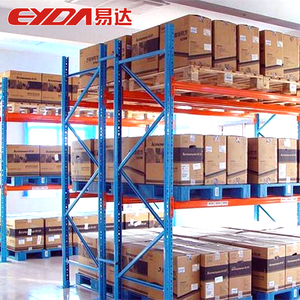
| Selective Pallet Racking | Manual FIFO Management | 40% – 45% (Aisle-Heavy) | 100% Immediate | Moderate to High | Lowest Initial Capex |
From custom structural punching geometries to marine-grade surface finishes, we tailor pallet racking architectures to individual engineering tolerances, national building codes, and material specifications.
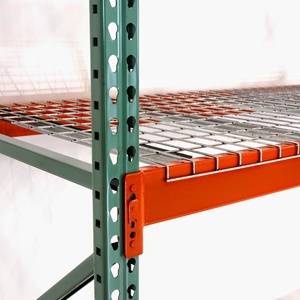
Fabricated exclusively from virgin Baosteel cold-rolled high-tensile carbon steel (Grade Q235B & Q355B). Upright profiles are roll-formed through 24-station automated rolling lines to secure millimeter tolerances, zero torsional twist, and load deflection limits strictly within L/200 under full static payload.
Every piece undergoes an exhaustive 8-step chemical pre-treatment cycle: degreasing, twin rinses, iron phosphating, and surface passivation. Electrostatic powder coating is applied at 70–90µm dry film thickness (DFT), baked at 200°C for exceptional resistance to high-humidity and saline environments.
Engineered site-specific to the international building code (IBC) and dynamic spectral accelerations (Ss, S1). In regions prone to seismic activity (such as Japan, Indonesia, and the Philippines), we calculate thickened baseplates, floor anchor shear values, and heavy-gauge cross-aisle portal bracing.
Dedicated distributor manufacturing programs including custom punch spacing (50mm, 75mm, 76.2mm teardrop), client logo laser-etching, specific RAL color codes, barcoded component bundles, and container stowage plans optimized to maximize 40ft High-Cube container volume.
How automation, real-time WMS telemetry, environmental ESG criteria, and cold-chain growth are reshaping global industrial storage procurement specifications.
The traditional forklift-loaded gravity flow rack is transforming into an automated picking and buffer interface. Procurement directors increasingly specify widened entry funnels, precision optical alignment targets, and reinforced floor buffers to accommodate Autonomous Mobile Robots (AMRs) and Automated Guided Forklifts (AGFs) that operate with sub-centimeter staging tolerances.
With global pharmaceutical cold chains and rapid-delivery frozen grocery networks expanding, FIFO racking must operate reliably down to -30°C without steel embrittlement or roller bearing grease freezing. Future demand focuses heavily on specialized food-safe low-temperature lubricants, galvanized roller tubes, and zinc-rich coatings that resist moisture condensation cycles.
Forward-thinking supply chain managers are shifting from purely static hardware to smart roller channels equipped with passive RFID sensing, weight-triggered inventory pulses, and automated brake performance monitoring. These IoT integrations communicate directly with Tier-1 Warehouse Management Systems (WMS) to prevent stock mismatches and track expiration dates automatically.
Combining over 25 years of metallurgical excellence with an integrated 30,000 m² factory footprint. Reliable supplier to top global logistics hubs, 3PL giants, and Fortune 500 manufacturing corporations.
Founded in 2001, providing structural racking design, roll forming, welding, and export execution for over two decades across 10,000+ facilities globally.
Massive production capacity powered by automated continuous roll forming lines, robotic welding stations, and high-speed multi-stage powder coating tunnels.
Third-party certified safety systems holding CE Certification (No. 2435-CPR-8605159), ISO 9001:2015 Quality Management (No. 18624Q00169R0M), and RoHS compliance.
Complimentary CAD warehouse floor layout, 3D architectural rendering, FEA load stress calculations, and complete installation drawings with on-site supervisor dispatch.
Key technical, structural, and shipping insights addressed directly by our senior structural engineering team.
Send your warehouse architectural drawings, pallet weight profiles, and daily turnover targets. Our engineering department will return a validated CAD layout, 3D structural render, and comprehensive factory-direct quotation within 24 hours.