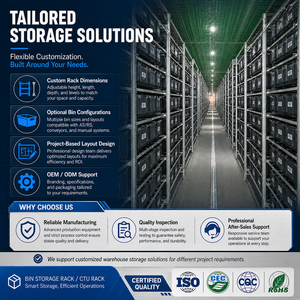
Engineered Storage Portfolio
Precision Structural Pallet Racking & Automated Systems
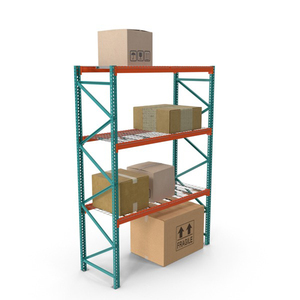
Manufactured using certified high-tensile Q235B cold-rolled steel with electrostatic thermosetting powder coating, delivering verified load capacities from 200 kg to 3,000 kg per level.
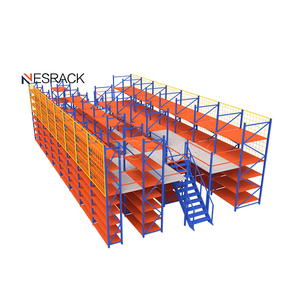
2001
Established Year
30,000t
Monthly Steel Capacity
30,000m²
Manufacturing Footprint
10,000+
Global Projects Delivered
Enterprise Reliability
Guangzhou HEDA Shelves Industrial Advantage
Combining heavy mechanical fabrication with computational structural modeling to support global procurement specialists, turnkey project contractors, and regional warehouse distributors.
Full-Cycle Direct Manufacturing
Unlike trading intermediaries, HEDA executes all 10 stages in-house: raw material slitting, computer-guided roll forming, hydraulic high-speed punching, robotic welding, automated pre-treatment, and electrostatic blue powder coating.
International Compliance Assured
Our engineered systems carry verified certification: CE Certificate No. 2435-CPR-8605159, ISO 9001:2015 Quality Management No. 18624Q00169R0M, and comprehensive RoHS chemical compliance, aligning with FEM 10.2.02 and EN 15512 safety codes.
Turnkey OEM/ODM Engineering
From custom beam-profile stamping (Dexion teardrop, box-beam, step-beam) to customer-branded column profiles and tailored RAL 5015 / RAL 5005 industrial blue powder applications, we match exact regional tenders.
Technical Whitepaper: Engineering Criteria for Industrial Blue Warehouse Racking
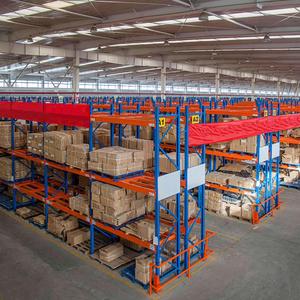
In modern industrial material handling, the distinctive industrial blue upright frame—often paired with safety orange (RAL 2004) support beams—represents far more than aesthetic convention. Color standardization enhances spatial depth perception for high-reach narrow-aisle forklift operators, minimizes glare under high-bay LED illumination, and supports rapid identification of structural load-bearing components. For industrial procurement teams, choosing an OEM/ODM blue warehouse racking manufacturer demands rigorous technical scrutiny over steel metallurgical standards, deflection coefficients, corrosion surface engineering, and dynamic load testing.
1. Material Specification & Structural Metallurgy: Cold-Rolled Q235B vs. Q355B
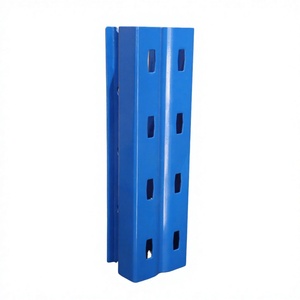
Reliable warehouse racking begins with high-grade carbon structural steel. HEDA Shelves utilizes cold-rolled Q235B and Q355B coil stock sourced exclusively from certified Tier-1 domestic steel mills. The yield point (yield strength $f_y \ge 235 \text{ MPa}$ for Q235B and $\ge 355 \text{ MPa}$ for Q355B) guarantees elasticity under sustained live load states. Uprights undergo roll-forming through a progressive 16-to-24 station roll train, producing continuous omega profiles ($\Omega$) with internal return bends that enhance torsional stiffness and buckling resistance under axial compression.
| Component Type | Material Standard | Profile Section (mm) | Material Thickness | Surface Treatment | Yield Strength ($f_y$) |
|---|---|---|---|---|---|
| Heavy-Duty Upright Columns | Q235B / Q355B | 80×60, 90×70, 100×70, 120×95 | 1.8 mm – 2.5 mm | Electrostatic Powder Coated (Blue) | $\ge 235 - 355 \text{ MPa}$ |
| Box Step Beams | Q235B Cold-Rolled | 80×50 up to 160×50 | 1.5 mm – 2.0 mm | Thermoset Polyester (Orange) | $\ge 235 \text{ MPa}$ |
| Pallet Support Crossbars | Q235B Structural Steel | 50×30 box / C-profile | 1.5 mm – 1.8 mm | Pre-Galvanized / Powder Coated | $\ge 235 \text{ MPa}$ |
| Mezzanine Primary I-Beams | Q355B Hot-Rolled | IPE 200 – IPE 400 | 4.5 mm – 11.5 mm | Anti-Corrosive Epoxy Primer + Topcoat | $\ge 355 \text{ MPa}$ |
2. Tropical-Grade Pre-Treatment & Electrostatic Polymerization
A recurring vulnerability in cross-border racking procurement is premature coating degradation and subsurface rust blister formation, particularly in tropical, high-humidity, or coastal storage environments across ASEAN, the Middle East, and Latin America. Raw cold-rolled steel carries protective oil films and surface mill scales that severely undermine direct powder adhesion.
HEDA implements a strict nine-stage continuous chemical pre-treatment cycle: hot alkaline degreasing, twin counter-flow water rinses, surface acid pickling (descaling), twin water rinses, surface conditioning, micro-crystalline zinc phosphating, and final demineralized rinsing. This forms an insoluble tertiary zinc phosphate crystalline boundary ($1.5 - 2.5 \text{ g/m}^2$) on the steel profile. The parts subsequently pass through an automated cleanroom where TGIC-free polyester epoxy powder is electrostatically applied via multi-axis reciprocating guns at 60–80 kV charge, followed by convection oven curing at $190^\circ\text{C}-200^\circ\text{C}$ for 20 minutes. The resulting coating achieves a dry film thickness of 60 to 90 microns, delivering superior cross-hatch cross-cut adhesion (Class 0 according to ISO 2409) and withstanding >500 hours of continuous neutral salt spray exposure (ASTM B117).
Future Sourcing & Procurement Trends in Industrial Racking Systems
Industrial storage procurement is transitioning from isolated structural hardware purchases toward integrated logistical architecture. Corporate buyers, regional supply chain directors, and EPC warehouse contractors must address the following macro trends shaping the market:
Integration with Autonomous Mobile Robots (AMRs) and Shuttle ASRS
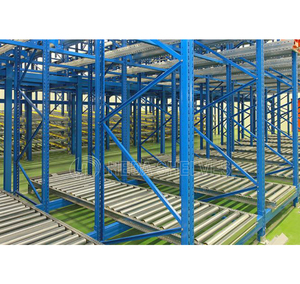
Static storage density has plateaued due to volumetric forklift reach boundaries and aisle dimensional requirements. As logistics operations address rising labor costs, forward-thinking operators are deploying high-density Radio Shuttle Racking and Automated Bin-Handling Mini-Load ASRS systems. Structural uprights and guide rails now require sub-millimeter beam leveling tolerances ($\le L/1000$) and specialized floor anchorages to ensure uninterrupted autonomous vehicle docking.
Seismic Resilience and Site-Specific Structural Verification
Major infrastructure development hubs across seismic belts (such as the Pacific Rim, Indonesia, the Philippines, and the Mediterranean) increasingly mandate building-integrated structural calculations. Modern procurement requires verified finite element analysis (FEA) evaluating overturning moments, ground acceleration coefficients ($S_s, S_1$), and live-load dissipation dynamics under local building standards rather than uniform static load charts.
Supply Chain Traceability and Low-Carbon Circular Manufacturing
Enterprise sustainability goals are making carbon footprint accounting an integral metric in industrial tenders. Global procurement departments are requesting steel source certifications, scrap-metal recyclability metrics, and zero-VOC powder-coating verification to comply with ESG frameworks and corporate scope-3 emissions disclosure protocols.
Ready to Calculate Your Warehouse Volumetric Capacity?
Send us your building dimensions, clear roof heights, pallet parameters, and handling equipment specifications. Our structural engineers provide complete CAD layout designs, 3D workflow simulations, and structural load calculations free of charge.
Procurement Intelligence
Frequently Asked Questions by Industrial Sourcing Teams
Direct technical answers addressing structural integrity, manufacturing capacities, international shipping, and OEM/ODM customizations.
What steel specifications and certifications are supplied with the racking?
We manufacture using certified Q235B and Q355B structural steel compliant with Chinese national standard GB/T 700 and European equivalent EN 10025 (S235JR / S355JR). Every production batch includes raw material mill test certificates (MTC) stating precise chemical composition (C, Mn, Si, P, S) and mechanical yield and tensile test results. Systems carry valid CE (2435-CPR-8605159) and ISO 9001:2015 accreditation.
Can HEDA engineer racks to integrate with existing Dexion or European profiles?
Yes. As an OEM/ODM specialist, our rolling mill trains feature adjustable cold-roll toolsets capable of matching Dexion upright profiles, teardrop hole pitches (50 mm, 50.8 mm, 75 mm, 76.2 mm), and connector hook patterns. We can manufacture compatible extension frames, add-on bays, or customized replacement beams that seat into existing warehouse rack grids.
How is container packaging managed to prevent transit damage on ocean voyages?
Upright frames and horizontal beams are nested, bundled, and strapped with high-tensile polyester bands over heavy-gauge corner edge protectors. Critical contact surfaces feature corrugated buffering, wooden skids, and moisture-resistant polyethylene wrapping. This packing density optimizes volumetric space within 40HQ ocean containers while preventing paint abrasion and profile twisting during intermodal freight movement.
What is the maximum achievable height and level load capacity?
Standard roll-formed selective pallet racking can reach column heights up to 12 meters with individual beam pair capacities reaching up to 4,000 kg per level under uniformly distributed load (UDL). For higher-bay applications or fully automated ASRS configurations exceeding 15 meters, we incorporate heavy structural I-beam columns and specialized baseplate anchorage systems.
What information is required to receive a comprehensive CAD proposal and quote?
We request your architectural warehouse floor plan (DWG or clear PDF) indicating column grid spacing, building clear heights, ingress/egress fire doors, and surface floor leveling tolerances. Furthermore, provide pallet parameters (width, depth, overall height including cargo, and maximum pallet weight), along with forklift brand, model, turning radius, and maximum mast extension.
What is the standard production lead time for full container orders?
Typical lead times for standard selective pallet racking ranges from 15 to 20 working days following final approval of engineering CAD drawings and deposit receipt. Highly customized mezzanine systems, specialized multi-tier catwalk structures, or large automation integration projects typically require 25 to 30 working days to complete fabrication, quality control, and trial assembly testing.