Featured Heavy-Duty Racking & Warehouse Handling Systems
Discover our primary export-grade push-back assemblies, dynamic runners, cold-storage compatible shuttles, and industrial pallets custom-manufactured in our certified facility.
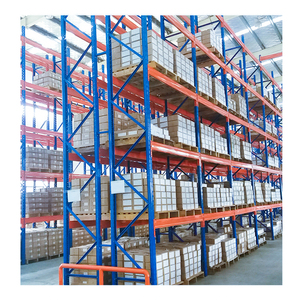 Direct Access
Selective Industrial Steel Pallet Racking System
Adjustable multi-tier pallet racking for rapid 100% SKU selectivity. Bolted beam connectors and safety drop locks.
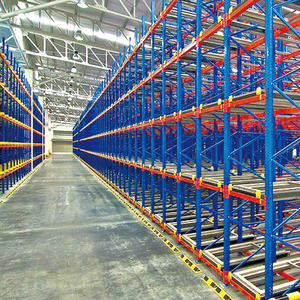 5-Layer Deep
Reinforced 5-Layer Heavy Duty Push Back Pallet Racking
Nested cart system riding on incline structural steel rails for dense LIFO picking without forklift lane entry.
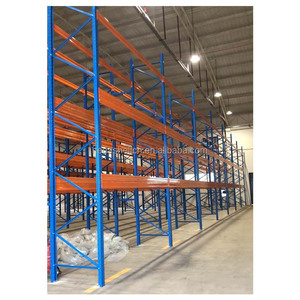 Heavy Duty
Industrial Heavy Duty Warehouse Storage Pallet Shelves
Standard and heavy-gauge upright frame assemblies engineered to withstand dynamic impact and heavy bulk staging.
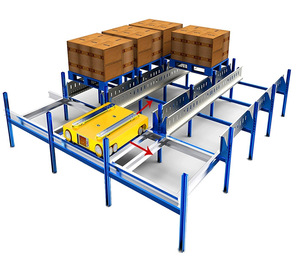 Semi-Automated
Automatic Radio-Controlled Warehouse Shuttle Racking
Intelligent motorized pallet runners navigating internal channel tracks. Maximizes cold storage cubic capacity.
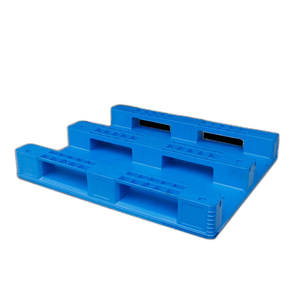 Logistics Pallet
NEXARA Heavy Duty HDPE Flat Surface Logistics Pallet
Precision-molded 1400x1400mm high-density polyethylene runners, optimized for push-back and shuttle contact surfaces.
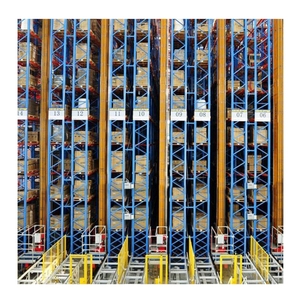 High-Bay AS/RS
ASRS High-Bay Racking with Integrated Stacker Crane
Precision-engineered high-tolerance structural racking framework designed for unmanned crane extraction systems.
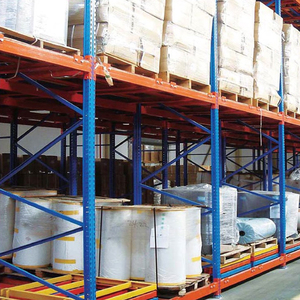 Corrosion-Proof
Electrostatic Powder-Coated Metal Push-Back Rack
Pickled, phosphated, and thermoset polyester-coated push-back racks engineered for high humidity and cold storage.
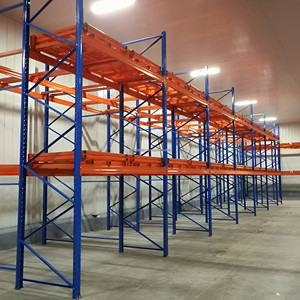 Ultra High-Density
High-Density Vertical Push Back Pallet Rack
Multi-tiered structural upright system configured with precision low-profile nested carts for optimal clear height usage.
Kinematics, Load Distribution, and Structural Mechanics of Push Back Pallet Racking
An authoritative technical reference for supply chain directors, structural engineers, and intralogistics procurement leads evaluating high-density storage solutions.
1. Kinematic Principles and Nested Carriage Engineering
Push back pallet rack systems operate on a gravity-assisted inclined mechanical rail system using a series of nested rolling carts (typically 2 to 6 deep). Unlike drive-in racking where forklifts must enter the structural matrix of the rack uprights, push-back racking isolates forklift movement strictly to the front aisle face. The first pallet is positioned directly onto the top cart carriage. When loading the second pallet, the forklift operator aligns the payload and gently pushes the initial pallet backward, exposing the underlying secondary cart.
The structural stability of this operation hinges on precise carriage slope inclination—typically calculated at an engineered gradient between 2.5% and 3.5% (approx. 1:40 to 1:30 slope). If the gradient is shallower than 2.0%, static friction within the cart ball bearings may cause pallets to stall upon extraction; conversely, an angle steeper than 4.0% induces excessive terminal velocity during retrieval, placing unsustainable shock loads on the front structural beam bumpers.
Physical Law of Carriage Movement: The push-back resistance force $F_{push}$ required by the forklift mast during loading is defined by $F_{push} = m \cdot g \cdot (\sin\theta + \mu \cdot \cos\theta)$, where $m$ is the combined pallet mass, $\theta$ is the rail incline angle, and $\mu$ is the rolling friction coefficient of the shielded steel bearing wheels. Our low-profile nested carts maintain $\mu \le 0.005$, ensuring minimum forklift strain and zero dynamic shifting.
At our Guangzhou automated fabrication facility, our structural engineering team utilizes FEA (Finite Element Analysis) to evaluate critical load stress nodes across carriage cross-members, wheel axle spindles, and inclined beam connectors under static, seismic, and dynamic deceleration loads.
2. Comparative Engineering Matrix: Push Back vs. Alternative High-Density Systems
Selecting the proper warehouse storage topology requires balancing floor density, capital expenditure, mechanical complexity, and picking cycle speed. Below is a comparative operational matrix compiled from verified project commissioning data:
| Storage Topology | Space Utilization | SKU Selectivity | Picking Cycle Time | Upright Damage Risk | Relative CAPEX | Inventory Logic |
|---|---|---|---|---|---|---|
| Push Back Racking (Nested Carts) | 75% – 85% | Moderate (1 SKU per lane) | Fast (Aisle access only) | Extremely Low (No entry) | Moderate | LIFO (Last-In-First-Out) |
| Drive-In Racking | 80% – 90% | Low (1 SKU per bay) | Slow (Mast travel inside lane) | High (Frequent collisions) | Low - Moderate | LIFO / Strict Batches |
| Pallet Flow (Gravity Roller Bed) | 85% – 90% | Moderate (Dedicated lane) | Very Fast (Separate load/pick) | Low (Dedicated faces) | High | FIFO (First-In-First-Out) |
| Radio Shuttle Automation | 85% – 92% | High Density / Moderate SKU | Automated / High Speed | Very Low (Shuttle inside) | High (Electronics & batteries) | FIFO or LIFO |
| Standard Selective Racking | 40% – 50% | 100% (Direct access) | Fastest per SKU | Moderate (Frequent turns) | Lowest Baseline | FIFO / LIFO Universal |
3. Strategic Procurement Trends Shaping 2025–2030 Warehousing
Industrial real estate rents have risen sharply across major international logistics hubs—from Southeast Asia (Selangor, Bangkok, Jakarta) to European 3PL corridors and North American transit nodes. This structural cost surge is accelerating high-density racking adoption. The primary procurement shifts our engineering consultancy observes include:
Cubic Compression over Footprint Expansion
Companies are retrofitting existing 8m to 12m clear-height warehouses with 4-to-6-deep push-back systems, unlocking up to 75% more pallet positions without the heavy tax and capital burden of new land acquisition.
ESG and Cold-Chain Thermal Efficiency
In cold stores and blast freezers, every cubic meter cooled directly impacts compressor power consumption. Push-back racking eliminates empty aisle corridors, dramatically lowering energy burn per stored metric ton of frozen food.
Seismic Resilience & Traceable Steel Compliance
Procurement directors increasingly bypass uncertified suppliers, demanding certified Q235B/Q355B hot-rolled strip steel, mill test certificates (MTC), and verified CE (EN 15512) and ISO 9001:2015 documentation for commercial insurance clearance.
4. Technological Advancements & Product Development Trends
Push-back racking has evolved significantly beyond rudimentary welded frames. Key engineering refinements manufactured inside our Guangzhou facilities include:
Ultra-Low Profile Telescoping Carriages: Traditional nested carts consumed significant vertical headroom (often exceeding 180mm per nest). Our multi-tier carriage profiles reduce nested height to less than 110mm, maximizing vertical clearance for oversized industrial pallets and preventing pallet-to-beam impingement during push actions.
Cryogenic Low-Temperature Bearing Assemblies: For blast freezers down to -30°C, conventional lubricating grease solidifies, causing cart wheel lockups. We utilize specialized dry-film or synthetic low-temp fluorinated lubricants paired with rubber-sealed labyrinth stainless steel bearings to ensure fluid, predictable kinetic descent.
Integrated Anti-Drop Centrifugal Braking Buffers: In 5-deep and 6-deep installations carrying pallets exceeding 1,200 kg, excessive kinetic accumulation during pallet extraction can damage forklift masts. We incorporate secondary dampening friction blocks and centrifugal speed-governing rollers along the track channel, ensuring safe, controlled pallet presentation at the pick face.
Guangzhou Heda Shelves Co., Ltd. — Your Global OEM/ODM Partner
Since 2001, providing high-precision structural steel racking to over 120 countries. Direct factory fabrication without broker margins.
Controlled 10-Stage Fabrication
From raw high-tensile steel coil slit-cutting, precision continuous roll-forming, automatic column punching, robotized welding, to multi-stage pickling and phosphating, our in-house manufacturing guarantees tight dimensional tolerances.
Tropical & Marine Grade Coating
Warehouses in Southeast Asia and coastal zones face relative humidity above 85%. Our electrostatic powder coating line applies thermosetting epoxy resin cured at 200°C over phosphated steel, resisting corrosion and salt air pitting.
Certified Structural Integrity
Backed by CE Certificate No. 2435-CPR-8605159, ISO 9001:2015 Certification No. 18624Q00169R0M, and strict RoHS compliance. We perform comprehensive mechanical deflection checks on every production run.
Complimentary 3D & CAD Engineering
Our dedicated structural engineering office provides warehouse space optimization layouts, forklift turning clearance checks, upright load-deflection profiles, and seismic calculations at zero cost prior to contract finalization.
Container-Optimized Logistics
Components are tagged, bundled, and container-packed with custom dunnage to maximize 40HQ cube utilization. Direct maritime access via Guangzhou/Nansha ensures rapid transit to global deep-water ports.
Turnkey OEM / ODM Customization
We produce customized upright hole pitches (50mm, 75mm, 76.2mm teardrop), specialized cart dimensions for European, Australian, or US GMA pallets, and custom color-coded powder coating tailored to customer corporate schemes.
Frequently Asked Technical Questions (FAQ)
Detailed answers addressing engineering tolerances, seismic compliance, pallet specifications, and operating clearances.
Request an Engineering Proposal & Free 3D CAD Warehouse Layout
Send us your warehouse dimensions, clear height, pallet dimensions, and SKU profile. Our certified engineering department will deliver an optimized high-density push-back racking layout, structural load matrix, and direct-factory FOB/CIF quotation within 24 hours.
Get a Quote