Engineered Warehouse Storage Racks & Systems
Precision cold-rolled Q235B/Q355B structural steel components designed for multi-tier fulfillment, palletized bulk logistics, and dense material handling environments.
Why Global Procurement Officers Partner with HEDA Shelves
Founded in 2001 in Guangzhou, China, Guangzhou Heda Shelves Co., Ltd. has developed into an internationally certified powerhouse in heavy-duty intralogistics infrastructure, exporting to over 120 countries worldwide.
25+ Years Engineering Mastery
Our technical teams specialize in finite element stress simulation (FEA), calculating Euler buckling parameters and beam deflection ratios under stringent dynamic payload conditions.
Complimentary CAD & 3D Modeling
Receive professional AutoCAD floor configurations, forklift turning radius simulations, and 3D architectural elevations without design fees prior to order confirmation.
CE & ISO 9001:2015 Certified
Fully certified under CE Certificate No. 2435-CPR-8605159 and ISO 9001:2015 No. 18624Q00169R0M, guaranteeing consistent yield strength and raw mill chemical traceability.
Optimized Sea Freight & ASEAN Speed
Positioned strategically next to Guangzhou and Nansha ports. Direct maritime routes provide 2–5 days transit to Vietnam, 3–5 days to Manila, 5–7 days to Singapore, and 6–8 days to Port Klang.
10 Controlled Steps: From Prime Steel Coil to Container Stacking
Unlike small assembly brokers, every upright frame, connector lug, welded baseplate, and load beam is formed in-house using automated continuous roll-forming lines.










Future Procurement & Technology Trends in Industrial Storage Racking
An authoritative engineering assessment for global supply chain leaders, warehouse project managers, and logistics real estate developers on modernizing storage density and lowering total lifecycle costs.
| Storage Racking Architecture | Floor Space Utilization (%) | Accessibility Index | Material Handling Unit Required | Optimal SKU Throughput Profile | Seismic & High-Bay Rating |
|---|---|---|---|---|---|
| Selective Pallet Racking | 35% – 42% | 100% Direct Picking | Standard Counterbalance / Reach Truck | High SKU Variety, Low-to-Medium Density | FEM 10.2.02 / RMI |
| Double-Deep Racking | 50% – 58% | 50% First Pallet Entry | Deep-Reach Pantograph Forklift | Medium SKU Variety, 2-4 Pallets/SKU | High Rigidity Tested |
| Drive-In / Drive-Through | 65% – 75% | Filo / Fifo Batch Run | Narrow Counterbalance (Inside Lane) | Bulk Raw Materials, Seasonal Harvests | Top-Tie Reinforced |
| Radio Shuttle Automation | 78% – 88% | Automated Internal Runner | Standard Forklift at Aisle Face | Cold Storage, FMCG, Beverage Bottling | PLC Dynamic Brake |
| Multi-Tier Mezzanine Platform | 150% – 280% Cube Gain | Floor-by-Floor Access | Manual Carts, Vertical Freight Hoists | E-commerce Parcel Picking, Auto Spares | 300-1000 kg/m² Rated |
1. Automated Shuttle Integration over Static Corridors
The global warehousing landscape is shifting rapidly from static drive-in corridors to semi-automated and fully automated Radio Shuttle Racking Systems. In conventional drive-in setups, forklifts must drive physically into the racking channels, increasing column impact damage rates by up to 68% over a three-year window.
Next-generation procurement focuses on pallet carriers governed by independent lithium-iron-phosphate (LiFePO4) power cells, communicating over 5.8 GHz Wi-Fi protocols with warehouse management systems (WMS). This eliminates aisle travel, drops cycle dispatch times to under 45 seconds per pallet, and ensures sub-zero operability down to -28°C in frozen seafood and pharmaceutical distribution facilities.
2. Metallurgy: Q355B Cold-Formed High Tensile Coils
Rising ocean freight metrics demand higher structural efficiency per ton of imported steel. Sourcing trends have progressed from standard hot-rolled generic angles to continuous cold-rolled omega-profile uprights using certified high-yield Q355B and Q235B structural grade coils.
By utilizing high-strength alloys with precise elongation percentages (yield strength ≥ 355 MPa), upright profiles achieve a 18% reduction in component deadweight while simultaneously increasing localized buckling threshold loads. Multi-bend profile geometry (such as 11-13 fold roll profiles) provides high moments of inertia (Ix, Iy), dramatically resisting torsional distortion during heavy seismic excitation.
3. Surface Pre-Treatment for Severe Tropical Climates
Industrial operations across Southeast Asia, coastal Latin America, and the Middle East struggle with early oxidation caused by ambient relative humidity exceeding 85% and airborne chloride salts. Traditional single-stage spray coatings suffer delamination within 18 months under coastal warehouse atmospheric conditions.
Future-proof procurement mandates an automated nine-stage pre-treatment wash including hot alkaline degreasing, zinc-phosphate micro-crystalline deposition, and demineralized rinses before applying thermosetting polyester resins. For aggressive cold-room condensation and semi-outdoor coastal loading platforms, hot-dip galvanization to EN ISO 1461 standards provides barrier protection lasting in excess of 20 years.
4. AGV / AMR-Friendly Floor & Rack Tolerances
Autonomous Mobile Robots (AMRs) and automated forklifts require tight structural deflection tolerances. Where conventional racking accommodates upright verticality deviations up to H/500, AGV-integrated high-bay configurations must respect stricter EN 15620 Class 300 tolerances (H/750). Modern Chinese manufacturers are incorporating laser-guided punching machines to hold hole pitch tolerances within ±0.1 mm over continuous 12-meter upright lengths.
5. Modular Multi-Tier Mezzanine Engineering
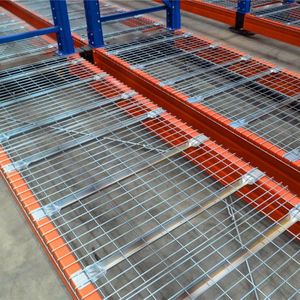
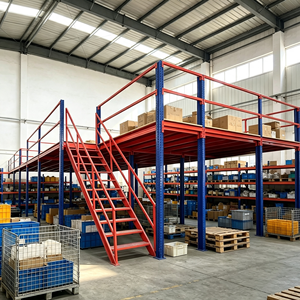
E-commerce logistics centers are facing skyrocketing land costs. The solution is vertical cubic expansion through rack-supported and structural steel mezzanines. By utilizing rolled continuous C/Z purlins and interlocking galvanized steel grating, multi-tier platforms convert vertical warehouse height into 2 to 4 levels of pick-and-pack floor space without civil structural re-permitting, bearing floor loads from 300 kg/m² to over 1,000 kg/m².
6. Sustainable Powder Recyclability & LCA Metrics
Environmental, Social, and Governance (ESG) guidelines now impact Tier-1 industrial tenders. Modern production facilities utilize TGIC-free architectural-grade polyester powder coatings with zero volatile organic compound (VOC) emissions. Closed-loop recovery cyclone collectors recapture up to 98% of oversprayed powder particles, and RoHS compliance ensures steel decking and fasteners are completely free of hexavalent chromium and lead.
Calculating Total Cost of Ownership (TCO) in Bulk Racking Procurement
Evaluating initial quotation prices versus operational lifecycle resilience. Understand the direct parameters determining factory pricing, structural safety, and container freight yield.
Raw Coil Steel Weight Accuracy
Industrial racking costs correlate directly with certified steel mass. Disreputable suppliers often trim sheet thickness by 0.2 mm (e.g., claiming 2.0 mm but delivering 1.8 mm nominal thickness). Over a 40HQ container, this subtle deviation compromises structural capacity by up to 22%. HEDA provides certified ultrasonic thickness testing and mill certificates with each batch.
Container Packaging Density
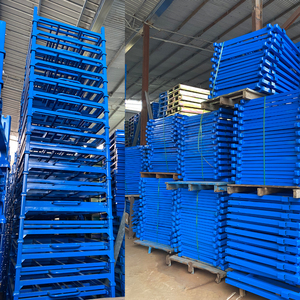
Because racking components are long and rigid, improper packing results in "shipping air." Our packaging engineers utilize custom 3D nesting layouts to pair heavy upright bundles with nested box beams, maximizing shipping containers to the full 26,000 kg payload limit and reducing sea freight cost per pallet position by 15% to 25%.
Seismic Certification Verification
Warehouses located along active fault zones (such as Indonesia, the Philippines, New Zealand, or western South America) require custom-engineered baseplates, anchor shear ratings, and K-bracing. Ensure that your supplier supplies structural calculation reports detailing dynamic seismic coefficient responses before final container dispatch.
Frequently Asked Technical Questions by Global Buyers
Clear, engineer-level responses addressing structural certifications, steel chemistry, container logistics, seismic compliance, and on-site assembly supervision.