Featured Industrial High Bay & Heavy-Duty Racking Systems
Engineered for extreme volumetric storage density, seismic resilience, and intensive throughput. Explore our flagship heavy-duty warehouse racking solutions manufactured in accordance with strict international safety standards.
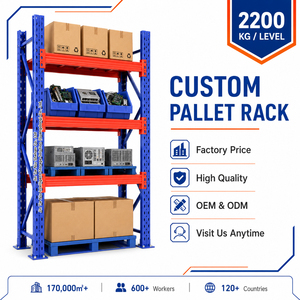
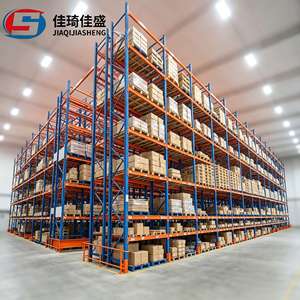
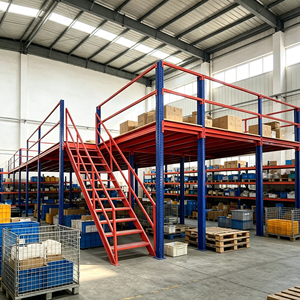
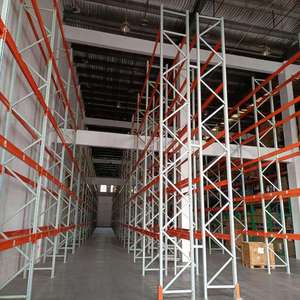
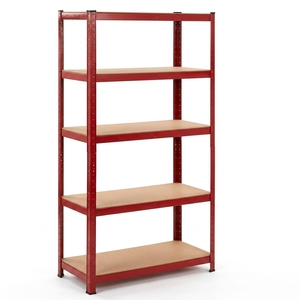
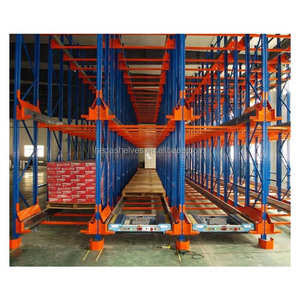
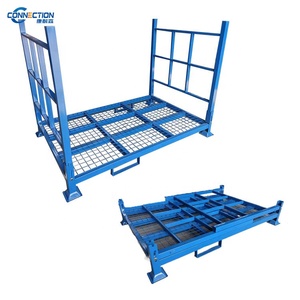
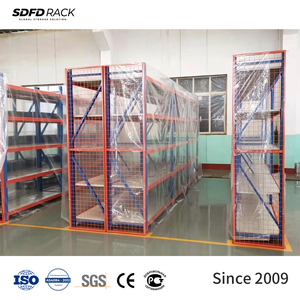
Structural Architecture & Structural Design of High Bay Racking
Modern distribution hubs, third-party logistics centers (3PL), and manufacturing plants require vertical clearances exceeding 12 to 35 meters. Engineering ultra-tall, narrow-aisle (VNA) or clad-rack warehouses demands uncompromising steel metallurgic precision, deflection calculations, and automated manufacturing tolerances.
Continuous Roll-Formed Upright Profiles
We utilize custom cold-roll continuous forming lines from certified high-tensile structural coil steel (Q235B / Q355B / SS400). Advanced multi-bend omega (Ω) upright profiles deliver supreme structural rigidity and torsion resistance under extreme dynamic loading. With standard column depths reaching up to 140mm and steel thickness up to 3.5mm, tall installations maintain straightness without structural fatigue.
Patented Interlocking Box-Beam Joints
High bay structural safety relies on connector connection moment capacity. Our interlocked beam connectors feature 3 to 5 heavy-duty cold-stamped claws paired with mechanical safety locking pins. Dual C-section nested interlocking box beams provide high horizontal beam loading up to 5,000 kg per beam level while dampening cyclic harmonics generated by fast automated retrieval Cranes and turret trucks.
Seismic & Geo-Structural Dynamic Analysis
Warehouses situated in earthquake-active belts (such as Southeast Asia, Oceania, and Latin America) require customized static and dynamic finite-element calculations (FEM). Our Guangzhou structural engineering team integrates UBC, Eurocode EN 15512, and RMI standards to specify enlarged baseplates, heavy bracing patterns, and high-tensile chemical anchors designed for horizontal ground acceleration.
| System Architecture | Typical Height Range | Pallet Capacity / Level | Aisle Width (AST) | Selectivity & Density Score | Optimal Industry Applications |
|---|---|---|---|---|---|
| High Bay VNA Pallet Racking | 8m – 18m | 1,000 kg – 3,500 kg | 1.6m – 1.9m | 100% Selectivity / High Density | E-Commerce Fulfilment, Retail DCs, Pharmaceutical |
| Radio Shuttle High Bay System | 6m – 24m | 500 kg – 2,000 kg | N/A (Lane Depth 20+ Pallets) | Medium Selectivity / Ultra-High Density | Cold Storage Logistics, Food & Beverage, FMCG |
| Clad-Rack Automated AS/RS | 15m – 40m | 1,000 kg – 4,000 kg | Dedicated Crane Track (< 1.5m) | 100% Automatic / Max Vertical Cube | Chemical Facilities, Automated Automotive Logistics |
| Multi-Tier Mezzanine High Bay | 6m – 12m | 300 kg – 1,000 kg/m² | 0.9m – 1.4m Walkways | Hand-Picking / Tiered Fulfillment | Apparel, Spare Parts Warehousing, Electronics |
Future Procurement Trends in High Bay Warehouse Racking
Global supply chain disruptions, soaring real estate leasing prices, and the shift toward omnichannel fulfillment are fundamentally transforming industrial storage procurement. Enterprise buyers must anticipate the following pivotal trends over the next decade.
Direct Mill-Integrated Procurement
To bypass rising trading intermediary margins, procurement executives are establishing direct supply frameworks with certified Chinese high-volume manufacturers capable of processing over 30,000 tons monthly. Direct factory coordination shortens engineering feedback loops and ensures complete material traceability from steel coils.
Total Life-Cycle Climate Pre-Treatment
Purchasers in high-humidity or sub-zero environments now refuse single-pass electrostatic coating. Modern standards mandate a strict 10-step pickling, surface phosphating, and nano-ceramic conversion wash before automated thermo-hardening epoxy powder application, or full hot-dip galvanizing for cold storage longevity.
Hybrid Automation Readiness
Instead of investing immediately in expensive fully automated warehouses, multinational enterprises increasingly procure "Automation-Ready" high bay static structures. These racks are built to millimeter-tight tolerances, enabling future integration of 4-way shuttles, AGV pallet jacks, or stacker cranes without structural retrofitting.
Containerized Freight Volumetric Engineering
With maritime logistics fluctuating, racking procurement teams focus on nesting efficiencies. Upright framing, step beams, and structural decks are pre-engineered to nest within 40HQ maritime containers, maximizing container weight capacity up to 26–28 metric tons and dramatically lowering freight per pallet location.
Initial purchase quotation represents merely 35% to 45% of total high bay infrastructure expenses over a 15-year lifecycle. Damage tolerance, upright deflection recovery, corrosion resistance in condensation environments, and modular adjustability without structural cutting are the true determinants of logistics facility profitability.
Next-Generation High Bay Storage Evolution
High bay racking is transitioning from passive steel frameworks into dynamic, smart, and sensor-monitored warehouse ecosystems designed to seamlessly connect with Warehouse Management Systems (WMS) and robotics.
IoT Structural Deflection & Impact Monitoring
Modern tall upright columns are increasingly outfitted with embedded strain gauges and 3-axis accelerometer sensor pods. These devices feed real-time structural health telemetry to the central control room. If a reach truck collides with a bottom aisle column or beam deflection surpasses safe thresholds due to uneven pallet loading, instant WMS alerts trigger automated lane lockdowns.
Sub-Zero Intelligent Radio Shuttle Automation
With cold storage energy costs surging, high bay systems leverage high-density automated shuttle cars powered by deep-freeze lithium titanate batteries that operate without thermal degradation at -30°C. Forklifts operate solely at the face of the bay, preserving refrigerated air and eliminating racking collision accidents inside deep drive-in channels.
Building-Integrated Rack-Clad Architecture
In high bay facilities exceeding 30 meters, the steel racking system itself forms the structural load-bearing building envelope. Roof trusses and insulated exterior wall panels mount directly onto the racking uprights, cutting civil construction schedules by 40% while delivering unrivaled volumetric space exploitation.
Why Global Importers & Contractors Choose HEDA Shelves
Guangzhou Heda Shelves Co., Ltd. has stood at the forefront of heavy-duty industrial storage innovation for more than two decades. Here is how our comprehensive manufacturing and engineering capabilities safeguard your investment.
Guangzhou Logistics Hub Transit Advantage
Operating adjacent to major international deep-water maritime terminals (Nansha / Huangpu / Shenzhen), we provide expedited ocean transit times across key international shipping lanes: 2–5 days to Vietnam, 3–5 days to Manila, 5–7 days to Singapore & Laem Chabang, 6–8 days to Port Klang, and 7–10 days to Jakarta, ensuring on-schedule project commissioning.
Verifiable International Certification
Our manufacturing processes and structural load calculations hold authoritative third-party compliance certificates: Official European CE Certification (No. 2435-CPR-8605159), ISO 9001:2015 Quality Management Accreditation (Certificate No. 18624Q00169R0M), and full RoHS compliance documentation available for global municipal and enterprise tenders.
100% In-House 10-Step Controlled Production
From raw slit steel coil inspection, high-precision automated punching, multi-roll cold forming, and robotized dual-side beam welding to chemical multi-tank pickling, phosphating, electrostatic powder coating, and pre-loading container assembly, every step is executed strictly in-house within our 30,000 m² factory.
| Destination Market | Primary Port of Discharge | Average Ocean Transit (South China) | Export Trade Terms Supported |
|---|---|---|---|
| Vietnam | Haiphong / Cat Lai (Ho Chi Minh City) | 2 – 5 Days | FOB, CIF, CFR, DDU |
| Philippines | Manila South / North Harbor | 3 – 5 Days | FOB, CIF, CFR |
| Thailand | Laem Chabang / Bangkok Modern Port | 5 – 7 Days | FOB, CIF, CFR, DDP |
| Singapore | Jurong Port / PSA Singapore | 5 – 7 Days | FOB, CIF, CFR, DDU |
| Malaysia | Port Klang (North/West) / Penang | 6 – 8 Days | FOB, CIF, CFR |
| Indonesia | Tanjung Priok (Jakarta) / Tanjung Perak | 7 – 10 Days | FOB, CIF, CFR |
Frequently Asked Questions by Industrial Buyers
Technical, commercial, and operational questions answered directly by our senior structural logistics engineering department.
Plan Your High Bay Warehouse Storage Expansion Today
Collaborate directly with Guangzhou Heda Shelves structural engineers. We provide complimentary CAD layout schemes, 3D dynamic warehouse visualizations, and formal structural calculations tailored to your budget and building parameters.