High-Performance Pallet Racking & Logistics Storage Configurations
Precision-engineered cold-rolled profile structures customized for maximum volumetric cubing, high pallet payload density, and seamless material handling equipment (MHE) integration.
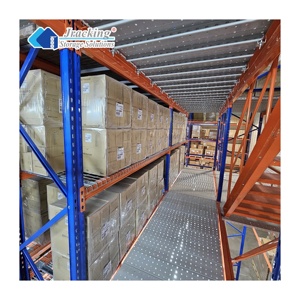 Heavy Duty
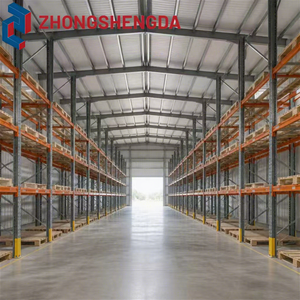 High Bay
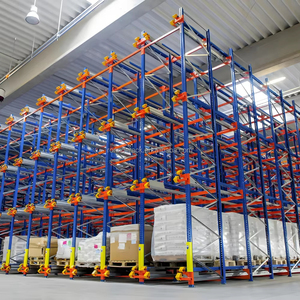 Automated
High Efficiency Automatic Warehouse Storage Radio Shuttle Pallet Racking System
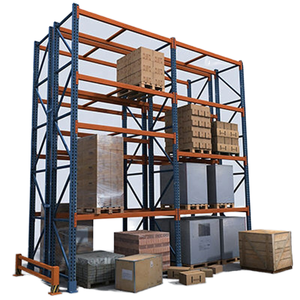 Anti-Corrosion
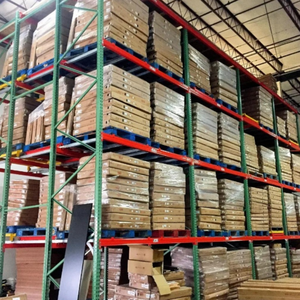 High Density LIFO
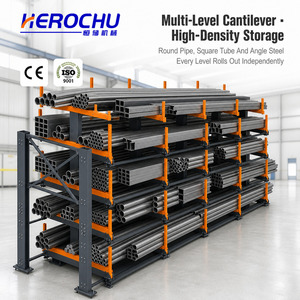 Long Goods
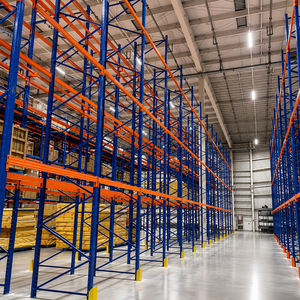 OEM & CAD
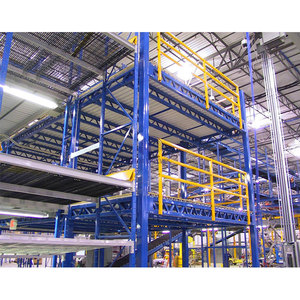 VNA Optimized
Architectural Mechanics & Physics of Very Narrow Aisle (VNA) Racking Systems
Very Narrow Aisle (VNA) racking systems represent the pinnacle of high-density vertical selective storage in modern supply chain engineering. By reducing conventional aisle clearances from 3.2–3.8 meters down to a strict 1.5–1.9 meters and extending vertical elevations up to 18 meters or higher, VNA architecture recovers up to 45%–50% of wasted aisle square footage, transforming dead circulation volume into direct, revenue-generating pallet locations without sacrificing 100% individual pallet selectivity.
Critical Structural Kinematics and Floor Tolerances
Unlike standard selective pallet racks where minor floor unevenness causes negligible crane or forklift interference, VNA systems operate at tight tolerances where mechanical mast oscillation directly threatens structural upright integrity. In high-bay VNA warehouses exceeding 12 meters, a 1 mm deviation in the concrete floor level translates into an amplified 10 mm mast displacement at the top beam elevation.
Consequently, manufacturing and installation specifications require strict alignment with international floor flatness standards, notably DIN 15185, TR34 (Class DM1 or Superflat), and ACI F-min 100. Structural engineering incorporates high-yield SS400 or Q355B cold-formed structural steel upright columns featuring continuous, automated omega profiles to eliminate localized torsional buckling under dynamic lateral loads.
MHE Guidance: Mechanical Low-Profile Rails vs. Inductive Wire Guidance
VNA articulated turret trucks or man-up order pickers operate at high traverse speeds inside the narrow aisle. Guidance is governed through two primary engineering modalities:
- Structural Guide Rails (Mechanical): Fabricated from inverted continuous steel angles (such as L100×75×8mm or L125×80×10mm) anchored directly to the concrete slab via chemical wedge anchors at 500mm intervals. Mechanical guide rails provide absolute physical protection, preventing turret truck chassis collisions with the bottom upright base plates.
- Inductive Wire Guidance (Electromagnetic): A precision slot (typically 4mm wide by 12–15mm deep) is saw-cut down the aisle centerline, into which a multi-strand copper antenna wire is embedded and sealed with high-tensile epoxy. A low-frequency alternating signal (5 kHz to 10 kHz) directs the vehicle steering sensors automatically, optimizing floor cleanliness and pallet bottom pick clearance.
| Storage System Type | Typical Aisle Width (mm) | Max Storage Height (m) | Selectivity Profile | Floor Footprint Utilization | MHE Requirement |
|---|---|---|---|---|---|
| VNA (Very Narrow Aisle) | 1,600 – 1,900 | 12.0 – 18.5+ | 100% Direct Access | 80% – 90% Volumetric | Articulated Turret Truck / Man-Up VNA / AGV |
| Standard Selective Racking | 3,100 – 3,800 | 6.0 – 11.5 | 100% Direct Access | 40% – 50% Volumetric | Standard Counterbalance / Reach Truck |
| Double-Deep Pallet Rack | 2,900 – 3,400 | 8.0 – 12.0 | 50% Immediate (LIFO) | 60% – 65% Volumetric | Deep-Reach Pantograph Forklift |
| Drive-In / Drive-Through | Continuous Lane | 6.0 – 10.0 | Low Selectivity (LIFO/FIFO) | 70% – 85% Volumetric | Standard Counterbalance (Enters Rack Lane) |
| Automated Radio Shuttle | 1,800 – 2,200 (Main) | 8.0 – 24.0 | Batch / SKU Clustered | 85% – 92% Volumetric | Independent 4-Way or 2-Way Robotic Shuttle |
Future Sourcing Dynamics: Automation, Structural Decarbonization & Hybrid Intralogistics
Modern global logistics hubs are experiencing rapid shifts toward automated cross-docking, escalating real estate rental yields, and stringent sustainability compliance. When sourcing high-bay VNA racking systems from China, tier-1 industrial clients and EPC logistics contractors must account for five pivotal engineering transformations reshaping warehouse procurement:
1. Unmanned AGV & AMR Integration
VNA aisles are migrating away from manual operator-driven turret trucks toward autonomous reach robotics (AMR) and driverless Automated Guided Turret systems. This requires manufacturers to produce upright punchings and drop-in beam tolerance variations within ±0.5 mm to prevent optical sensor positioning aborts during high-speed pallet drops.
2. Green High-Tensile Micro-Alloy Steel
Global carbon footprint disclosure requires lighter tare weights with enhanced load-bearing characteristics. The transition from plain Q235B to micro-alloyed cold-rolled Q355B and high-strength dual-phase steel delivers up to 25% material weight savings without compromising ultimate tensile strength or modulus of elasticity.
3. In-Rack Sprinkler & ESFR Fire Optimization
NFPA 13 and FM Global safety standards dictate precise flues in high-bay structures above 12 meters. VNA layouts must balance structural longitudinal bracing with clear transverse flues (minimum 75–150 mm) to permit internal horizontal sprinkler pipe runs and rapid heat thermal cone ventilation.
4. Seismic Ductility & FEM 10.2.02 Standards
For sites across seismic fault zones, procurement models now mandate non-linear response spectrum analysis. China's top manufacturers deploy multi-point connector beam end-connectors with 4 to 5 lock-pins and oversized cast-steel base plates that absorb cyclical energy during lateral earth acceleration.
5. Fast-Track Modular Prefabrication
EPC contracts demand shortened installation schedules. Pre-assembled boltless bracing panels, self-aligning upright column splicing sleeves, and laser-notched interlocking beam sections reduce project installation man-hours by up to 35% on site.
Engineered in Guangzhou: Production Infrastructure, Scale & Verification
Headquartered in Guangzhou, Guangzhou Heda Shelves Co., Ltd. has led cold-formed steel warehouse storage engineering since 2001. Operating a dedicated 30,000 square meter industrial manufacturing base with more than 300 experienced technical specialists, our monthly production capacity reaches 30,000 tons. We supply turnkey racking solutions to over 120 countries, delivering more than 10,000 high-density storage installations across Southeast Asia, the Middle East, Europe, and the Americas.
End-to-End In-House Precision Manufacturing
HEDA Shelves maintains complete vertical control over every steel forming and surface engineering stage. Our plant operates continuous roll-forming lines capable of handling high-gauge steel coils up to 4.0 mm thickness, automated multi-head punching systems with precision pitch intervals, and robotic beam welding units that deliver full structural fillet welds to FEM 10.2.02 and RMI standards.
To counter tropical humidity, coastal salt mist, and industrial chemical atmospheres, every manufactured component undergoes a rigorous 10-stage pre-treatment regimen. This includes high-pressure degreasing, ultrasonic water washing, rust-inhibiting pickling, zinc phosphating, and deionized neutralization before electrostatic thermosetting epoxy polyester powder coating (cured at 180°C–200°C for superior impact resilience and ASTM D3359 cross-hatch adhesion).
Verified International Accreditations & Testing
For government tenders, multinational 3PL infrastructure contracts, and institutional engineering approvals, HEDA Shelves provides fully traceable, certified documentation:
- CE Certification: Compliant under Construction Products Regulation No. 2435-CPR-8605159.
- ISO 9001:2015: Quality Management Certification No. 18624Q00169R0M, covering complete structural design, steel forming, and testing protocols.
- RoHS & REACH Compliance: Certified chemical-free powder coatings safe for dry food warehouses and pharmaceutical cleanroom distribution.
- Full Static & Dynamic Load Testing: Factory load benches verify actual beam deflection and upright collapse thresholds under calibrated hydraulic presses.
10-Stage Precision Manufacturing Workflow
Raw Steel QC
Mill-certified Q235B / Q355B coils verified for tensile yield.
Precision Slitting
CNC slitting to exact coil strip widths (±0.1 mm tolerance).
Auto Punching
Continuous hydraulic stamping of standardized 50mm/75mm pitches.
Cold Roll Forming
18-stand progressive cold rolling for complex omega upright profiles.
Box Beam Interlock
Dual-C interlocking continuous seam welding for rigid beams.
Robotic Welding
Automatic multi-claw connector welding with zero spatter.
Shot Blasting
Mechanical surface scale removal to Sa 2.5 cleanliness standard.
Pickle & Phosphate
10-tank chemical dip conversion coating for corrosion defense.
Powder Coating
Automated Nordson electrostatic guns delivering 60–90 μm film.
Container Packing
Bundle strapping, corner protective sleeves & moisture-proof wrapping.
Very Narrow Aisle Racking: Technical & Procurement FAQ
Authoritative engineering answers to complex technical questions encountered during VNA planning, building interface analysis, and international factory procurement.
Request a Structural Engineering Analysis & Custom VNA Layout
Consult directly with HEDA Shelves' senior logistics storage engineers. We calculate your warehouse volumetric cubing, deliver compliant static load calculations, and produce turnkey CAD layouts free of charge.