Engineered Heavy Duty Industrial Pallet Racking Portfolio
Explore our world-renowned industrial rack frameworks engineered specifically for global commercial warehouses, distribution hubs, cold storage logistics, and vertical fulfillment centers.
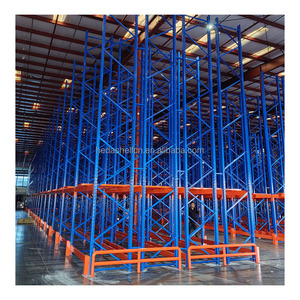
Heda Economical Heavy Duty Industrial Shelving Double Deep Pallet Racks Steel Storage Racking
- Load Rating: 1,000–4,500 kg/level
- Storage Depth: 2 Pallets Deep (LIFO)
- Steel Grade: SS400 / Q235B High Tensile
- Height Span: Up to 12,000 mm
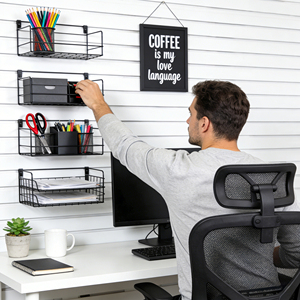
Heavy Duty PVC Slat Wall Panel Waterproof Interlocking Garage Wall Organizer 75 Lb Load Capacity Customize
- Panel Material: 100% Virgin Cellular PVC
- Slot Spacing: Universal 3-Inch Pitch
- Load Capacity: 75 lbs / Slot Foot
- Corrosion Class: 100% Waterproof / Anti-Mold
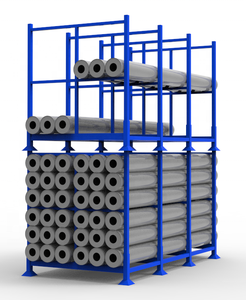
Custom Commercial Stack Metal Pallet Racking Fabric Roll Stacking Shelves Spare Storage Display Storage Rack for Warehouse
- Frame Structure: Collapsible Post Stacking
- Stacking Rating: 4-5 Tiers Fully Loaded
- Payload Max: 1,500 kg per Rack Cell
- Surface Coating: Electrostatic Powder Shield
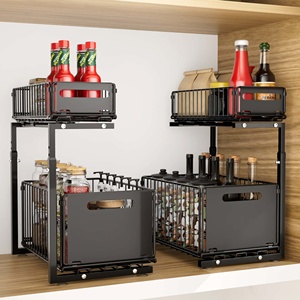
2 PACK 2 Tier L Shape Under Sink Height Adjustable Kitchen Organiser Drawer Separately Slide Storage Shelf Spice Organizer Rack
- Configuration: L-Shaped Stepped Structure
- Slide Mechanism: Precision Dampened Rails
- Material: Carbon Steel + Rust Protection
- Application: Maintenance & Micro Parts
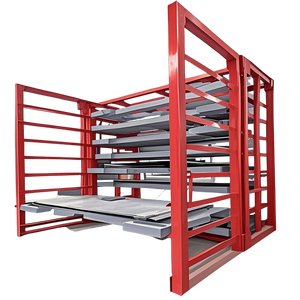
Customized Heavy-Duty 5 Layer Steel Metal Storage Rack Foldable Drawer Type Sheet Shelving System Stacking Racks Shelves
- Drawer Capacity: 2,000–5,000 kg/tier
- Extraction Rate: 100% Full Extension Telescopic
- Specialty: Sheet Metal & Die Mold Safe
- Operation: Overhead Crane & Hoist Ready
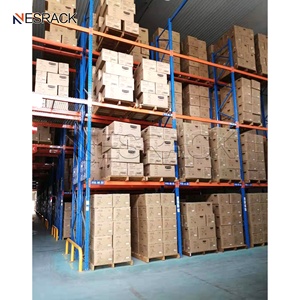
Industrial Heavy Duty 5 Layer Storage Shelves System Multi-layer Stacking Units Metal Rack Warehouse Steel Pallet Shelf
- Tier Count: 5 Adjustable Shelving Tiers
- Payload / Beam: 800–2,500 kg / level
- Deck Material: Reinforced Steel / Wire Mesh
- Pitch Adjust: 50 mm / 75 mm Increments
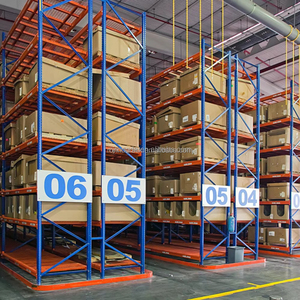
Industrial Commercial Shelving Warehouse Heavy Duty Racking Very Narrow Aisle Racking
- Aisle Clearance: 1,600 mm – 1,800 mm
- Floor Space Gain: +45% Over Selective Racking
- Mast Reach: Up to 16,500 mm Elevation
- Guidance Tech: Floor Rails or Wire Induction
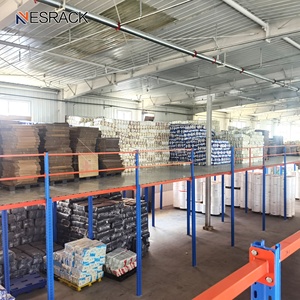
Heavy Duty Industrial Steel Rack for Medium Weight Warehouse Pallet Racking Cargo & Storage Equipment
- Upright Profile: Omega Cold-Formed Section 90-120mm
- Connectors: 4-to-5 Tooth Riveted Safety Claws
- Finish: Degreasing + Pickling + Epoxy Powder
- Compliance: ISO 9001:2015, CE Certified
Why China Leads the World in Heavy Duty Pallet Racking Engineering & Exportation
In the arena of global material handling and contemporary supply chain logistics, China stands as the indisputable epicentre of heavy-duty industrial pallet racking design, fabrication, and worldwide delivery. The global shift toward extreme vertical cubic storage, smart automated guided vehicle (AGV) integration, and seismic-resilient logistics centers demands steel racking structures that strictly exceed conventional static loading limits. As an acknowledged tier-one China top heavy duty pallet racking system exporter, our production lines in Guangzhou translate pure metallurgy into mission-critical supply chain assets.
Procuring heavy-duty warehouse storage systems is no longer a simple transactional purchase of formed sheet metal; it is a vital structural civil engineering procurement process. Modern distribution facilities spanning Southeast Asia, North America, Europe, Australia, and the Middle East operate under drastically diverse geographical conditions—ranging from high-frequency seismic acceleration in the Pacific Rim to extreme tropical humidity (85%+ RH) across ASEAN maritime transit belts, down to deep sub-zero conditions in multi-tier cold chains (-30°C). China's leading heavy-duty racking exporters resolve these complex mechanical stresses through automated continuous cold roll-forming lines, finite element structural analysis (FEA), high-strength low-alloy (HSLA) steel chemistries, and specialized multi-stage electrostatic anti-corrosion coating processes.
Engineering Architecture & System Trade-Off Matrix
Selecting the optimum heavy-duty racking system requires balancing selectivity, volumetric storage density, SKU rotation frequency, and capital expenditure indices.
| Racking Architecture | Pallet Selectivity | Cubic Space Utilization | Standard Load / Tier | Material Flow Model | CapEx Index | Primary Industrial Application |
|---|---|---|---|---|---|---|
| Selective Pallet Racking | 100% Direct | 40% – 50% | 1,000 – 4,500 kg | FIFO (First-In, First-Out) | Low | Fast-moving FMCG, retail distribution, general 3PL hubs |
| Double Deep Pallet Racks | 50% Direct Access | 60% – 65% | 1,000 – 3,500 kg | LIFO (Last-In, First-Out) | Moderate | Bulk distribution, dry grocery, multi-batch manufacturing |
| Very Narrow Aisle (VNA) | 100% Direct | 80% – 85% | 1,000 – 4,000 kg | FIFO Dynamic | Moderate-High | E-commerce fulfillment, pharmaceutical DCs, high-value parts |
| Drive-In / Drive-Through | Low (<15%) | 75% – 85% | 1,000 – 2,000 kg | LIFO / FIFO Option | Moderate | Cold storage freezers, beverage bottling, homogeneous raw crops |
| Radio Shuttle Automation | Lane Dependent | 85% – 92% | 1,000 – 2,000 kg | Hybrid FIFO & LIFO | High | Blast freezer cold chain, seafood, chemicals, dairy production |
| Multi-Tier Mezzanine Rack | 100% Accessible | Up to 250% (Floor Doubled) | 300 – 1,000 kg/m² | Continuous Manual Pick | Moderate | Automotive spare parts, garment fulfillment, micro-warehousing |
Structural Metallurgy: Cold-Formed Steel Grades, Beam Dynamics & Deflection Mechanics
The absolute integrity of a heavy-duty racking framework depends directly on the yield point ($f_y$) and ultimate tensile strength ($f_u$) of the raw structural coils. Unlike low-cost fabrication workshops that utilize recycled or uncertified steel scrap, our Guangzhou factory processes certified premium prime hot-rolled carbon strip steel sourced exclusively from top domestic mills including Baosteel, Ansteel, and Shougang.
1. Upright Column Engineering (The Omega Section): Our heavy-duty upright frames are roll-formed through 22 to 26 successive precision profiling stations into an asymmetrical closed-face Omega ($\Omega$) profile. This geometric configuration maximizes the radius of gyration ($r$), delivering superior torsional stiffness and compressive buckling resistance under eccentric structural loading. With steel gauges ranging from 1.8 mm to 3.0 mm and column depth widths spanning 90 mm, 100 mm, 120 mm, and 140 mm, our uprights deliver safe point load capacities surpassing 32,000 kg per bay.
2. Interlocking Twin-C Box Beam Mechanics: Pallet load cross-members are fabricated using twin nested C-channels continuously seam-welded by automated robotic MIG equipment. This produces a unified structural box beam that completely neutralizes lateral torsional buckling. Beam ends are fitted with heavy-gauge 3-prong, 4-prong, or 5-prong stamped claw connectors engineered to engage seamlessly with the upright teardrop or diamond hole pitch (available in 50 mm, 75 mm, and standard 76.2 mm / 3-inch imperial increments). High-shear zinc-plated spring safety locks prevent accidental beam displacement even when subjected to sudden upward vertical forklift impacts exceeding 5 kN.
3. Limiting Deflection Ratios ($L/200$ vs. $L/250$): Under full design working loads, our beam spans comply strictly with the serviceability limit state (SLS) requirements of European EN 15512 standards. Maximum allowable mid-span deflection is mathematically bounded by:
\delta_{max} \le \frac{L}{200} \quad \text{(Industrial Standard)} \quad \text{or} \quad \delta_{max} \le \frac{L}{250} \quad \text{(Automation / AS/RS Standard)}
This rigid limitation eliminates elastic fatigue, prevents excessive tilt angles on stored pallets, and protects warehouse logistics personnel from progressive structural collapse.
Guangzhou HEDA Shelves: Factory-Direct Engineering Authority
Over 25 years of specialized structural export operations, empowering international contractors, system integrators, and logistics mega-hubs with cost-effective Chinese precision manufacturing.
30,000 Metric Ton Monthly Output
Featuring continuous automated cold roll-forming lines, multi-spindle high-speed hydraulic CNC punching systems, and precision robotic MIG welding gantries operating 24/7 to guarantee rapid delivery cycles.
Verified CE & ISO 9001 Credentials
Full global legal conformity with CE Certification (No. 2435-CPR-8605159), ISO 9001:2015 Quality Management Systems (No. 18624Q00169R0M), and full compliance with RoHS hazardous material limitations.
Free Structural CAD & 3D Modeling
Our dedicated team of civil and logistics engineers prepares full DWG AutoCAD floor layouts, isometric 3D operational renders, static load computations, and seismic base plate anchorage calculations without upfront charge.
Tropical-Grade Pre-Treatment System
Every component undergoes hot-alkali degreasing, industrial acid pickling, zinc phosphating, and automatic dry-off before receiving 60–90 μm electrostatic thermosetting powder coat to resist coastal salt mist and high humidity.
Optimized Ocean Freight Densification
Custom robotic bundle strapping, specialized wooden dunnage cradles, protective bubble wrapping, and automated container packing matrices maximize weight and volume in each 40ft HQ, drastically cutting ocean freight per pallet slot.
Global On-Site Installation Supervision
Complete piece-marked structural installation blueprints, 3D step-by-step video assembly guides, multi-lingual English technical hotline support, and on-site veteran master installation supervisors dispatched upon client request.
10-Stage Closed-Loop Heavy Duty Racking Production Protocol
Spectrometry QC
Raw steel coil chemical assay & tensile coupon testing.
Slitting & Cutting
High-precision CNC coil decoiling, slitting & shearing.
Hydraulic Punching
Continuous servo column pitch punching with 0.1mm tolerance.
Multi-Pass Cold Roll
24-station cold profiling ensuring straightness and zero torsion.
Robotic Welding
Automated dual-torch robotic MIG beam-end connector welding.
Ultrasonic Inspection
Non-destructive weld seam testing and load verification.
Chemical Wash
Multi-bath immersion pickling, degreasing & phosphating.
Electrostatic Coat
Swiss GEMA automated powder booth with 200°C curing oven.
Cross-Hatch Assay
Coating adhesion test, impact test & film thickness gauge.
Unitized Packing
Heavy steel strapping, shrink-film sealing & container loading.
Future Procurement & Technological Trends in Pallet Racking (2026–2030)
Strategic supply chain forecasts and technological transitions reshaping global heavy-duty racking design, automation interfaces, and international procurement standards.
Trend 1: Accelerated Shift Toward Hybrid Automated Storage & Pallet Shuttle Racking
Soaring global industrial land prices and surging warehouse labor costs in urban logistic gateways (such as Singapore, Bangkok, Los Angeles, Rotterdam, and Dubai) are rapidly making conventional wide-aisle forklift racking obsolete. Global procurement directors are decisively shifting capital allocations toward high-density radio shuttle racking and automated crane-accessible AS/RS high-bay systems. Racking exporters in China are engineering structural uprights capable of supporting high-speed automated shuttle carts accelerating at 1.5 m/s² inside storage channels, which requires absolute horizontal rail straightness tolerances under ±1.0 mm across a 50-meter lane.
Trend 2: Climate-Resilient & Sub-Zero Cold-Chain Structural Metallurgy
The worldwide expansion of cold-chain logistics for biological pharmaceuticals, frozen seafood, and fresh agricultural food exports has created unprecedented demand for racks that perform reliably in sub-zero freezers down to -30°C. Standard structural carbon steels suffer severe ductile-to-brittle transitions under sustained low temperatures, making them vulnerable to catastrophic fracture under forklift impact. Future procurement specifications mandate Charpy V-notch impact-tested steels (such as Q355D or Q355E) with certified minimum absorption energy of 27 Joules at -20°C. Furthermore, pre-galvanized or continuous hot-dip galvanized finishes (HDG with zinc layer coating ≥ 65–85 μm) are increasingly preferred over standard powder coats to permanently resist condensation-driven oxidation in cycling temperature freeze-thaw zones.
Trend 3: Seismic-Engineered Racking Architecture Across the Pacific Ring of Fire
Warehousing developments across seismic-active territories—including Indonesia, the Philippines, Japan, New Zealand, Chile, and the US West Coast—now mandate that heavy-duty pallet racks be engineered as formal civil seismic buildings. Structural engineers evaluate P-Delta second-order lateral displacement effects, ground acceleration coefficients ($S_s$ and $S_1$), and site soil classification categories. Advanced procurement calls for widened seismic base plates (minimum 12 mm – 20 mm thickness), dual chemical concrete anchor bolts (M16/M20 Grade 8.8) with calculated pull-out shear thresholds exceeding 45 kN, and heavy-duty double-diagonal back-bracing trusses that dissipate kinetic energy without structural failure.
Trend 4: Smart Racking Sensor Integrations & Carbon Footprint Audits
Over the 2026–2030 horizon, pallet racking is transitioning from passive structural steel into intelligent warehouse hardware. Exporters are embedding wireless IoT deflection sensors, tilt-meters, and RFID inspection chips directly into structural beam connectors and column feet to report mechanical damage from forklift impacts via cloud dashboards. Simultaneously, global multinational 3PL corporations are demanding full Environmental Product Declarations (EPD) and scope 1-3 carbon tracking data from Chinese exporters, ensuring steel mills utilize renewable electric-arc-furnace (EAF) manufacturing and zero-VOC powder formulations.
Frequently Asked Questions by Global Importers & Procurement Directors
Direct, engineering-backed answers covering structural calculation, sea freight logistics, installation, seismic compliance, and international payment terms.
Q What primary parameters do your engineers need to generate a precise 3D warehouse layout and quote?
To provide an engineered AutoCAD layout and structural calculation sheet, we require: (1) Architectural floor plan (DWG or PDF) showing clear ceiling height under trusses, building column positions, door clearances, and fire sprinkler line levels; (2) Pallet specifications including overall dimensions (Width × Depth × Height including cargo overhang) and maximum gross weight per pallet; (3) Forklift model details, specifically mast type, maximum collapsed mast height, maximum fork reach elevation, and minimum turning radius (right-angle stacking aisle width requirement); (4) Total SKU profile, required daily pallet in/out throughput, and local environmental conditions (e.g., cold room temperature or seismic zone).
Q How does HEDA Shelves ensure safety and structural stability against seismic forces in regions like Southeast Asia or the Americas?
Our engineering department conducts structural finite element analysis (FEA) based on dynamic seismic response spectra. For seismically active regions (such as the Philippines, Indonesia, Chile, California, and New Zealand), we integrate site-specific peak ground acceleration (PGA) factors into the frame design. Calculations specify reinforced upright column profiles, heavier gauge steel base plates (10mm to 16mm thick) with multiple anchor bolt holes, specialized Grade 8.8 expansion or chemical resin anchors, and horizontal/vertical bracing towers to safely dissipate dynamic lateral seismic shock waves without structural collapse.
Q What surface treatment options are available to protect racking against corrosion in humid, tropical, or cold-storage environments?
We provide three distinct levels of industrial anti-corrosion protection: (1) Standard Electrostatic Powder Coating: Includes automatic 5-stage hot degreasing, acid pickling, zinc phosphating, and thermosetting epoxy-polyester powder baking (60–90 μm film thickness) suitable for ambient temperature, climate-controlled dry distribution centers; (2) Continuous Pre-Galvanized Steel: Upright frame members and wire mesh decking roll-formed directly from mill-certified galvanized steel coil ($Z120-Z275$ zinc coating), ideal for high humidity; (3) Hot-Dip Galvanizing (HDG): Finished black steel components are dipped into molten zinc at 450°C, producing a metallurgical zinc-iron alloy layer (65–100 μm thickness) according to ISO 1461, ensuring complete protection for blast freezers, outdoor staging yards, and corrosive coastal marine ports.
Q What are the indicative sea transit times and ocean shipping terms from your Guangzhou production facility?
Our plant in Guangzhou is adjacent to major deep-water ocean container terminals (Nansha, Huangpu, and Shenzhen / Hong Kong). We regularly export under FOB, CIF, CFR, and DDU/DDP terms worldwide. Indicative port-to-port sea transit times are:
• Southeast Asia: Vietnam (2–4 days), Manila, Philippines (3–5 days), Singapore & Laem Chabang, Thailand (5–7 days), Port Klang, Malaysia (6–8 days), Jakarta, Indonesia (7–10 days).
• Middle East & South Asia: Jebel Ali, Dubai (14–18 days), Dammam (18–22 days), Nhava Sheva, India (10–14 days).
• Australia / New Zealand: Sydney / Melbourne (14–18 days), Auckland (18–22 days).
• Europe & Americas: Rotterdam / Hamburg (28–35 days), Los Angeles / Long Beach (14–18 days), Santos, Brazil (32–38 days).
Q How do you maximize ocean container volumetric efficiency to minimize freight costs for overseas importers?
Ocean freight cost per pallet position is a critical determinant of final landed cost. We employ specialized nested stacking algorithms: upright frames are designed to bundle with interlocking contours; box beams are banded in tight wooden-cradled units with protective foam edge protectors to eliminate transit scuffing; small accessories (base plates, bolts, safety lock pins, row spacers) are packed in heavy-duty wooden shipping crates. A standard 40ft High Cube container typically holds between 22 to 25 metric tons of heavy-duty racking steelwork, ensuring 98%+ cubic and weight optimization.
Q What third-party certifications and mill test reports (MTR) are supplied with shipments?
Every production batch is accompanied by comprehensive quality and compliance documentation: (1) Factory Certificate of Conformance; (2) Original Steel Mill Material Test Reports (MTR) according to EN 10204 3.1 verifying chemical analysis (C, Si, Mn, P, S) and mechanical yield/tensile strength; (3) Third-party CE Mark Conformity Certificate No. 2435-CPR-8605159; (4) ISO 9001:2015 Quality Management System Certificate No. 18624Q00169R0M; (5) Static and dynamic weld test reports and dry powder coating adhesion cross-hatch reports.
Q Can your heavy-duty pallet racking be customized to interface with automated shuttle carts, AGVs, or automated crane systems?
Yes. A significant percentage of our export volume consists of high-precision rack frameworks for semi-automated and fully automated intralogistics systems. For radio shuttle racking, our roll-forming lines produce heavy galvanized shuttle sub-rails with built-in end stops and optical reflector mounts. For automated guided vehicles (AGVs) and Very Narrow Aisle (VNA) systems, we supply ground-mounted continuous heavy steel guidance rails (such as $75\times50\times6$ mm angle steel) or facilitate wire-guided induction channel cutouts. Tolerances on automated racking lines adhere to strict international FEM 9.831 tolerances.
Q How is on-site installation managed for large-scale international warehouse projects?
Every shipment includes an exhaustive project assembly manual with individually color-coded component tags matching our CAD layout drawings. All upright frames, beam tiers, frame spacers, and floor anchors are clearly marked. In addition to high-resolution 3D instructional videos, our engineering division offers two levels of on-site service: (1) Dispatching a senior bilingual mechanical racking installation supervisor to oversee, train, and certify the client's local assembly crew; (2) Providing full turnkey installation through our vetted network of regional engineering partners in Southeast Asia, the Middle East, and Latin America.
Request Your Free 3D Warehouse Racking Layout & Structural Proposal
Connect directly with our Guangzhou structural engineering team today. Send us your architectural floor plan, pallet dimensions, and storage targets, and receive an engineered CAD layout, static load calculation sheet, and full export cost estimate within 24 hours.