High-Density & Heavy-Duty Storage Configurations
Explore precision-fabricated racking systems, from semi-automated radio shuttles and dynamic gravity-fed rollers to structural cantilever and mezzanine installations designed for global export.
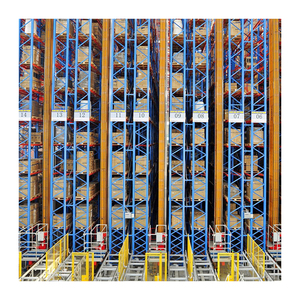
Automated Pallet Racking System Smart Inventory Circulation Industrial Radio Shuttle Steel
Semi-automated pallet carrier system designed for deep lane cold-store and FMCG warehousing with FIFO/LIFO flexibility.
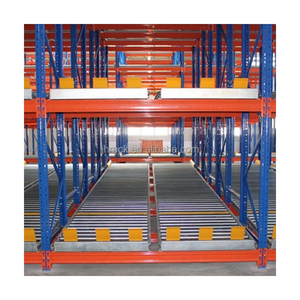
Chinese Racking Suppliers Roller Racking System Pallet Storage Warehouse Gravity Flow Rack
Self-propelled dynamic roller beds providing strict first-in, first-out stock rotation without internal vehicle traffic.
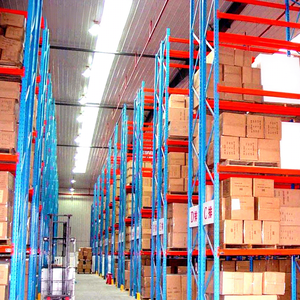
Factory Price Eyda Steel Heavy Duty Powder Coated VNA Rack Very Narrow Aisle Storage Rack
Ultra-dense vertical storage reaching up to 15 meters with mechanical guide rails or wire induction guidance systems.
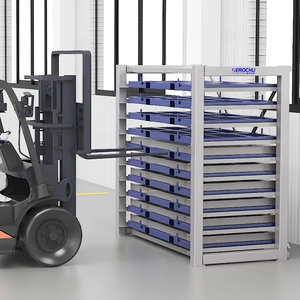
Forklift Rack Heavy Duty Steel Pallet Rack Industrial Storage with Integrated Safety Lock
Standard high-rigidity teardrop or slotted column profiles configured with beam drop-out prevention safety mechanisms.
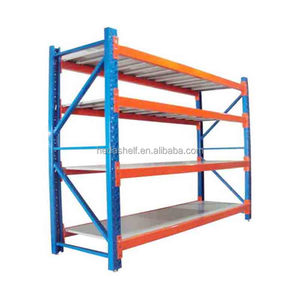
Heavy Duty Metal Boltless 4 Tier Garage Shelves Storage Rack Units & Manual Picking Bays
Fast-assembly modular shelving units engineered for bin storage, maintenance workshops, and light-to-medium parts handling.
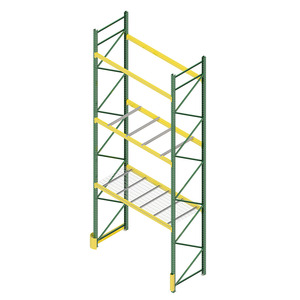
WAREHOUSE RACKING Warehouse Heavy Duty Cold Storage Rack Selective Narrow Aisle System
Low-temperature treated structural alloy uprights built to endure thermal fatigue and moisture condensation in blast freezers.
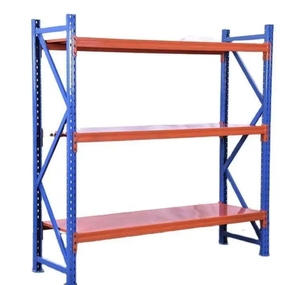
Dedicated Industrial Cross Beam Rack Strong Load-Bearing Steel Selective Pallet Rack
Versatile cross-beam storage structures compatible with Euro, US GMA, and custom industrial skids up to 4,500 kg per level.
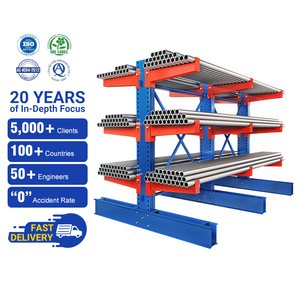
Durable Heavy-Duty Industrial Shelving Unit Adjustable Cantilever Arm Racks for Warehouse
Unobstructed frontal access for lumber, piping, extrusions, and heavy building supplies with high moment arm resistance.
Deep-Lane Radio Shuttle Systems: Mechanical & Electrical Architecture
A granular look at load vectors, automated cycle dynamics, rail tolerance geometry, and cold-store performance optimization.
Optimizing Volumetric Density vs. Cycle Velocity
The core structural advantage of the shuttle pallet racking system lies in its decoupling of horizontal material transport from forklift aisle travel. In conventional drive-in systems, reach trucks or counterbalanced forklifts must traverse the physical structural bays, inducing dynamic frame oscillation, increasing mast impact risks, and capping practical storage lane depths at 6 to 8 pallets.
By integrating autonomous battery-powered shuttle carriers within precision-stamped guide rails, lane depths can safely exceed 40 to 60 pallet positions. The carriage navigates underneath the pallet bed, executes an electro-mechanical or hydraulic vertical lift of 25 mm to 40 mm, and traverses the channel at speeds up to 1.2 m/s empty and 0.8 m/s loaded. This mechanical independence delivers an 80% to 90% building cubage utilization rate while cutting material handling vehicle runtime by over 50%.
Inquire Now| Performance Metric | Radio Shuttle Rack | Drive-In Racking | Selective Pallet Rack |
|---|---|---|---|
| Volumetric Utilization | 85% – 92% | 70% – 75% | 40% – 50% |
| Pallet Cycle Speed | 35–45 Pallets/hr | 15–20 Pallets/hr | 25–30 Pallets/hr |
| Forklift Mast Collision Risk | Near Zero (External) | High (In-Aisle Driving) | Low to Moderate |
| Operational Temperature | -30°C to +45°C | -25°C to +40°C | Ambient / Cold |
| Logistics Flow Compatibility | FIFO & LIFO Supported | Strictly LIFO (Mostly) | 100% Direct FIFO/LIFO |
Future Procurement Trends in High-Density Automated Warehousing
How supply chain executives, industrial developers, and logistics engineering teams are adapting procurement frameworks to macro technology shifts.
1. Near-Instant Cold Chain Scalability
Global demand for blast freezing, pharmaceutical staging, and temperature-controlled food distribution is driving 40% of new shuttle rack procurements. Cold storage facilities face high kilowatt-hour costs per cubic meter. Shuttle configurations eliminate wasted aisle air volume, decreasing thermal dissipation surfaces and minimizing energy burn per stored pallet position.
- Sub-zero lithium iron phosphate (LiFePO4) battery packs
- Cold-hardened microcontrollers rated down to -30°C
- Condensation-resistant hot-dip galvanizing options
2. WCS/WMS Native API Integration
Procurement teams are shifting away from standalone proprietary radio controllers toward open-architecture industrial IoT. Modern shuttle carriers must integrate seamlessly into ERP platforms (SAP, Manhattan, Infor) via standard Modbus, Profinet, or MQTT interfaces, providing automated telemetric diagnostics, battery health monitoring, and dynamic route optimization.
- Automatic pallet profiling and dimensional checking
- Centralized fleet coordination without human intervention
- Real-time track-and-trace down to bin level coordinates
3. Rigorous Seismic & Dynamic Load Compliance
With massive installations in seismic zones throughout Southeast Asia (Indonesia, Philippines) and the Americas, compliance with EN 15512, FEM 10.2.02, and AS 4084 standards is now a non-negotiable procurement requirement. Finite Element Analysis (FEA) is deployed upfront to verify column buckling resistance under asymmetric live shuttle loadings.
- Custom baseplate anchor configurations for dynamic loads
- Heavy-duty portal bracing frameworks
- Yield-strength verified Q235B and Q355B cold-rolled steel
The Technological Evolution: From 2D Radio Shuttles to 4D Multi-Directional Swarms
Understanding the hardware and software trajectory empowers supply chain architects to deploy future-proof infrastructure today.
First Generation: Manual Remote Shuttles
Introduced to replace sluggish drive-in forklift rails. Forklift operators position the carrier into designated channel lanes and command movement using handheld industrial RF pendants. Ideal for single-SKU batch runs and cost-sensitive initial automation phases.
Second Generation: Continuous Optical & LiDAR Feedback
Modern CE-certified shuttle systems leverage absolute rotary encoders, time-of-flight (ToF) distance laser sensors, and integrated rail-clamp emergency stopping brakes. Shuttles automatically correct pallet pitching, adjust for overhang, and report fault codes via wireless industrial mesh networks.
Third Generation: 4D Multi-Directional & Vertical Lifts
The cutting-edge frontier features 4-way travel across orthogonal rail grids combined with automated high-speed vertical hoists. Swarm robotics algorithms allocate multiple shuttles across complex multi-tier mezzanines, removing the requirement for forklift repositioning entirely.
Guangzhou Heda Shelves Co., Ltd. – Factory-Direct Authority
Combining 25+ years of engineering experience with world-class production capacity, third-party compliance, and direct export infrastructure.
Engineering Precision from Coiled Steel to Certified Bay
Established in 2001, Guangzhou Heda Shelves Co., Ltd. operates a state-of-the-art 30,000 square meter production facility equipped with high-precision continuous cold-roll forming lines, automated CNC column punching presses, robotic cross-beam welding cells, and an environmentally compliant multi-stage electrostatic powder coating line.
We do not broker racking; we design, calculate, fabricate, test, and ship directly from Guangzhou to the world's most critical distribution networks. Every structural component conforms strictly to CE certification standards (Certificate No. 2435-CPR-8605159) and ISO 9001:2015 quality control oversight (Certificate No. 18624Q00169R0M).
Turnkey Sourcing Capabilities
From initial preliminary architectural drawings to shipping container optimization, our in-house civil and mechanical engineers deliver fully customized CAD floor plans, 3D spatial renderings, and dynamic load-vector calculations within 24 to 48 hours.
- Free preliminary 3D rendering and CAD layout design
- Custom paint-matching and hot-dip galvanized weatherproofing
- Container-optimized bundling reducing sea freight damage to zero
- On-site or remote video installation engineering guidance
Our 10-Step Quality-Controlled Manufacturing Pipeline
Direct oversight at every mechanical stage ensures zero-defect tolerance for high-tolerance automated shuttle tracks.
Raw Material QC
Certified mill-grade structural steel coils inspected for chemical composition and tensile yield.
Precision Slitting
High-tolerance CNC uncoiling and precision longitudinal strip slitting within sub-millimeter tolerances.
Column Punching
High-speed continuous automated multi-stage punch presses form uniform hook and locking apertures.
Cold Bending
Multi-roller continuous cold roll forming shapes uprights, shuttle tracks, and load beams.
Profile Roll Forming
Complex geometric profiling designed to maximize polar moment of inertia against deflection.
Surface Polishing
De-burring, edge smoothing, and structural bead weld prep ensuring uniform paint adhesion.
Robotic Welding
Automated multi-axis robotic welders join beam end-connectors with deep-penetration weld pools.
Pickling & Phosphating
Intensive chemical bath cleaning removing micro-scale mill scale, rust, and oils prior to painting.
Electrostatic Coating
High-adhesion thermosetting epoxy powder cured at 200°C for high impact and scratch resilience.
Final QC & Pack
Sample assembly load tests, laser straightness verification, and container-optimized steel banding.
Frequently Asked Questions by Industrial Storage Buyers
Direct technical answers addressing engineering parameters, duty cycles, ambient limitations, and international logistics.
What pallet styles and base configurations are compatible with radio shuttle tracks?
Radio shuttle systems are engineered around standard perimeter bases, including Euro pallets (800x1200 mm), UK Standard (1000x1200 mm), US GMA (48x40 inch), and heavy industrial skids. Because the shuttle vehicle enters beneath the pallet runners to execute a vertical lift, bottom board thickness, center bearer clearance (minimum 90 mm required), and board deflection parameters must be verified during design. For non-standard plastic skids, runners with anti-slip rubber inlays and reinforced cross-bars are custom specified.
How do radio shuttle systems perform in blast freezers and sub-zero cold rooms?
Our cold-chain shuttle units are purpose-built for sustained operations down to -30°C. Standard off-the-shelf lithium cells experience severe capacity drops under sub-zero temperatures. Our systems use specialized low-temperature Lithium Iron Phosphate (LiFePO4) battery packs equipped with internal heating elements during recharging cycles. Electronic boards are sealed in conformal moisture-proof coatings to eliminate freeze-thaw condensation short circuits when traveling between temperature zones.
What is the typical battery operating life and replenishment protocol?
Equipped with high-density quick-charge battery systems, a single shuttle delivers 8 to 10 hours of continuous heavy-duty cycling. Complete recharge is achieved within 2.5 to 3 hours using an automated industrial docking bay. Most operations run on a continuous rotation strategy: while a shuttle operates on Battery A, Battery B recharges at the charging station, ensuring 24/7 round-the-clock logistics circulation without taking the carrier offline.
How is structural safety ensured against seismic events and horizontal impacts?
All HEDA shuttle rack installations conform to FEM 10.2.02 and EN 15512 specifications. In high-seismic geographic areas such as the Pacific Ring of Fire (Philippines, Indonesia, Latin America), our structural team runs site-specific dynamic response spectra analyses. Uprights are fitted with enlarged heavy-gauge anchor base plates, reinforced portal frame sway bracings, and aisle-end floor-mounted impact bollards to isolate internal storage lanes from material handling equipment.
What documentation and verification are supplied for port customs and building permits?
Every export shipment from Guangzhou includes a comprehensive compliance dossier: CE Declaration of Conformity (Certificate No. 2435-CPR-8605159), ISO 9001:2015 inspection certificates, steel mill raw material mechanical test reports, computerized component-numbered installation manuals, CAD anchor point floor loads, and structural static calculation sheets signed by licensed structural engineers.
What is the typical lead time and shipping transit from Guangzhou to international hubs?
Standard fabrication lead time for a 1,000 to 5,000 pallet-position shuttle system ranges from 20 to 28 working days. Direct ocean transit times from the Port of Guangzhou/Nansha are exceptionally competitive: 3 to 5 days to Manila or Ho Chi Minh City; 5 to 7 days to Singapore and Bangkok; 6 to 8 days to Port Klang; 14 to 18 days to Australia/Middle East; and 22 to 28 days to Western European and North American ports.