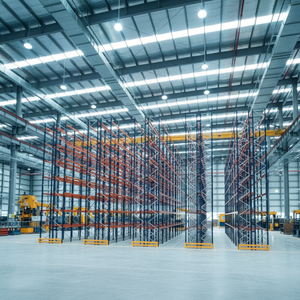
Engineered Storage Equipment
Industrial Pallet Racking & Structural Safety Systems
Fabricated in accordance with EN 15512 and ISO standards. Designed to integrate seamlessly with standard backstops, push-through crash barriers, and automated material handling layouts.
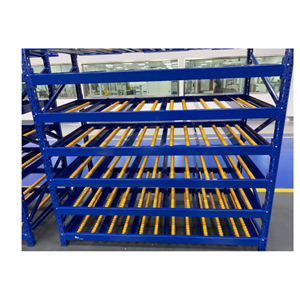
Selective Heavy Duty Modular Steel Pallet Racking
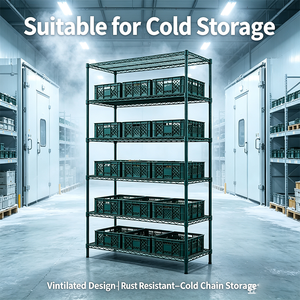
Rust Resistant Industrial 6 Tier Wire Shelving Rack
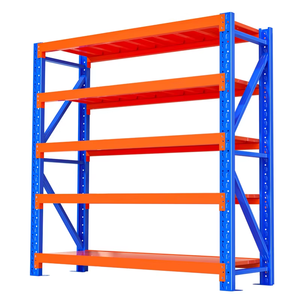
Adjustable Boltless Warehouse Metal Storage Rack
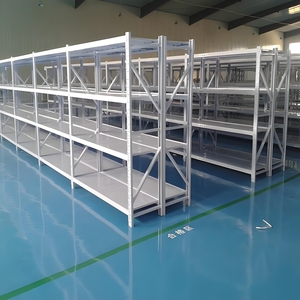
Medium Duty Industrial Metal Shelving System
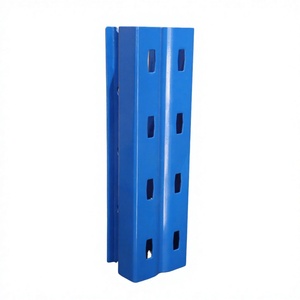
Dexion Compatible Upright Pallet Racking Frame
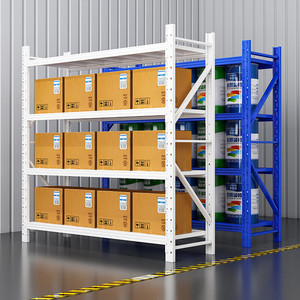
Industrial High Load Capacity Warehouse Shelving
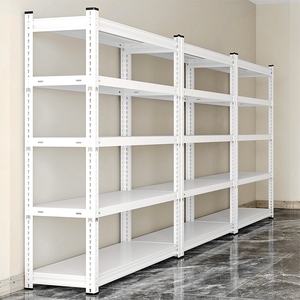
Adjustable Steel Warehouse Pallet Racking Unit
Technical Insight & Engineering Standards
What Constitutes True CE-Certified Push-Through Protection in Pallet Racking?
In high-density modern intralogistics, selective and double-deep racking profiles are subjected to repetitive, dynamic forklift loading cycles. An ongoing challenge encountered by warehouse plant operators and logistics safety consultants is pallet push-through—the unintended over-travel of unit loads beyond the rear support beam. When a forklift operator introduces a pallet too deep into a bay, three critical hazards arise: direct collision with structural building walls, violation of mandatory longitudinal flue spaces (rendering ceiling-mounted ESFR fire sprinkler systems non-compliant), or complete dislodgment of the opposite pallet on back-to-back rack arrangements.
As a verified CE-certified pallet racking push-through protection manufacturer, our engineering framework treats push-through barriers not as optional passive accessories, but as vital load-bearing safety components designed under EN 15512:2020 and FEM 10.2.02 parameters. A fully compliant system must balance structural rigidity with calculated deflection capacity to withstand direct forklift kinetic forces without warping upright frames or popping beam clips.
Key Engineering Standard Compliance (EN 15635 & NFPA 13): Longitudinal flue spaces of 75mm to 150mm must remain continuously unobstructed across back-to-back racks to channel thermal upward plumes toward fire detection and sprinkler heads. Our heavy-duty tubular and wire-mesh push-through safety guards provide physical offset stops that prevent pallet overhang beyond standard 50mm allowances.
Critical Push-Through Protection Architectures Manufactured In-House
Depending on the building footprint, material handling equipment (MHE) kinematics, and load fragility, our automated production lines engineer three core variants of pallet stopping mechanisms:
Offset Beam Pallet Stops
Constructed from structural cold-formed RHS or C-channel profiles mounted to uprights via heavy-gauge brackets. Available in flush, 50mm, or 100mm offset depths to accommodate precise pallet overhang tolerances while preserving certified flue zones.
Heavy-Duty Wire Mesh Screens
Engineered modular steel-mesh panels fixed onto the rear of single-bay runs overlooking pedestrian walkways, pick corridors, or sensitive conveyor systems. Rated to stop loose falling cartons, damaged skids, and shifting pallet loads.
Curved Deflection Crash Barriers
Designed for automated crane lanes and drive-in racking entries. Manufactured with contoured contact surfaces and yield shock-absorption mounting hardware that absorb kinetic pallet contact without transmitting damage into vertical columns.
Industry Horizon
Future Procurement & Technological Trends in Rack Safety
How automation, strict fire safety enforcement, and sustainable metallurgical finishing are redefining pallet containment equipment purchases through 2030.
Integration with VNA & AGV High-Bays
As Automated Guided Vehicles (AGVs) and Narrow Aisle Turret trucks dominate distribution centers, laser-guided vision sensors mandate millimetric rack alignment. Future pallet backstops will feature optical retro-reflective targets and tactile sensor integrations.
Tightening ESFR Fire Audit Mandates
Insurers worldwide (e.g., FM Global) increasingly reject claims where flue spaces are crushed. Procurement managers are standardizing mechanical bolted stops rather than relying solely on driver visual alignment to guarantee permanent flue gap compliance.
Modular Low-Carbon Pre-Treatment
Procurement teams are prioritizing ESG standards. Our production utilizes high-efficiency pickling and phosphating lines followed by closed-loop electrostatic powder coating, eliminating toxic solvent emissions while guaranteeing over 500 hours of salt-spray resilience.
Seismic Resilience in Aisle Protection
Modern pallet stops must not only resist dynamic fork impacts but also maintain positive load engagement during seismic lateral acceleration. We engineer dynamic connection joints that prevent bracket shearing under severe oscillatory ground motion.
Enterprise Manufacturing Competence
Why Global Logistics Leaders Partner with HEDA
Delivering high-precision roll-formed racking, specialized mezzanine engineering, and robust push-through pallet protection directly from our South China manufacturing complex.
Third-Party Certified Integrity
Production operations are backed by valid CE Certification (Certificate No. 2435-CPR-8605159), ISO 9001:2015 Quality Management certification (No. 18624Q00169R0M), and full RoHS compliance across all anti-corrosion coatings.
End-to-End In-House Fabrication
From raw steel slitting, automated column punching, and roll forming to manual/robotic welding, pre-treatment pickling, and electrostatic finishing. Quality control is applied step-by-step before container packing.
Free Complete Layout Engineering
Our experienced structural engineering team delivers free detailed 2D CAD floor plans, load calculation sheets, and photorealistic 3D structural renderings customized to your forklift turning radiuses and pallet sizes.
Procurement Clarity
Frequently Asked Questions for Project Engineers
Addressing technical clearances, safety compliance, seismic parameters, and logistics execution.
Fire safety codes such as NFPA 13 and European local warehouse ordinances demand a continuous, unobstructed longitudinal flue space (typically 75mm to 150mm) between back-to-back pallet rows. Without push-through safety stops, forklift drivers frequently shove pallets too deep, sealing this channel. Our pre-set mechanical stops physically arrest the pallet skid at a calibrated overhang line, guaranteeing that water discharged from ceiling sprinklers can penetrate downward to the lower storage tiers.
Yes. While integrating backstops during the initial project build is the most economical path, our modular bracket designs are engineered to clamp or bolt directly into universal teardrop, hex-hole, or slotted upright profiles (including Dexion, Colby, and standard European upright standards) without requiring on-site cutting or welding.
Our CE Certificate No. 2435-CPR-8605159 verifies that our steel storage systems undergo rigorous Factory Production Control (FPC) and conform to EN 1090-1 and EN 15512 standards. This ensures traceability of raw Q235B/Q355B steel coils, calibrated yield-strength testing, robotic weld seam certification, and verified deflection testing under full design working loads.
For standard ambient warehouses, our multi-stage pre-treatment (acid pickling and phosphating) paired with heavy electrostatic polyester powder coating delivers exceptional rust resistance. For sub-zero freezers (-30°C) or highly humid coastal environments across Southeast Asia and Latin America, we manufacture hot-dip galvanized (HDG) or pre-galvanized components to eliminate micro-cracking and corrosion flaking.
To provide an accurate CAD schematic and quotation, our engineers need: your warehouse clear ceiling height, slab thickness and concrete compressive strength, pallet specifications (Width x Depth x Height and total gross weight), forklift make/model and mast lift height, and whether your layout is configured for single or back-to-back selective aisles.
Secure Your Facility with Certified Push-Through Protection
Connect directly with our engineering department in Guangzhou. Get free 2D CAD layouts, structural calculations, and competitive factory-direct pricing for your next warehouse storage development.