Engineered Industrial Pallet Rack Bays & Storage Structures
From single-bay selective configurations to integrated multi-tier racking networks, each structural assembly is fabricated under rigorous EN 1090-1 and EN 15512 European structural safety mandates, custom-sized to withstand static and dynamic operational loads.
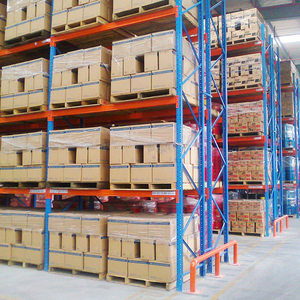
Combined Load-Row Connected Industrial Pallet Racking System Heavy Duty Warehouse Storage Racks 2000kg Steel
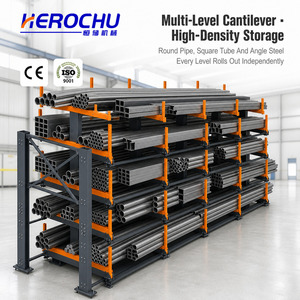
Hand Crank Telescopic Cantilever Rack | Single Side 4 Levels 1000 kg Per Arm | Q235B Steel | Steel Pipe Bar Sheet Metal Storage
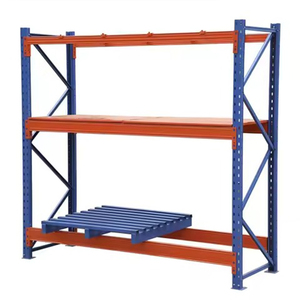
Multi Level Industrial Pallet Racking With Q235 Steel Upright Frame
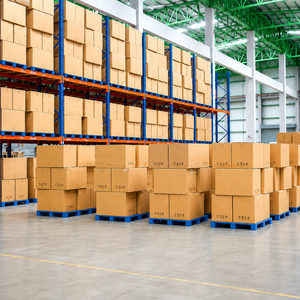
Steel Storage Rack 2000kg Heavy Duty Q235B Pallet Rack Warehouse Storage Rack High Density Industrial Shelving Solution
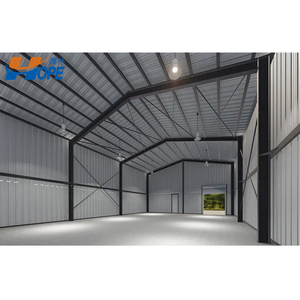
Steel Structure Warehouse Building Prefab Warehouse Steel Structure
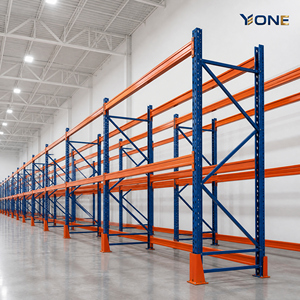
Heavy Duty Pallet Racking Warehouse Storage Rack System Q235B Steel For Freight Distribution With Pitch Levels
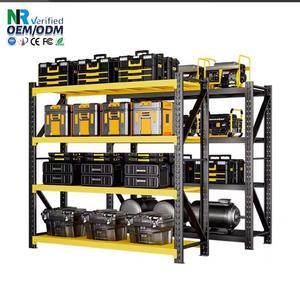
Manufacturer Long Span Storage Adjustable 200Kg Steel Racking Shelving Stacking Racks
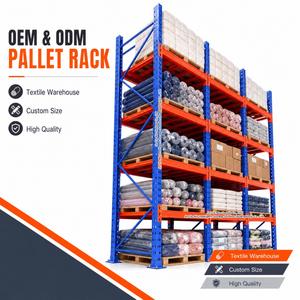
4-level Heavy Duty Rack Warehouse Storage Rack Heavy Duty Pallet Shelving Factory Supply Wholesale Garment Fabric Manufacturer
EN 15512, FEM 10.2.02 & CE Structural Mandates for Steel Racking Bays
Industrial pallet rack bays are classified as critical load-bearing steel structures under the European Construction Products Regulation (CPR 305/2011/EU). Procuring compliant racking requires deep structural analysis of frame elasticity, second-order $P$-$\Delta$ effects, and beam-to-column connector moment rotation capacity.
Material Metallurgy: Q235B vs. Q355B and Deflection Equilibrium
In high-bay racking systems exceeding 8 meters in upright elevation, the selection of cold-formed structural steel dictates the dynamic resilience of the entire bay array. HEDA Shelves uses premium grade certified Q235B and Q355B hot-rolled micro-alloyed carbon steel coils compliant with GB/T 700 / GB/T 1591, exhibiting direct mechanical equivalence to European EN 10025-2 S235JR and S355JR.
The yield strength of Q235B ($R_e \ge 235\text{ MPa}$) coupled with an elongation percentage of $\ge 26\%$ ensures exceptional energy dissipation under dynamic impact, whereas Q355B ($R_e \ge 355\text{ MPa}$) is incorporated into lower critical upright sections and heavy ground anchors to counteract axial compressive stresses that can exceed $180\text{ kN}$ per column profile. European Standard EN 15512 strictly governs beam deflection limits, mandating that the vertical deformation under full safe working load (SWL) must never exceed $\delta \le L/200$ (where $L$ is the clear span of the horizontal bay beam). For high-precision automated stacker crane aisles or radio-shuttle high bays, HEDA limits this deflection to $\delta \le L/400$, preventing drive-track misalignments and secondary shear stress transfer to beam connector claw lugs.
| Engineering Attribute | Standard Selective Pallet Bay | Drive-In / Drive-Through Bay | Radio Shuttle High-Density Bay | Telescopic Cantilever System |
|---|---|---|---|---|
| Governing Standard | EN 15512 / FEM 10.2.02 | EN 15620 / FEM 10.2.07 | EN 15629 / FEM 9.831 | EN 1993-1-3 (Eurocode 3) |
| Steel Substrate | Q235B / S235JR | Q235B Cold-Formed | Q355B Uprights / Q235B Rails | Hot Rolled IPE / Q235B Sheet |
| Max Load per Bay ($SWL$) | Up to 24,000 kg (per frame) | Up to 18,000 kg (per lane) | Up to 36,000 kg (per block bay) | Up to 12,000 kg (per tower) |
| Beam Connector Locking | 5-Claw Welded Lock Plate | Integrated Cantilever Saddle | Continuous Formed Rail Bracket | Bolted Radial Pin Mechanism |
| Maximum Deflection Ratio | $\le L/200$ (Serviceability) | $\le L/250$ Cantilever Rail | $\le L/350$ Guide Channel | $\le L/150$ Arm Free End |
| Safety Pin Shear Rating | $\ge 12.5\text{ kN}$ Static Resistance | N/A (Bolted Bracket) | $\ge 18.0\text{ kN}$ High-Shear Pin | Mechanical Ratchet Clamping |
Furthermore, under CE Marking directive 2435-CPR-8605159, factory production control (FPC) guarantees that every roll-formed omega profile undergoes automated ultrasonic thickness gauging and continuous weld integrity inspection to completely eliminate microscopic tearing along punch pitch lines.
10-Stage Precision Production from Steel Coil to Containerization
Unlike trading brokers, HEDA Shelves executes complete vertical integration across a 30,000 m² facility. From slitting master coils to surface nanoceramic phosphating and robotic electrostatic curing, each phase preserves metallurgical stability.










Future Procurement Trends in Industrial Pallet Rack Bays
Industrial warehousing is undergoing fundamental structural modernization. Supply chain executives must align equipment tenders with evolving robotic automation, carbon border adjustment taxes, and microclimate durability requirements.
1. Hybrid AS/RS & Autonomous Mobile Robot (AMR) Interfacing
Traditional static rack bays are transitioning rapidly into automated robotic interfaces. Pallet rack bays now incorporate cold-drawn bottom guide rails, photoelectric sensor cut-outs, and laser target reflector mounts to assist high-speed vision-guided AGVs and autonomous reach trucks. Clear span bay tolerances have tightened from $\pm 5\text{mm}$ to less than $\pm 1.5\text{mm}$ across complete aisle runs, forcing suppliers to implement robotic beam welding fixtures that guarantee absolute repeatability.
Trend Impact: Critical for 2026–2030 DCs2. CBAM Compliance & Low-Carbon Electric Arc Furnace (EAF) Steel
With the European Union's Carbon Border Adjustment Mechanism (CBAM) fully transitioning from reporting to tariff enforcement, global tier-1 buyers increasingly demand third-party verified Environmental Product Declarations (EPD). Suppliers must document Scope 1, 2, and 3 embodied carbon footprints. HEDA integrates closed-loop water treatment lines, zero-VOC triglycidyl isocyanurate (TGIC)-free thermosetting powder coatings, and clean-energy EAF strip coils to minimize lifecycle emissions per bay position.
Trend Impact: Direct European Tariff Mitigator3. Seismic Micro-Zoning & Dynamic Base Isolation Anchoring
High-intensity logistics corridors across Southeast Asia (the Pacific Rim Ring of Fire), Southern Europe, and Latin America mandate seismic structural calculations conforming to EN 16681 and FEMA 460 standards. Procurement tenders now evaluate ductility behavior factors ($q$), post-elastic frame deformation, dynamic floor amplification, and dual-anchor base plates featuring heavy-gauge chemical grout encapsulation to prevent shear pullout during Richter scale 7.0+ seismic events.
Trend Impact: Zero Collapse & Life Safety Mandate4. Cold Chain & Sub-Zero Metallurgical Ductility Integrity
The rapid expansion of cold chain logistics for pharmaceutical biologics and deep-frozen food networks requires racking bays to operate at sustained temperatures of $-25^\circ\text{C}$ to $-35^\circ\text{C}$. Standard structural carbon steels become susceptible to brittle cleavage fracture at low temperatures. Modern bay tenders specify Charpy V-notch impact toughness certified to maintain $\ge 27\text{ Joules}$ absorption at $-20^\circ\text{C}$, preventing structural snapping during forklift impact.
Trend Impact: Essential for Cold-Store Safety5. Sensor-Embedded Structural Health Monitoring (SHM)
Smart pallet rack bays are being retrofitted with tri-axial piezoelectric impact accelerometers and continuous strain gauges integrated into the lower upright frame columns. These IoT-enabled modules register sub-critical forklift collisions, monitoring deflection in real-time and feeding predictive stress warnings into warehouse management platforms (WMS) long before plastic buckling or catastrophic collapse can occur.
Trend Impact: Proactive Asset Risk ManagementThird-Party Audited Factory Certifications
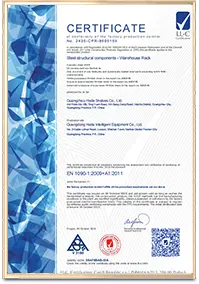
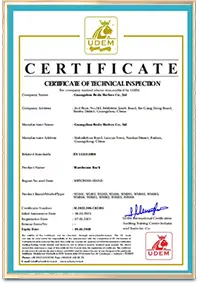
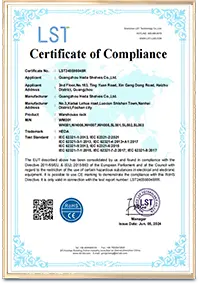
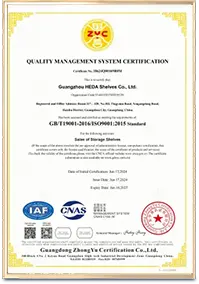
For international engineering consultants, municipal building inspectors, and enterprise procurement boards, HEDA Shelves provides fully traceable, certified compliance documentation with authentic test certificates and global registration serials:
- CE Certification No. 2435-CPR-8605159 (EN 1090-1 / EN 15512 Execution Class EXC2)
- ISO 9001:2015 Quality Management Registration No. 18624Q00169R0M
- RoHS Heavy Metal Free Compliance (Clean epoxy powder surface treatment)
- Mill Test Certificates (EN 10204 Type 3.1) with full heat traceability for all coils
Why Engineering & Procurement Directors Partner with HEDA
Established in 2001, Guangzhou Heda Shelves Co., Ltd. combines quarter-century manufacturing expertise with advanced structural engineering services. We mitigate foreign procurement risk through engineering transparency and rapid sea logistics.
Free 3D Layout & Static FEA Calculations
Prior to project quotation commitments, our structural engineering team generates complete AutoCAD floor designs, realistic 3D volumetric renderings, and static structural load calculations based on your clear roof heights, slab load capacities, and forklift models at zero cost.
Tropical-Grade Pretreatment & Anti-Corrosion
Operating across Southeast Asian, Middle Eastern, and coastal climates demands advanced metal treatment. Every component undergoes immersion pickling, surface conditioning, and phosphating prior to electrostatic epoxy coating, passing 500-hour ASTM B117 salt-spray rust tests.
Optimized Ocean Freight & Direct Port Velocity
Located directly within the Pearl River Delta logistics corridor in Guangzhou, shipments dispatch rapidly via Nansha, Yantian, and Shekou. Components are nesting-bundled and mathematically container-loaded to reach maximum weight/volume fill in 40HQ containers, slashing landed freight cost per pallet bay.
Frequently Asked Technical & Sourcing Questions
Answers to common structural, regulatory, and logistics inquiries submitted by warehouse developers, 3PL managers, and supply chain project engineers.