When warehouse growth outpaces floor space, storage choices quickly affect daily operations. Warehouse Pallet Storage Racks can improve vertical capacity, but only when their design suits the goods, equipment, and building. A rack that looks sturdy in a catalog may not fit a narrow aisle or changing pallet loads.
MHI’s 2024 Annual Industry Report found that 55% of surveyed supply chain professionals planned to invest more than $1 million in innovation. The figure signals serious investment, not a guarantee that any particular storage system will deliver results. Details matter. The Rack Manufacturers Institute’s ANSI MH16.1 standard offers a technical reference for the design, testing, and use of industrial steel storage racks. Buyers should still request project-specific load calculations and clear documentation.
This guide examines China-based suppliers through practical questions: What rack configurations do they offer? Can they explain materials, finishes, tolerances, and quality checks? Do they provide installation guidance and responsive after-sales support? Compare quotations against the same specifications, not just the lowest unit price. A small difference in beam dimensions can affect compatibility with existing equipment. So can an unclear load label. Supplier claims deserve verification, and a short factory visit or independent inspection may reveal gaps that brochures miss. Not glamorous, but useful. The following overview helps buyers identify credible manufacturers and ask better questions before placing an order.
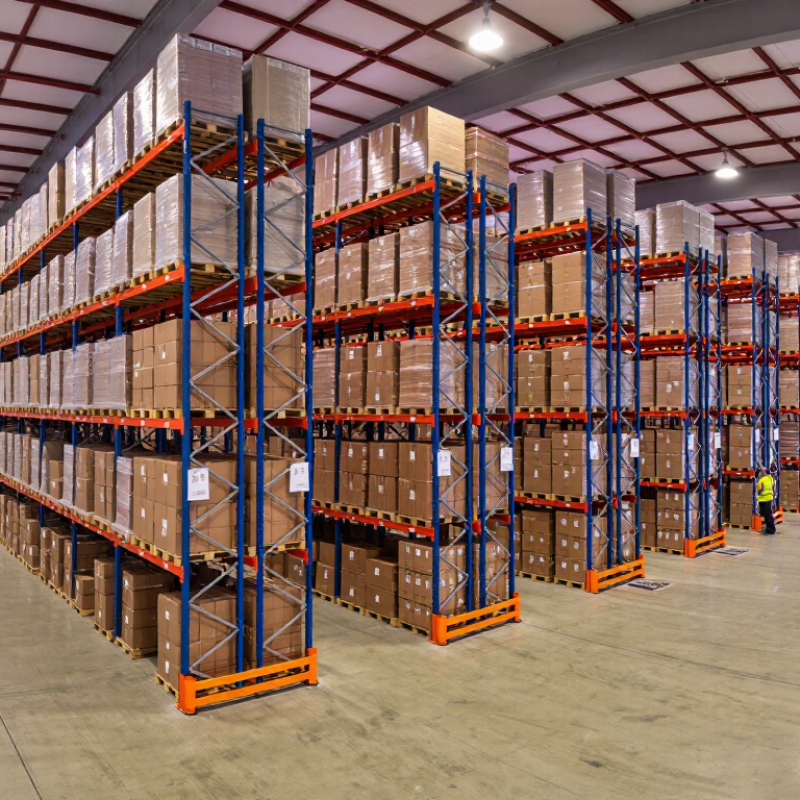
What Are Warehouse Pallet Storage Racks?
China Top Warehouse Pallet Storage Racks Suppliers?
What Are Warehouse Pallet Storage Racks?
Warehouse pallet storage racks are steel structures that hold palletized goods in organized, accessible positions. A typical system has upright frames, horizontal beams, and supported pallet loads. Forklifts place pallets into bays, while rack layout determines aisle width, storage density, and access. A beam level is not just a shelf; its rated capacity depends on the rack design, load, and configuration. That sounds simple. It isn’t.
MHI’s 2024 Annual Industry Report, based on a survey of more than 1,000 supply-chain professionals, found that 55% planned to increase investment in supply-chain technology. This is not a pallet-rack adoption rate, but it reflects growing pressure to make warehouse operations more capable and efficient. Racks remain physical infrastructure, so digital planning cannot compensate for poor installation or unclear load limits. OSHA’s material-handling rule calls for stored materials to be secured against sliding or collapse. In practice, operators should check beam locks, upright damage, and pallet condition during inspections. A bent frame may look minor, yet its impact is difficult to judge by appearance alone. Load signs and qualified inspections matter.
China Top Warehouse Pallet Storage Racks Suppliers? - What Are Warehouse Pallet Storage Racks?
| Rack System | How It Stores Pallets | Pallet Selectivity | Space Use | Suitable Inventory | Key Considerations |
|---|---|---|---|---|---|
| Selective pallet rack | Each pallet is stored in an individual position and accessed from an aisle. | High: each pallet can be accessed directly. | Requires aisles for forklift access; offers straightforward access to stored goods. | Many product lines with frequent, varied pallet movements. | A common, adaptable layout. Aisle width and rack capacity depend on the handling equipment, pallet dimensions, and engineered design. |
| Double-deep rack | Stores pallets two positions deep, usually accessed with a suitable deep-reach forklift. | Medium: the front pallet must generally be moved to reach the pallet behind it. | Stores more pallets per aisle than single-deep selective rack, while reducing direct access. | Products with multiple pallets per SKU and moderate turnover. | Requires compatible handling equipment and inventory procedures that account for the less accessible rear position. |
| Drive-in rack | A forklift enters a rack lane to place or retrieve pallets on supported rails. | Low to medium: pallets within a lane are typically handled in a last-in, first-out sequence. | High storage density because multiple pallet positions share a lane and fewer aisles are needed. | Large quantities of relatively uniform products with limited SKU variety. | Lane depth, forklift compatibility, pallet condition, and operating practices are important to safe use. |
| Drive-through rack | A forklift can enter a lane from either end for pallet storage and retrieval. | Medium: access from both ends can support first-in, first-out handling when operated accordingly. | High storage density, generally with access aisles at both ends of the lanes. | Bulk stock where product rotation is needed and SKUs can be grouped by lane. | Requires a layout that provides access at both ends; actual stock rotation depends on warehouse procedures. |
| Pallet flow rack | Pallets move by gravity along inclined roller or wheel lanes from the loading side to the picking side. | Lane-based: pallets are accessed in sequence within each lane. | High density with separate loading and unloading aisles. | High-throughput products suited to first-in, first-out flow. | Lane design must match pallet characteristics and load requirements; braking and flow-control components may be needed. |
| Push-back rack | Each new pallet pushes the previous pallet farther back along a nested cart or rail system. | Lane-based: pallets are typically retrieved in a last-in, first-out sequence. | High density with fewer aisles than single-deep selective storage. | Several pallets per SKU where compact storage is a priority. | Requires compatible pallets, careful forklift operation, and system-specific design and maintenance. |
| Mobile pallet rack | Rack rows move on powered or mechanically driven bases to open an access aisle where needed. | High when the required aisle is opened; only selected aisles may be available at one time. | Can reduce the number of permanently open aisles and increase storage density. | Warehouses with limited floor space and a need to access a broad range of stored products. | Requires a suitable floor, safety controls, and operational planning for aisle access and system movement. |
Note: Warehouse pallet storage racks are engineered structures used to store palletized loads. Safe load capacity, dimensions, anchoring, and configuration are project-specific and should be determined by a qualified rack designer using the actual building conditions, pallet loads, and material-handling equipment.
FAQS
The market includes manufacturers, system integrators, and trading firms. Manufacturers make rack components; integrators may also plan layouts and coordinate installation. Some combine both roles.
Request layout drawings, load tables, steel and coating specifications, and inspection records. Confirm that capacity ratings match your exact beam and upright sizes. Paperwork helps, but it cannot show every workmanship detail.
Ask whether ratings apply to individual beams or complete rack bays. Review the proposed configuration and load assumptions with a qualified rack engineer. Small detail, big risk.
Provide clear height, aisle width, door locations, floor conditions, and sprinkler clearances. Include pallet dimensions, loaded weights, and forklift details. A missed column can change the layout.
Not necessarily. Request an itemized proposal and check whether anchoring, guards, delivery, and installation are included. Compare matching specifications, not price per bay alone.
Ask for photos of welds, punched holes, and finished edges. If possible, inspect a sample or visit the factory. I might be overchecking one weld, but a single sample cannot prove consistent production.
Confirm who verifies site measurements, packs components, and handles missing or damaged parts. Ask how design changes are managed if measurements differ. That happens.
A manufacturer may suit repeat orders. An integrator may help with mixed layouts or phased installation. Check references from similar projects, and verify dimensions locally; supplier drawings may miss an uneven floor.
Conclusion
Warehouse Pallet Storage Racks are systems designed to store palletized goods safely and make efficient use of warehouse space. Common options supplied in China include selective racks for direct access to individual pallets, drive-in systems for high-density storage, and solutions designed for specialized handling or automated operations. Each system suits different inventory patterns, equipment, and space requirements, so understanding how goods move through a warehouse is an important first step.
China’s pallet rack supplier market includes manufacturers and trading companies with varying capabilities, product ranges, and levels of technical support. Buyers can assess potential suppliers by reviewing material specifications, structural design, production quality controls, customization options, communication, and installation or after-sales services. Before choosing, define storage capacity, load requirements, available space, and future expansion plans. Comparing proposals against these needs can help identify a suitable supplier and create a practical storage solution without focusing on price alone.